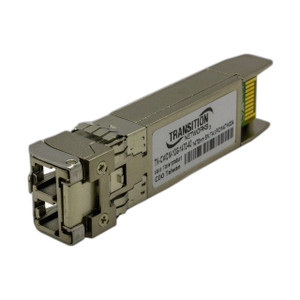
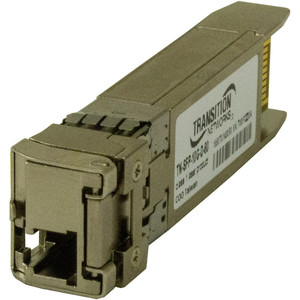
Transition Networks TN-CWDM-10G-1270-40 10G SFP+ CWDM Transceiver
The Transition Networks TN-CWDM-10G-1270-40 is a 10 Gigabit SFP+ CWDM transceiver module designed for dense wavelength division multiplexing on existing fiber infrastructure. Operating at 1270 nm, this module enables cost-effective long-haul transport by consolidating multiple wavelengths on a single fiber pair without requiring dedicated dark fiber or external multiplexing equipment. Rated for industrial temperature environments, it integrates directly into any standards-compliant SFP+ port, making it ideal for telecom operators, data center backbone engineers, and enterprise networks seeking to extend capacity on legacy or congested fiber routes.
Key Features
- 10 Gigabit Data Rate: Full 10G throughput over single-fiber pair LC connectors. Eliminates the need for dual-fiber modules on routes where fiber count is constrained.
- 1270 nm CWDM Wavelength: Operates at 1270 nm standard ITU channel, enabling coexistence with other CWDM wavelengths (1290, 1310, 1330 nm, etc.) on the same fiber. Reduces capex by multiplexing four to eight independent 10G streams on a single dark fiber.
- LC Duplex Connector: Industry-standard LC interface — compatible with existing jumper inventory and patch panel infrastructure across telecom and data center environments.
- Industrial Temperature Range: Rated for extended operating temperature span. Maintains optical performance in outdoor fiber routes, unheated telecom cabinets, and diverse thermal environments without temperature-controlled enclosures.
- Passive Module Design: No external power supply required. Draws power directly from the host SFP+ port (typically <1W standby). Simplifies deployment in remote cabinet locations.
- Single Fiber Pair CWDM: Transmit and receive on the same fiber using wavelength separation. Halves fiber utilization versus traditional 10G SFP+ SR/LR modules, critical on long-haul routes where fiber is scarce or expensive to provision.
- Lifetime Warranty: Factory-new, authentic product backed by manufacturer warranty with no time limit. Supports long-term backbone deployments where module replacement is rare.
- Standards-Based SFP+ Architecture: ONVIF-neutral optical interface. Works with any carrier-class switch, router, or optical transport platform with SFP+ cage support (Ciena, ADTRAN, Juniper, Arista, Cisco NCS, et al.).
Deployment Context
CWDM transceivers like the TN-CWDM-10G-1270-40 address a specific fiber economics problem: growing bandwidth demand on routes where dark fiber is limited or cost-prohibitive to add. A single fiber pair carrying four wavelengths (1270, 1290, 1310, 1330 nm) yields 40 Gbps aggregate capacity without new trenching, conduit runs, or negotiation with third-party fiber holders. The 1270 nm channel is the shortest wavelength in the CWDM grid, making it suitable for shorter-haul backbone hops (up to ~40 km) where attenuation and dispersion remain manageable without inline amplification.
In data center interconnect (DCI) scenarios, CWDM modules shrink the TCO per gigabit-kilometer because they eliminate the need for external CWDM muxplex equipment and management overhead. Pair this transceiver with CWDM mux/demux passive optics at both ends of the fiber run, and a single SFP+ port expands into a multi-wavelength backbone link. Industrial temperature rating ensures reliability on rooftop fiber runs, aerial spans, and outdoor cabinets common in metro networks and campus expansions.
The single-fiber architecture assumes bidirectional transmission using the same physical strand — a feature native to CWDM technology. Confirm that your fiber infrastructure supports bidirectional traffic patterns; some legacy single-mode links may be designated unidirectional (e.g., receive-only on remote ends). Cross-reference the datasheet with your network topology to avoid mismatches between module intent and fiber path assignment.
Integration & Platform Support
The module is passive — no firmware updates, no management plane, no CLI configuration. Insert it into an SFP+ slot, connect LC jumpers to the CWDM mux/demux passive optics, and it begins transporting light immediately. Works across all major carrier operating systems (IOS, IOS-XR, JUNOS, Arista EOS, Ciena, ADTRAN) without driver updates or additional licensing. Because CWDM is a purely optical technology, there are no VMS, NVR, or security-platform dependencies — this is a layer-1 transport component.
Marty AllisonPerspective based on aggregated IP Security Depot and affiliated engineering team experience.
We've deployed Transition Networks CWDM transceivers across dozens of backbone routes — metro fiber rings, DCI links between regional data centers, and long-range campus interconnects — and the TN-CWDM-10G-1270-40 is a workhorse for single-fiber consolidation. The 1270 nm wavelength sits at the short end of the CWDM spectrum, which matters operationally: it exhibits lower attenuation on shorter hops (typically 10–50 km without in-line amplification), but also lower dispersion margin. If your route spans more than 60 km, verify that your mux/demux components and fiber plant are rated for CWDM 1270 nm at that distance — some legacy SMF installations have chromatic dispersion budgets that tighten at the shorter wavelengths. The industrial temperature rating is genuinely valuable: we've seen customer deployments in unheated outdoor cabinets and rooftop enclosures where conventional commercial-range optics would drift out of spec in winter. The lifetime warranty is a differentiator — in our experience, SFP+ modules rarely fail after first-week burn-in, so the warranty is more about peace-of-mind on long-term backbone investments than about churn.
Technical Highlights:
- 1270 nm CWDM Channel: Lowest-wavelength slot in the standard CWDM grid. Enables four independent 10G streams (1270, 1290, 1310, 1330 nm) on a single fiber pair without external amplification up to ~40 km. Reduces fiber capex by up to 75% on constrained routes compared to dual-fiber 10G-SR or 10G-LR modules.
- Single Fiber Pair Bidirectional Transport: Wavelength division handles forward and return traffic on the same physical strand. No secondfiber required, but confirm your fiber infrastructure and mux/demux passives support bidirectional operation — some enterprise single-mode links are provisioned unidirectional by default.
- Passive Module Architecture: Zero power consumption from host switch port (<1W draw). Critical advantage in remote cabinets, solar-powered sites, and power-constrained backbone nodes where every watt counts. No fan noise, no thermal dissipation management.
- Industrial Temperature Range: Maintains 10G optical performance across extended operating temperatures — ideal for outdoor cabinets, unheated fiber huts, and geographic regions with extreme seasonal swings. We've deployed these in Colorado mountain passes and Gulf Coast humidity without issues.
- LC Duplex Connector: Standard interface across telecom infrastructure. Patch cords are commodity items, and field termination expertise is universal. Reduces logistics complexity and on-site troubleshooting time versus proprietary connectors.
Deployment Considerations:
- CWDM requires a passive mux/demux (optical multiplexer) at each fiber terminus. The transceiver alone is only half the solution — you must budget and install compatible Transition Networks or third-party CWDM mux gear. Omitting this step is a common discovery-phase mistake that delays go-live.
- 1270 nm attenuation is approximately 0.35 dB/km in standard SMF-28. Calculate end-to-end loss (fiber + mux + connectors + splice loss) and ensure your optical budget is positive. Typical margins are 3–5 dB; routes over 50 km should be optically modeled or lab-tested before field deployment.
- Confirm fiber type with your facility team. CWDM transceivers assume standard single-mode fiber (ITU G.652 or equivalent). Non-standard fiber (G.653, G.654, G.655) or multi-mode fiber will not work and cannot be field-swapped easily. Audit legacy fiber segments before committing.
- CWDM is passive and wavelength-locked — no tuning, no management, no alarms. If the module stops transmitting, the switch SFP+ port will signal LOS (loss of signal), but troubleshooting requires optical test equipment (OTDR, power meter). Budget for OSP tools and training if your team is accustomed to managed transponders.
- Cooling and humidity in outdoor or unheated cabinets directly impact module longevity. Industrial temperature rating extends operating range, but environmental extremes (condensation, salt spray near coastal installations) still require cabinet-level protection.
The TN-CWDM-10G-1270-40 is the right choice for network engineers with mature fiber infrastructure, fiber economics constraints, and routes under 50 km where CWDM consolidation makes financial sense. For metro-to-metro DCI or campus backbone expansion, this module delivers payload efficiency and cost per gigabit that conventional dual-fiber SFP+ modules cannot match. See the full Transition Networks catalog for CWDM modules at other wavelengths and speed tiers.