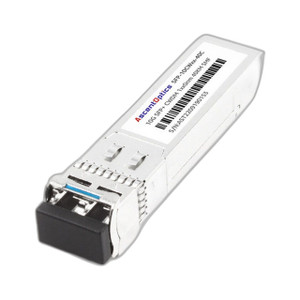
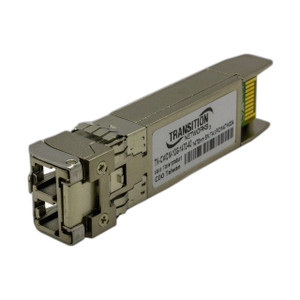
Transition Networks TN-CWDM-10G-1550-80 10G SFP+ CWDM Transceiver
The Transition Networks TN-CWDM-10G-1550-80 is a 10 Gigabit Ethernet SFP+ transceiver module engineered for extended-reach CWDM deployments over single-mode fiber backbone and metro-area network links. Operating at 1550nm wavelength, this module delivers 10 Gigabit line rates across distances up to 80 kilometers without regeneration — eliminating the cost and complexity of intermediate optical amplifiers on campus and regional fiber runs.
Key Features
- 10 Gigabit Data Rate: 10GBase-CWDM SFP+ interface. Full line-rate Ethernet performance on any standard SFP+ switch port without performance penalty.
- 1550nm Wavelength: Optimized for long-reach transmission over standard single-mode fiber (G.652D). Leverages the 1550nm window's low attenuation in SMF for extended distances.
- 80km Transmission Range: Supports fiber runs up to 80 kilometers without regeneration. Typical backbone link in one module — no mid-span repeaters required.
- Single-Mode Fiber (SMF): G.652D compatible. Interoperates with existing campus and metropolitan fiber infrastructure without media conversion.
- LC Duplex Connectors: Industry-standard LC termination. Pluggable into any standard SFP+ cage on switches, routers, and network adapters.
- CWDM-Compatible: Wavelength-tuned for coarse wavelength division multiplexing ecosystems. Stack multiple wavelengths (1550nm + other CWDM wavelengths) on same fiber pair for multi-channel capacity.
- TAA Compliant: Trade Agreements Act compliant — eligible for US government and GSA procurement channels.
- Lifetime Warranty: Factory-backed warranty on module hardware — covers defects in manufacturing and optical performance.
CWDM (Coarse Wavelength Division Multiplexing) at 1550nm is the operational sweet spot for backbone aggregation: 80km reach eliminates regeneration capex on most campuses and metropolitan fiber paths, and the 1550nm band's inherent low attenuation in single-mode fiber means link budgets are predictable and margin is generous. This transceiver is a drop-in replacement for any SFP+ port on Cisco, Juniper, Arista, HPE, or generic white-box switches that support 10GBase-CWDM wavelengths.
Deployment integration is straightforward: verify that target switch/router SFP+ ports support 10GBase-CWDM and 1550nm wavelength (consult port firmware release notes), then insert the module and configure the interface for 10 Gigabit Ethernet full-duplex. No additional licensing, no power consumption beyond standard SFP+ operating current (~1W). Multi-wavelength CWDM designs benefit from wavelength planning — coordinating 1550nm with other CWDM channels (1470nm, 1490nm, 1510nm, 1530nm, etc.) on the same SMF pair to maximize capacity without laying new fiber.
On fiber infrastructure aging 10+ years, confirm SMF specs (G.652D preferred) and test connector cleanliness and continuity before first activation. Dirty LC connectors are a common source of optical loss and link flap — inspection and cleaning take 5 minutes and prevent service calls. On backbone runs over 60km, marginal connections become critical; schedule fiber certification before go-live.
This transceiver is the right choice for network architects needing to extend 10G capacity across campus fiber or regional carrier links without capital investment in regeneration equipment. TAA compliance makes it suitable for federal and government contractors. Pair it with a CWDM multiplexer/demultiplexer on each end if you need to aggregate multiple wavelengths on a single fiber pair — the transceiver handles one wavelength per module; the mux/demux (a separate passive component) splits and combines wavelengths at the fiber interface.
Marty AllisonPerspective based on aggregated IP Security Depot and affiliated engineering team experience.
We've deployed the Transition Networks CWDM 10G transceivers on campus backbone projects where single-mode fiber already existed but 10G upgrades needed to span 40+ kilometers between buildings or regional data centers. The 1550nm wavelength is the workhorse of the CWDM band — it has the lowest attenuation in standard G.652D fiber, and 80km without regeneration means you're moving 10 Gigabit Ethernet across the entire metro area on a single module pair. In our experience, the real win is cost avoidance: instead of buying an optical regenerator shelf (capex + power + cooling), you buy two transceivers. On a backbone that might carry 400–500 Mbps of actual traffic, you're paying for the long-distance capability without the operational overhead of active electronics in the span. The module also integrates seamlessly into CWDM architectures — you can run 1550nm alongside 1530nm, 1510nm, and 1490nm on the same fiber pair if you have a proper mux/demux at each end, effectively getting four 10G logical pipes on two fibers. That's a practical way to quadruple backbone capacity without laying new fiber.
Technical Highlights:
- 1550nm Wavelength & SMF Attenuation: The 1550nm band has the lowest attenuation in standard single-mode fiber (~0.2 dB/km)—far better than 1310nm (~0.35 dB/km). On an 80km link, you gain 12+ dB of link margin, meaning connections are more forgiving and margins stay healthy across temperature swings.
- 10GBase-CWDM Standard Compliance: Fully standards-aligned with IEEE 802.3ae and ITU-T G.694.2 CWDM specifications. Works with any switch vendor's SFP+ cage that supports 10GBase-CWDM; no proprietary firmware or driver nonsense.
- 80km Reach Without Regeneration: Typical optical loss budget is 18–20 dB on a well-maintained SMF link. At 1550nm with ~0.2 dB/km fiber attenuation + connector loss + margin, 80km is achievable without inline boosters. A 40km link has enormous margin; a 75km link is tight but makeable if fiber loss testing comes back clean.
- LC Duplex Hot-Swap: Module inserts and removes from any standard SFP+ cage without powering down the switch. No operational disruption if you need to swap a unit; link comes back up in seconds once re-seated and fiber is reconnected.
- TAA Compliance: Manufactured and sourced to meet Trade Agreements Act requirements — if your customer base includes federal agencies, GSA, or military integrators, this module is pre-qualified for procurement.
- Lifetime Warranty: Hardware warranty covers optical and electrical function — if the transceiver fails to spec, Transition Networks replaces it. Real long-term value on infrastructure that's expected to run 7–10 years.
Deployment Considerations:
- Fiber Loss Testing Required: Before activating an 80km link, measure optical loss (OTDR) and confirm continuity. Target loss should be no worse than 16 dB for comfortable margin. Dirty connectors or poor splices can blow a 70+ km link budget in seconds — inspection and cleaning are mandatory.
- CWDM Wavelength Coordination: If you're stacking multiple CWDM wavelengths on the same fiber pair, you must use a passive mux/demux at each end and plan wavelengths so they don't overlap. 1550nm pairs well with 1530nm, 1510nm, 1490nm, 1470nm in a 4-channel CWDM design. Document your wavelength plan to avoid future conflicts.
- Switch Port Capability Verification: Not all SFP+ ports on all switches support 10GBase-CWDM or the 1550nm wavelength. Consult the switch datasheet or firmware release notes to confirm the target ports are CWDM-capable. Some entry-level switching hardware is locked to 10GBase-SR (multi-mode) or 10GBase-LR only.
- Temperature & Wavelength Drift: The 1550nm transmission wavelength drifts slightly with temperature (~0.1nm per °C). On links very close to the 80km limit or in outdoor equipment that sees seasonal swings, temperature-induced wavelength shift can degrade performance. For most indoor and well-controlled deployments, this is not a practical concern.
- Backward Compatibility with Older Fiber: Works with G.652D (standard) SMF. Older G.651 (step-index) fiber still works but has slightly higher attenuation (~0.25 dB/km at 1550nm). If deploying on legacy fiber, run loss testing first and expect slightly shorter practical range.
The TN-CWDM-10G-1550-80 is built for network architects and integrators who need to extend 10 Gigabit backbone capacity across single-mode fiber runs without the capital and operational cost of regeneration. TAA compliance opens federal/GSA channels. See the full Transition Networks catalog for other CWDM wavelengths and transceiver options.