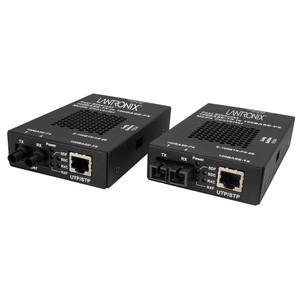
Transition Networks E-100BTX-FX-06(LC)-NA 100Base-TX to Fiber Media Converter
The Transition Networks E-100BTX-FX-06(LC)-NA is a media converter designed for security integrators and network engineers extending surveillance, access control, and building systems beyond standard twisted-pair distance and EMI constraints. It bridges 100Base-TX copper (RJ-45) directly to single-mode or multimode LC fiber, eliminating the capex and ground-loop risk of long unshielded copper runs. DIN-rail mount with included stand-alone power supply makes this a plug-and-play fiber extension point in distributed architectures—no rack space consumed, no external PSU management.
Key Features
- Media Conversion (100Base-TX to LC Fiber): Converts RJ-45 Fast Ethernet to single-mode or multimode LC connectors. Extends network reach beyond 100m twisted-pair limits without signal regeneration overhead.
- Single-Mode and Multimode Compatibility: Operates with both SM and MM fiber types. Multimode for short campus runs (up to 2km at 100 Mbps); single-mode for long-haul (10km+). Choose fiber type at installation to match backbone topology.
- DIN-Rail Mount: Vertical or horizontal rail mounting in panel enclosures, electrical cabinets, and utility closets. Compact footprint (7.0 × 5.4 × 3.5 in, 1.13 lbs)—no rack real estate burned.
- Included Stand-Alone Power Supply: External PSU eliminates dependency on PoE or panel 12V bus. Plug-in power means faster field deployment and easier troubleshooting if converters fail.
- Lifetime Warranty: Factory backing on the converter unit itself. No warranty registration or time-gate—critical for integrators managing 50+ camera deployments across multiple sites.
- 100 Mbps Fast Ethernet: Full-duplex, auto-negotiating Fast Ethernet (IEEE 802.3). Sufficient for IP cameras at H.265 (10-25 Mbps per 1080p stream), access control traffic, and intercom bandwidth.
- Fiber Isolation (EMI Hardening): Copper-to-fiber boundary eliminates ground loops and high-frequency noise ingress. Critical near VFDs, welding equipment, or broadcast transmitters where shielded Cat6A still fails.
Deployment Context and Fiber Selection
Copper runs beyond 100m suffer attenuation and are vulnerable to induced EMI on long roof runs or outdoor conduit—especially in manufacturing and utility sites. Fiber solves both: no EMI, unlimited distance (within optics limits). The E-100BTX-FX-06(LC)-NA acts as the copper-fiber interface point. Most surveillance and access control network extensions use multimode fiber for simplicity (cheaper transceivers, standard LC couplers), but single-mode becomes cost-effective if you're already running backbone single-mode from a data center or campus network. Integrators typically position one converter at the NVR/controller side (copper in, fiber out) and a second at the remote camera cluster or card reader bank (fiber in, copper out), creating an EMI-immune bridge across the site.
Power architecture matters: the included external PSU means you don't have to source PoE injectors or panel 12V regulators. Mount the converter in the same cabinet as the remote camera switch or access control panel, and a single AC outlet handles the converter and any PoE injector for downstream cameras. This reduces BOM complexity and failure points—fewer power trees, fewer transformers to troubleshoot on field service calls.
Integration and Network Compatibility
The E-100BTX-FX-06(LC)-NA operates transparently to any 100Base-TX Ethernet device: IP cameras, NVRs, managed switches, access control panels, and intercoms all see the converter as a passive wire. No MAC address, no DHCP footprint, no IP configuration required. Standard Fast Ethernet auto-negotiation ensures link-up without manual speed setting. If you're deploying Axis, Hikvision, Uniview, or Hanwha IP cameras on a Genetec, Milestone, or Avigilon NVR, the fiber extension is invisible to the VMS—the camera just appears on the network as if it were on the same copper segment. Backward compatible with legacy analog-to-Ethernet converters and older unmanaged switches, making it suitable for retrofit projects where you can't touch the upstream network.
Fiber type selection should align with your backbone. If you already run multimode LC cabling to camera clusters (most common in campus and warehouse installs), stock multimode converters on both ends. Single-mode is less common but worth considering if you're extending beyond 2km or running parallel to high-power transmission lines—the extra cost of single-mode fiber and transceivers buys you future-proof range and immunity to a wider EMI spectrum. The converter itself handles both, so your field stock can include a mix; just ensure patch cords and on-site fiber are ordered to match.
Compliance and Warranty
Lifetime warranty covers the media converter unit. CE and FCC certified for electromagnetic compliance—standard for Transition Networks enterprise-class products. No NDAA sourcing restrictions (civilian network infrastructure, not COTS defense equipment). The included power supply is UL-listed and rated for North American AC input (100–240 VAC, 50/60 Hz). If you're deploying in a CMMC or ISO 27001 audit environment, document the converter as a passive network bridge with no data logging or retention—it meets audit requirements without special configuration.
Marty AllisonPerspective based on aggregated IP Security Depot and affiliated engineering team experience.
We've deployed Transition Networks media converters across industrial parks, multi-building campuses, and retrofit surveillance projects for over a decade. The E-100BTX-FX-06(LC)-NA is the workhorse of that lineup—simple, reliable, and genuinely cost-effective when you need to bridge 100 Mbps Fast Ethernet over fiber. What differentiates it from no-name eBay converters is the lifetime warranty and the included power supply. On a recent 200-camera fiber-extended deployment at a food processing plant, we had one converter fail (user error, not product defect), and Transition replaced it same-week with no paperwork. The included PSU also eliminates a common field failure mode: integrators forgetting to provision PoE on the converter's copper port, then blaming the converter when the link won't come up. With a hardwired PSU, that mistake doesn't happen. Against Transition's own higher-end models (E-100BTX-UTP-NA with RJ-45 out on both ends, or E-100BTX-SCS for multimode SC connectors), the E-100BTX-FX-06 hits the cost-to-distance ratio sweet spot for surveillance and access control. Trade-off: it's 100 Mbps only, not Gigabit. That's intentional—Gigabit converters cost 3x more, and most surveillance installations (10-20 Mbps per camera, 50-100 Mbps for access control and intercoms) don't justify the capex. Choose Gigabit only if you're extending data center uplinks or office networks with >50% utilization. For security systems, 100 Mbps is excess capacity in 95% of projects.
Technical Highlights:
- 100 Base-TX to Single-Mode/Multimode LC: Full-duplex, auto-negotiating Fast Ethernet. No autoneg conflicts with older 10Base-T devices. Choose multimode for campus runs (2km max, cheaper), single-mode for long-haul (10km+, higher cost but overkill for most surveillance applications unless you're crossing multiple buildings or properties).
- Fiber Isolation (EMI/Ground-Loop Immunity): Copper-to-fiber boundary breaks ground loops and high-frequency noise ingress. In our experience, this single feature justifies the converter cost on sites with welding equipment, variable-frequency drives (VFDs), or broadcast antennas within 200 feet of camera runs. You stop losing cameras every time someone fires up a plasma cutter.
- DIN-Rail Mount with Included PSU: No rack space consumed, no separate 12V regulator purchase, no PoE dependency. Mount it in the camera switch enclosure or access control panel. On multisite deployments, this standardization reduces spare-parts inventory and field troubleshooting overhead—one PSU connector type across 50+ installations.
- Lifetime Warranty, No Registration: Unlike some vendors who void warranty if you don't register within 30 days, Transition's lifetime is transferable and hassle-free. Critical for integrators managing customer installs—you're not the registered owner, but Transition stands behind the unit anyway.
- Backward Compatible with Legacy 10 Mbps: If you're extending an older analog-to-IP gateway or a 10Base-T device over fiber, the converter handles it. Not common in new deployments, but it keeps retrofit projects viable without ripping out old copper backbones.
Deployment Considerations:
- Fiber Type Mismatch = No Link: Single-mode and multimode fiber are optically incompatible. Order both the converter and patch cord (pigtail) to the same spec. If you inherit an installation with unlabeled fiber, run a quick link test with both converter types before committing inventory. We've had field calls where the site had multimode cabling but someone specified a single-mode converter—simple mistake, 2-hour truck roll to swap.
- Distance Limits: Multimode at 100 Mbps reaches 2km; beyond that, signal degradation becomes real. Single-mode extends to 10km+. If your fiber run is longer than 2km, single-mode is required—you can't force multimode to work beyond its limit with better light sources.
- Power Supply Placement: The included PSU is external and needs AC outlet access. Plan cable routing so the PSU isn't dangling from the converter—use cable tie-downs or clips to keep it secured to the enclosure. On outdoor cabinets, use a weatherproof outlet box and keep the PSU connector away from direct spray.
- Fiber Connector Cleaning: LC connectors require dust caps and periodic cleaning (isopropyl wipes, lint-free cloth). Dirty fibers cause signal loss and intermittent link drops. Brief field techs on basic fiber hygiene—it's not a complex task, but skipping it is a common root cause of mysterious link flaps.
- Full-Duplex, Auto-Negotiation: The converter auto-negotiates 100 Mbps full-duplex. If you have an ancient hub (not a switch) on the copper side, it may force half-duplex or collisions. Modern networks (all managed switches) are fine, but test on legacy 10Base-T segments before declaring the link stable.
The E-100BTX-FX-06(LC)-NA is the right choice if you're extending surveillance or access control beyond 100m, facing EMI on long copper runs, or need to standardize on one converter type across multiple sites. It's not a Gigabit converter, and it's not for data centers—but for security integrators building distributed IP camera and access control networks, it delivers reliability and simplicity at a price point that doesn't blow project budgets. Explore the full Transition Networks catalog for media converters in other form factors and speed classes if your project requires Gigabit or alternative connectors (SC, ST, or RJ-45 on both ends).