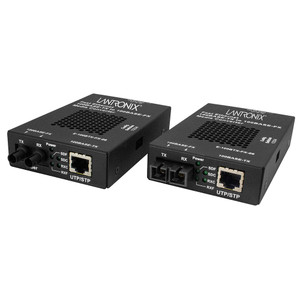
Transition Networks E-100BTX-FX-06-NA Fast Ethernet Media Converter
The Transition Networks E-100BTX-FX-06-NA is a Fast Ethernet media converter designed to bridge 100Base-TX copper and 100Base-FX fiber connections. Deployed in campus networks, remote facility links, and fiber-to-Ethernet integration for security and telecom infrastructure, this external converter extends network reach far beyond standard copper Ethernet limits—solving a real problem on larger properties or multi-building sites where running Category 5/6 cable simply isn't practical.
Key Features
- 100 Mbps throughput (Fast Ethernet): Handles standard data-link speeds across copper-to-fiber boundaries without bottleneck. Sufficient for most IP camera streams, access control feeds, and VoIP traffic in mid-size deployments.
- 12.4-mile fiber transmission distance: Multimode fiber operation reaches distances that copper cannot approach. Eliminates the 100-meter copper Ethernet limit and scales your network architecture across campus or between remote buildings without intermediate repeaters.
- 100Base-TX and 100Base-FX compatibility: Accepts standard RJ-45 copper Ethernet on one port and connects to fiber connectors on the other. No special cabling prep required—integrates into existing structured cabling with minimal reconfiguration.
- External form factor: Mounts on a wall, in a cabinet, or on a DIN rail. Compact footprint keeps cable runs clean and simplifies field installation at network edge locations, camera enclosures, or remote nodes.
- TAA compliance: Meets Trade Agreements Act requirements for government and regulated-sector procurements. Eliminates sourcing and audit risk for public-sector or federal integrations.
- Low power consumption: Operates efficiently without demanding external power infrastructure. Reduces operational cost and cooling load in installations where multiple converters are daisy-chained across a site.
Integration & Compatibility
The E-100BTX-FX-06-NA functions as a transparent layer-1 bridge. It requires no IP configuration, DHCP, or management interface—plug it in and it works. Standard 100 Mbps data-link protocols pass through unchanged, so cameras, NVRs, access panels, and intercoms that run over copper Ethernet on one side will communicate seamlessly with devices on the fiber side. Firmware management is not required. For large-scale media converter deployments, consider network switches with integrated fiber ports as an alternative to stacking multiple converters.
When to Choose a Different Model
If you require Gigabit (1000 Mbps) throughput, you'll need a higher-speed variant in the Transition Networks line—the E-100BTX-FX-06-NA tops out at Fast Ethernet and will become a bottleneck on 1G or 10G network segments. Similarly, if you need managed features (SNMP monitoring, link-state reporting, or redundancy protocols), this passive converter won't provide them. For sites requiring real-time diagnostic telemetry or automatic failover, explore managed fiber switches instead.
Typical Deployments
Common scenarios include linking a building IP camera system across fiber to a central NVR located elsewhere, extending secure access-control networks to remote gates or perimeter readers, and bridging PoE-powered devices over long-distance fiber runs. The 12.4-mile range means a single converter can connect campus zones that would otherwise require multiple repeaters or active infrastructure.
Expert Considerations
Before deployment, verify fiber plant condition and connector type (SC, ST, LC, or MU) match your infrastructure. A poorly terminated or degraded fiber link will cause intermittent packet loss that appears as random frame drops on your security feeds—difficult to diagnose after installation. Test the run with a light meter first. Also confirm that your camera or device PoE injector is rated for the distance; fiber converters themselves are unpowered, so PoE still flows over the copper side and must reach the remote device within standard limits.
Frequently Asked Questions
Q: Does the E-100BTX-FX-06-NA require configuration or management?
A: No. This is a transparent layer-1 converter. Plug in the copper and fiber, and it bridges traffic automatically. No IP address, no CLI, no firmware updates needed.
Q: What fiber connector types does the E-100BTX-FX-06-NA support?
A: Consult the datasheet for the exact connector type on your unit (SC, ST, LC, or MU are common). Verify your fiber plant matches before ordering.
Q: Can I use the E-100BTX-FX-06-NA to extend PoE to a camera 12.4 miles away?
A: PoE power is sourced on the copper side and is subject to standard IEEE 802.3 distance limits (typically ~100 meters for standard PoE). The converter itself does not amplify or regenerate PoE. For ultra-long-distance PoE, use a powered fiber transceiver or deploy a local PoE injector at the remote end.
Q: Is the E-100BTX-FX-06-NA TAA compliant?
A: Yes. It is TAA-compliant, meeting Trade Agreements Act requirements for government and regulated-sector procurement.
Q: What happens if the fiber link degrades or breaks?
A: The converter will cease passing traffic. This is a passive bridge with no diagnostic output. Monitor your network end-to-end with a management VLAN or dedicated monitoring device; do not rely on the converter itself for link-state alerts.
Q: Does the E-100BTX-FX-06-NA support Gigabit Ethernet?
A: No. This model is limited to 100 Mbps (Fast Ethernet). If you require 1 Gbps or higher, consult the Transition Networks catalog for Gigabit media converters.
Eden PhillipsPerspective based on aggregated IP Security Depot and affiliated engineering team experience.
The Transition Networks E-100BTX-FX-06-NA (often searched as E 100BTX FX 06 NA) is a straightforward passive converter that solves a specific infrastructure problem: getting Fast Ethernet beyond the 100-meter copper limit. The 12.4-mile fiber reach is the headliner here, and it's real—multimode fiber in good condition will deliver that distance without active repeaters or managed infrastructure.
Technical Highlights:
- 12.4-mile maximum distance: Multimode fiber operation eliminates the copper bottleneck. On a typical campus or industrial site with multiple buildings, one converter at each end can span distances that would otherwise require dozens of intermediate access points or expensive single-mode fiber upgrades.
- 100 Mbps throughput (100Base-TX/100Base-FX): Adequate for most IP security feeds, access control, and VoIP on mid-size networks. Not suitable for modern Gigabit camera systems or high-volume data streams; if your network core is 1G or 10G, this becomes a choke point.
- TAA compliance: Eliminates procurement friction for federal, state, and public-sector jobs where country-of-origin and supply-chain verification are mandatory.
Deployment Considerations:
- No diagnostics or management: This is a transparent bridge. If the fiber link fails or degrades, you have no built-in alerting. Network monitoring must happen upstream (via SNMP traps on your devices or a dedicated management VLAN). Don't expect to log into the converter itself—there is no web interface.
- Fiber plant verification is critical: Dirty connectors, bent fiber, or unmatched connector types will cause intermittent frame loss that's extremely hard to troubleshoot after installation. Always meter the fiber run and test continuity before going live.
- PoE limitation: The converter is unpowered and transparent. PoE sourced on the copper side still obeys the ~100-meter distance limit; you cannot magically extend PoE across 12 miles via this device. Deploy a powered fiber transceiver or a remote PoE injector if you need to power a camera at distance.
Best fit: campus network backbone links between buildings, remote facility connections where dark fiber is already in place, and integration of isolated security or access-control segments where 100 Mbps is sufficient. If you need Gigabit or managed failover, upgrade to a managed fiber switch or a Gigabit media converter from the Transition Networks lineup.