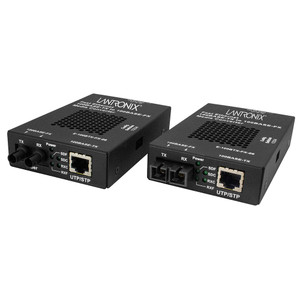
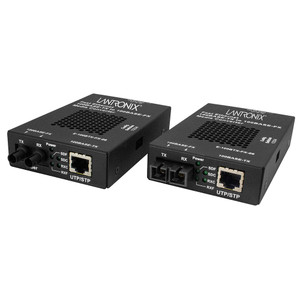
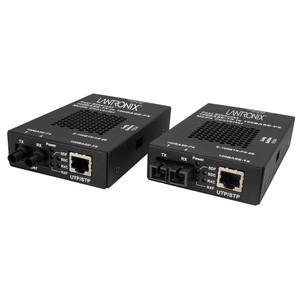
Transition Networks E-100BTX-FX-06(SM)-NA 100Base-TX Media Converter
Overview
The Transition Networks E-100BTX-FX-06(SM)-NA is a 100Base-TX media converter that bridges copper Ethernet (RJ-45) to single-mode fiber, extending connectivity across distances and environments where direct copper runs are impractical or pose noise/grounding risks. This converter is relevant for enterprise networks, security integrations, industrial control systems, and campus deployments where fiber backbone infrastructure must carry Fast Ethernet traffic to distant IP cameras, access control panels, or network devices.
Key Features
- 100Base-TX to Single-Mode Fiber Conversion: Translates standard Fast Ethernet (100 Mbps) copper signaling into single-mode optical form. This matters because single-mode fiber can span approximately 6 kilometers without signal repeaters—far exceeding copper's typical 100-meter limit—so you can bridge distant buildings or extend a fiber backbone to edge equipment without intermediate switches.
- Electrical Isolation via Fiber: Fiber inherently breaks ground loops and RF coupling that degrade copper-based systems in electrically noisy environments (factories, utility substations, rail yards). If your cameras or control devices are prone to noise-induced dropouts or corruption, fiber isolation solves that at the media layer.
- Single-Mode Fiber Port: Single-mode fiber (typically 9/125 µm core) is narrower than multimode, requiring precision transceivers but delivering longer reach and lower attenuation over distance. Use this when distance exceeds what multimode fiber (62.5/125 or 50/125 µm) can reliably handle—generally beyond 2 km or in high-noise RF environments.
- Compact Desktop Form Factor: Housed in a small standalone enclosure suitable for mounting on a patch panel or shelf in an equipment rack, office, or outdoor cabinet. No special chassis or rack-mount frame needed.
- Standard Power Input: Powered via common industrial supply options (verify voltage in datasheet). No PoE pass-through; this device is purely a media translator, so any equipment on the copper side must source power independently.
- Plug-and-Play Operation: No configuration required. Connect copper to one port, fiber to the other, apply power. The converter auto-negotiates with the connected equipment. Ideal for integrators who need to deploy quickly without firmware updates or console access.
Integration and Deployment Context
This unit sits at the boundary between a copper Ethernet segment (building wiring, device cables) and a fiber backbone. Typical deployments include: a central NVR connected via copper switch to a media converter, which then feeds a fiber run to a remote camera site or gatehouse where a second converter translates back to copper for local equipment. It works with any standard Fast Ethernet device—IP cameras, industrial sensors, network switches, or terminal equipment that speaks RJ-45 Ethernet. Fiber optic cabling itself is not included; you source appropriate single-mode fiber (typically LC or SC connectors) separately.
When to Choose a Different Model
If your backbone requires speeds above 100 Mbps (e.g., 1 Gbps or 10 Gbps cameras, uncompressed video streams), the E-100BTX-FX-06(SM)-NA will become a bottleneck and you should evaluate higher-speed variants in the Transition Networks media converter family. Conversely, if your fiber run is under 500 meters and your environment is electrically quiet, multimode fiber converters cost less and simplify fiber termination—single-mode is overkill in that case.
Frequently Asked Questions
Q: Does the E-100BTX-FX-06(SM)-NA support full-duplex Fast Ethernet?
A: Yes. The converter maintains full 100 Mbps duplex operation over fiber, delivering the same effective throughput as a copper link.
Q: Can I daisy-chain converters or use them with network switches?
A: Yes. Each end of the fiber link needs its own converter. A switch can plug into the copper port, and any mix of devices (cameras, sensors, NVRs) can connect downstream.
Q: What fiber connector types does the E-100BTX-FX-06(SM)-NA support?
A: Confirm in the datasheet—common single-mode fiber interfaces are LC or SC. Order matching fiber patch cables and connectors to ensure compatibility.
Q: Is the E-100BTX-FX-06(SM)-NA suitable for outdoor use?
A: The converter housing is typically rated for indoor environments. For outdoor deployment, mount it inside a weatherproof enclosure or cabinet and run only the fiber cabling outside.
Q: What is the maximum distance the E-100BTX-FX-06(SM)-NA can cover over single-mode fiber?
A: Single-mode fiber reach on 100Base-TX is approximately 6 kilometers with standard transceivers, but verify with the datasheet for exact specifications and any environmental derate factors.
Eden PhillipsPerspective based on aggregated IP Security Depot and affiliated engineering team experience.
I use the E-100BTX-FX-06(SM)-NA (often searched as E 100BTX FX 06(SM) NA) when copper backbone extensions start creating grounding headaches or when a customer's site layout demands fiber isolation. Single-mode fiber reach—roughly 6 km standard—is the real differentiator here. Fast Ethernet at that distance beats trying to install intermediate switches or copper repeaters.
Technical Highlights:
- 100Base-TX Copper Interface: Negotiates with any Fast Ethernet device without special drivers or firmware updates. Plug, power, done.
- Single-Mode Fiber Transceiver: Narrower core (9/125 µm) than multimode reduces attenuation loss per kilometer, essential for 6 km runs. A multimode converter would struggle beyond 2 km reliably.
- Galvanic Isolation: Fiber breaks ground loops inherent to long copper runs. In noisy industrial sites (motor control centers, welding bays, RF transmitter stations), this isolation prevents bit errors and packet loss that plague unshielded copper backbone extensions.
Deployment Considerations:
- 100 Mbps is the hard ceiling. If your security system or industrial network includes 1 Gbps cameras or switches, this converter becomes a bottleneck. Plan accordingly or upgrade the backbone first.
- Fiber termination and patching require LC or SC connectors matched to the converter's port type. Mismatched connector types are a gotcha—verify pinout before ordering cable runs.
- The converter itself is passive on the fiber side and auto-negotiates on Ethernet. Minimal troubleshooting surface, which is good for remote or unstaffed sites.
Best fit: extending Fast Ethernet to a distant camera location, access control reader, or industrial device where a fiber backbone is already in place or cost-justified. Skip this if you need gigabit speeds or if copper is under 100 meters and the environment is electrically quiet.