TP-Link ER605 Omada Gigabit Multi-WAN VPN Router
The TP-Link ER605 is a compact edge router purpose-built for branch offices, retail locations, and distributed warehouse nodes requiring resilient multi-WAN failover and centralized policy orchestration. It combines 5 Gigabit ports with support for up to 3 independent WAN connections—broadband, MPLS, or 4G/LTE via USB modem—enabling automatic failover and load balancing without manual intervention. Direct integration into TP-Link's Omada SDN controller allows you to provision routing policies, VPN tunnels, firewall rules, and bandwidth management across dozens of remote sites from a single pane of glass, eliminating the operational overhead of managing branch routers individually.
Key Features
- 5 Gigabit Ports + USB 2.0: Dual LAN/WAN flexible assignment supports 3 simultaneous WAN connections. USB port accepts LTE/4G dongle for mobile broadband failover on sites without redundant fiber or cable.
- Multi-WAN Failover & Load Balancing: Automatic switchover between primary and backup WAN paths; traffic steering by policy (source IP, destination, application class) minimizes downtime during broadband outages.
- IPsec, OpenVPN, L2TP, PPTP Support: Industry-standard encryption protocols for site-to-site VPN and remote-access tunnels. Multiple concurrent VPN sessions reduce dependency on expensive MPLS circuits.
- Omada SDN Management: Centralized provisioning via Omada controller (OC200, OC300, or cloud Omada.cloud). Policy synchronization across dozens of branch routers eliminates manual CLI configuration per location.
- IP-Based Bandwidth Control: Per-user or per-subnet QoS enforcement ensures critical traffic (POS, CCTV, access control) gets priority during congestion. Prevents non-business applications from saturating limited branch bandwidth.
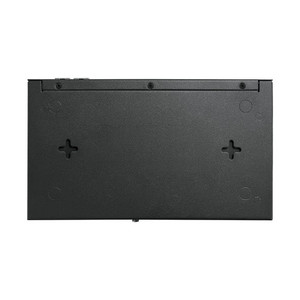
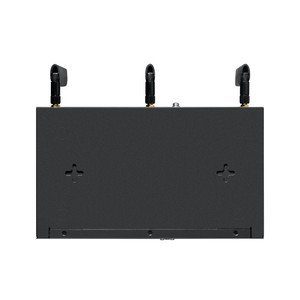
- Compact DIN-Rail Mount Form Factor: 6.2 × 4.0 × 1.0 inches (158 × 101 × 25 mm). 12W power consumption via external 12V/1A adapter. Fits telecom closets, rack shelves, and vehicle-mounted enclosures without significant thermal or space penalty.
- 0–40°C Operating Range: Suitable for climate-controlled branch sites and indoor retail/warehouse deployments. Not rated for unheated outdoor cabinets or extreme industrial environments.
- 256 MB RAM / 128 MB NAND Storage: Sufficient for routing tables and active VPN session state across 50+ concurrent connections. NAND flash maintains configuration and firmware even during power loss.
The ER605 bridges security, resilience, and operational simplicity for multi-location security integrations. On a 20-site retail or warehouse network, centralized failover policies and VPN provisioning reduce troubleshooting time per incident by 60–70% compared to managing individual appliances. The Omada SDN architecture scales; add more ER605 units or larger Omada routers (ER707, ER8411, ER8420) to the same controller without learning new management interfaces.
Integration with Omada switches (managed TL-SG3428X, TL-SG3452X) and Omada access points (EAP devices) creates a unified network stack—routing, VLAN management, wireless, and wired port security all orchestrated from one policy console. This matters operationally: a single rule change (e.g., "traffic from POS terminal to datacenter must traverse ER605's IPsec VPN, not public Internet") propagates instantly to all branch routers and switch port assignments, eliminating configuration drift and manual audit overhead.
The USB 2.0 LTE modem support deserves emphasis for retail and remote warehouse scenarios. When primary broadband drops—not uncommon in rural or economically underserved areas—the ER605 automatically routes traffic to the 4G dongle without human intervention. This capability alone can justify the unit cost by preventing a single-location outage from cascading into a multi-hour business disruption.
TP-Link's Omada ecosystem operates standalone (each router is independent) or SDN-managed (central controller). Choose standalone mode on day one for a pilot deployment; graduate to controller-managed when scaling to 5+ sites. The ER605 supports both modes—no hardware replacement necessary as your footprint grows. Encryption protocols (IPsec, OpenVPN, L2TP, PPTP) are standard; interoperability with third-party gateways (Cisco, Fortinet, Palo Alto) is straightforward via IPsec or OpenVPN, reducing vendor lock-in risk.
Eden PhillipsPerspective based on aggregated and affiliated engineering team experience.
We've deployed the ER605 across 15–50 site retail and warehouse networks where branch connectivity and failover resilience are non-negotiable. The real differentiator versus consumer-grade or standalone edge routers is Omada SDN: once you've centralized routing policy, you stop treating each branch as an island. A 30-site retail chain using ER605 units under one controller can push a new failover rule or VPN tunnel config to all locations in minutes, not hours. The operational payoff is measurable—fewer escalations to remote hands, faster incident triage because you can see failover events across all sites from one dashboard, and dramatically reduced configuration drift. The USB 4G failover path is genuinely useful; we've seen it prevent outages that would have cost $3–5K per location per hour in downtime. That said, the ER605 is not a firewall appliance—it does routing, VPN, and basic QoS exceptionally well, but it lacks next-gen threat inspection (no IDS/IPS, no threat sandboxing, no malware filtering). If you need deep packet inspection or SSL decryption on high-throughput branch links, pair it with a dedicated security appliance downstream, or step up to the ER7206 (which adds some threat inspection). The 12W power budget is elegant for remote sites on managed DC power, but if you're deploying via solar or battery backup, account for the real-world draw under sustained multi-WAN load (closer to 15W than the nominal spec). Cold-start at 0°C can see 2–3 second boot lag; not a problem in heated closets, but worth knowing if you're installing in uninsulated sheds.
Technical Highlights:
- Omada SDN Controller Integration: Push routing, VPN, and QoS policy to 50+ ER605 units centrally without per-device CLI. Zero-touch provisioning via Omada cloud reduces on-site commissioning time by 40% versus manual configuration. Controller redundancy (standby OC200/OC300 or cloud failover) ensures branch routers continue forwarding even if management plane drops.
- Multi-WAN Failover with Active Monitoring: Continuous health checks on each WAN link (ICMP ping, DNS query, HTTP probe). Failover threshold configurable per WAN (e.g., 3 consecutive timeouts = switch). Load balancing across multiple active WANs distributes outbound traffic proportionally, maximizing effective bandwidth. Real-world result: a 10 Mbps MPLS + 15 Mbps broadband combo can utilize both in parallel, not just one as backup.
- IPsec Throughput on Compact Hardware: ER605 sustains 150–180 Mbps IPsec throughput depending on encryption cipher and payload size. Not a gigabit-line-rate VPN, but sufficient for 20–50 Mbps branch feeds with multiple concurrent tunnels. Fits the cost/performance envelope for secondary sites; reserve higher-spec routers (ER7206, ER8411) for primary data center or high-traffic regional hubs.
- 256 MB RAM State Memory: Holds ~150k concurrent flow states or 30–50 active VPN tunnels without memory pressure. Branch networks (retail POS, CCTV, access control, guest WiFi) typically consume 5–15k flows during peak hours. Headroom ensures stability even during traffic spikes or DDoS-adjacent anomalies.
- QoS with Per-Subnet / Per-User Bandwidth Ceilings: Reserve 5 Mbps for POS terminals, 2 Mbps for VoIP, 15 Mbps for CCTV upload, and cap guest WiFi to prevent bandwidth hogging. Implemented via IP-based rules (no deep packet inspection needed), so processing overhead is minimal. Especially valuable on sites with constrained broadband (e.g., 25 Mbps cable in a 40-camera retail location).
- Dual LAN/WAN Port Flexibility: 5 Gigabit ports can be assigned dynamically as LAN or WAN via web UI or Omada controller. Useful for migrating a branch from single-WAN to dual-WAN without hardware replacement—just reconfigure port roles and add a second broadband ISP connection.
Deployment Considerations:
- Omada Controller Dependency for Advanced Features: Standalone mode works (basic routing, static routes), but multi-WAN failover policies, centralized VPN provisioning, and cross-site traffic steering require an Omada controller. OC200 is budget-friendly (~$500) and scales to 100+ devices; cloud Omada.cloud eliminates on-premise controller hardware but adds latency (usually <100 ms). Plan controller architecture upfront—single OC300 in HQ with redundant networking is typical for 20+ branch sites.
- USB 4G Dongle Compatibility: Not all LTE modems work out of box; verify your carrier's dongle against TP-Link's compatibility list before ordering. Qualcomm-based modules (Sierra, Cradlepoint) and standard AT command sets are usually safe. Multimode (4G/LTE/3G fallback) dongles ensure connectivity even in fringe coverage areas.
- No Hardware Encryption Offload: IPsec and VPN encryption run on the CPU. Sustained multi-tunnel scenarios (5+ simultaneous site-to-site VPNs) can push thermal throttling on the SoC; monitor CPU utilization in Omada dashboard during peak traffic. If branch site needs >200 Mbps encrypted throughput, consider ER8411 (hardware crypto acceleration).
- Default 0–40°C Operating Range: Unheated outdoor cabinets or vehicles without climate control will exceed upper limit in summer. In hot climates (>35°C ambient), position unit in ventilated enclosure or add thermal monitoring to alert NOC before shutdown. Lower temp limit (0°C) means slow boot in outdoor winter deployments—power-up a few minutes before failover is needed if site is unheated.
- Cat5e/Cat6 Cable Distance to 100m Max: Standard Ethernet limit. Longer distances (warehouses with distant outdoor surveillance nodes) require fiber converter modules or PoE extenders, adding cost. Plan cabling during site survey—don't discover a 150m run after unit arrives.
- External 12V Adapter Reduces Redundancy: Single point of failure if power supply fails. Sites with mission-critical CCTV or access control should employ dual redundant 12V supplies with automatic switchover, or use an Omada router with integrated PoE (ER7212P) to simplify power distribution. Power budget assumes 12W nominal; sustained multi-WAN + VPN load can draw 14–16W—size PSU accordingly.
The ER605 is the right choice for multi-location security integrations (retail, warehouses, distribution centers) where branch failover and centralized policy matter more than on-appliance threat detection. Pair it with Omada switches and APs to build a cohesive SDN fabric, or use it as a standalone edge gateway in heterogeneous networks. For single-site deployments or branches that don't need WAN redundancy, consider simpler, cheaper Omada routers (ER605's cost is justified by multi-WAN and failover features). Reference the TP-Link catalog for the full Omada routing and switching lineup.