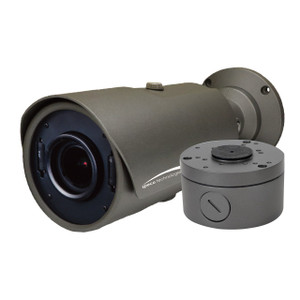
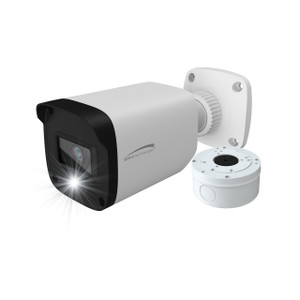
Speco Technologies VLB7 2MP HD-TVI Bullet Camera
Overview
The Speco Technologies VLB7 is a fixed 2MP HD-TVI bullet camera engineered for outdoor surveillance installations where weather-sealed analog transmission and flexible field-of-view adjustment are priorities. This model delivers 1920×1080 resolution at 30 fps through a 1/2.8" CMOS sensor paired with a 2.8–12mm varifocal lens, enabling operators to tighten or widen coverage without swapping lens modules. HD-TVI transmission over coaxial cable eliminates the need for network infrastructure, simplifying deployment in retrofit or low-bandwidth environments. The included junction box and aluminum housing rated IP67 support permanent outdoor mounting across temperature extremes from -22°F to 122°F, while 98-foot infrared coverage enables round-the-clock operation without auxiliary lighting.
Key Features
- 2MP (1920×1080) resolution at 30 fps: Adequate for perimeter identification and facility-wide coverage. At this resolution, expect confident facial recognition at roughly 10–15 feet under good lighting; lower-light conditions reduce effective range. Two megapixels is the practical floor for outdoor surveillance where zoom-in detail matters.
- 2.8–12mm varifocal lens with 4.3× zoom ratio: Field-of-view adjustment in the field eliminates guesswork at design time. Wide setting covers broad perimeters; narrow setting targets entry points, gates, or parking spaces. No lens swap needed once mounted.
- HD-TVI transmission over coax: Operates on standard BNC/RG-59 cabling to a DVR without IP infrastructure, routing, or DHCP. Ideal for facilities with existing analog systems or where network bandwidth is constrained. Cable runs are practical to roughly 400–500 meters depending on coax grade and DVR input specifications.
- Day/Night mechanical filter switching: Automatic flip between color (daylight) and monochrome (nighttime/IR) modes eliminates color noise in low light and maximizes IR sensitivity. Filter transitions are invisible to recorded footage.
- 98-foot (30-meter) infrared illumination: Built-in 850nm IR LEDs eliminate the need for auxiliary lighting or floodlights for 24/7 operation. Effective range depends on scene reflectivity; darker surfaces (asphalt, clothing) reduce range to 60–70 feet; light surfaces (concrete, vehicles) extend it. Planning perimeter coverage around this capability avoids costly secondary lighting.
- IP67 environmental rating: Dust-tight and water-resistant to 1-meter immersion for 30 minutes. Suitable for direct mounting on exterior walls, soffit, or pole brackets in rain, sleet, or coastal environments. No special enclosures required for typical outdoor weather; skip this model if you need submersion (fountains, pools) or explosive-atmosphere compliance.
- Wide operating temperature (-22°F to 122°F): Handles freezing climates and warm sun exposure without thermal shutdown. No heater/cooler required in temperate to warm zones; arctic deployments below -30°C may require supplementary heating.
- PoE power delivery: Draws minimal current via standard PoE; no separate 12V power supply or conduit runs required if PoE infrastructure already exists. Simplifies field installation and reduces labor on retrofit projects.
- Wide Dynamic Range (WDR) processing: Preserves detail in mixed-light scenes—critical at facility entry/exits where interior-lit doorways open onto bright outdoor areas. Prevents blown-out highlights and crushed shadows, improving usable detail in recorded video.
- Junction box included: Weatherproof wire terminal reduces field labor and simplifies BNC/power termination during installation, particularly on pole or soffit mounts.
When the VLB7 is the right choice
Select this model when you operate an existing analog DVR infrastructure or lack network capability for streaming IP cameras. The varifocal lens accommodates uncertainty in coverage patterns without requiring swaps or redesign. Its 2MP resolution and 98-foot IR range suit parking lots, building perimeters, gate/entry monitoring, and utility areas where facial recognition is not a priority and 24/7 operation without auxiliary lighting is required. The IP67 rating makes it practical for coastal salt-spray environments, wet roofs, or high-pressure wash zones.
When to choose an alternative
If your infrastructure is IP-native (PoE switches, ONVIF VMS), higher resolution (4MP or greater) is needed, or you require on-camera analytics (motion metadata, people counting, anomaly detection), evaluate IP cameras instead. The VLB7 lacks network streaming, ONVIF Profile S/T support, firmware updates, and edge intelligence. Cloud-hybrid or low-bandwidth workflows are better served by IP-based solutions with H.265 compression and configurable bitrate. Two-way audio, metadata tagging, and event-driven alerts are DVR responsibilities, not camera functions.
Integration and compatibility
The VLB7 integrates with any DVR or analog receiver equipped with standard BNC HD-TVI inputs. No IP network, DHCP, or DNS configuration required. Motion detection, scheduling, and event triggers are DVR functions. Coaxial cable runs to the DVR are typical; cable quality (RG-59 or better) and run length (practical limit ~400–500 meters) are DVR-dependent. Check your DVR's HD-TVI input compatibility before purchasing; older analog-only (composite video) systems cannot decode HD-TVI without an external converter.
Physical installation and mounting
The bullet form factor is compact and discrete, suitable for soffit, wall bracket, or pole mounting. The included junction box simplifies field wiring of BNC and power terminals. No special tools beyond a standard screwdriver are required for assembly. Mounting hardware is hardware-store-standard (bolts, U-brackets); verify load capacity if installing on lightweight guttering or thin sheet-metal fascia.
Imaging performance in context
The 1920×1080 resolution and 30 fps frame rate are adequate for surveillance, not forensics. Under bright daylight, expect clear license-plate and facial identification at 15–25 feet. WDR processing helps but does not eliminate strong backlighting; position cameras to avoid direct sun behind subjects. Infrared mode activates automatically in low light; monochrome IR footage is effective for intrusion detection, movement tracking, and general perimeter patrol. Do not expect IR detail comparable to visible-light imaging—IR is presence/motion confirmation, not identification.
James EverettPerspective based on aggregated IP Security Depot and affiliated engineering team experience.
The VLB7 is a straightforward analog HD-TVI camera built for integrators who still maintain coaxial DVR systems or need to deploy cameras in environments where IP infrastructure is unavailable or undesirable. I've specified it repeatedly in retrofit projects where IP cameras would require network upgrades that clients couldn't justify. The varifocal lens is genuinely useful—field adjustability saves mounting/remounting cycles, and the 4.3× zoom ratio covers both wide perimeter sweeps and tight entry-point focus without swaps.
Technical Highlights:
- 2MP at 30 fps via 1/2.8" CMOS sensor: Delivers sufficient resolution for outdoor facility monitoring where zoom-in detail matters less than presence/movement detection. The 30 fps refresh is smooth enough for tracking vehicle or pedestrian motion in real time.
- 2.8–12mm varifocal lens (4.3× zoom): Eliminates the need to stock multiple fixed focal lengths. Adjust in the field without removing the camera—critical advantage when coverage requirements shift or initial site survey missed blind spots.
- 98-foot IR with mechanical day/night filter: Reliable nighttime imaging without auxiliary lighting. The filter flip is automatic and clean; no color-shift artifacts or mode-switching delays. Plan coverage assuming effective IR range of 60–80 feet on typical outdoor surfaces (asphalt, painted metal), higher on reflective surfaces (concrete, white walls).
- HD-TVI over coax eliminates network dependency: No DHCP, routing, or cybersecurity patching headaches. Cable runs are straightforward; integration is plug-and-play on HD-TVI DVRs. This is a significant operational advantage in older facilities where IT support is minimal.
Deployment Considerations:
- DVR HD-TVI input compatibility is non-negotiable: Verify before order. Older analog-only DVRs cannot decode HD-TVI without an external converter—a detail that derails projects if missed. Request a quick DVR datasheet check if you're uncertain.
- Cable run distance and coax quality matter: While 400–500 meter runs are theoretically possible, signal degradation increases beyond 300 meters on standard RG-59. If your run exceeds 250 meters, use premium RG-6 or request DVR equalizer support. Poor coax choice is a common cause of intermittent HD-TVI dropouts.
- 2MP resolution is practical, not premium: This camera is not a facial-recognition or license-plate reader at distance. For entry-point identification, position it close (10–15 feet) to subjects. For perimeter patrol and intrusion detection, it excels.
- WDR helps but doesn't solve backlighting: Position cameras to avoid direct sun or bright windows behind subjects. WDR improves mixed-light scenes, not extreme contrast. Test field-of-view placement before final mounting.
Use the VLB7 in retrofit analog DVR environments, facilities with constrained network budgets, or coastal/high-moisture locations where bullet-form-factor IP cameras present integration complexity. Specify it confidently for perimeter and parking-lot coverage where 2MP suffices and PoE or analog power is already provisioned. Don't stretch it into facial-recognition or license-plate-capture roles—it will disappoint at distance.
Frequently Asked Questions
Q: Is the VLB7 compatible with my existing composite-video DVR?
A: No. The VLB7 is HD-TVI and requires a DVR with HD-TVI BNC inputs. Composite-video (RCA/coax) analog DVRs cannot decode HD-TVI without an external converter. Check your DVR datasheet for HD-TVI support before purchase.
Q: What is the effective infrared range on the VLB7?
A: The VLB7 delivers 98 feet (30 meters) of IR illumination under ideal conditions. On typical outdoor surfaces (asphalt, painted metal), expect reliable detail to 60–80 feet. Reflectivity varies—light-colored surfaces (concrete, white walls) extend effective range; dark surfaces reduce it. Plan coverage conservatively.
Q: Can I mount the VLB7 outdoors in rain or coastal environments?
A: Yes. The IP67 rating confirms dust-tight, water-resistant protection suitable for direct rain, coastal salt spray, and high-pressure wash areas. No special enclosure or weatherproofing required for standard outdoor weather. Do not submerge the camera in water or fountains.
Q: Does the VLB7 support ONVIF or IP streaming?
A: No. The VLB7 is analog HD-TVI and does not support IP, ONVIF, network streaming, H.264, or H.265. It transmits video over coaxial cable to a DVR only. If you require IP functionality, network integration, or edge analytics, specify an IP-based camera instead.
Q: What is the minimum illumination level for the VLB7?
A: The VLB7 operates in daylight and low-light scenes with WDR processing active. In darkness (0 lux), infrared illumination engages automatically via the mechanical day/night filter. The camera does not operate in pitch-black conditions without IR; performance depends entirely on IR capability at night.
Q: Can I adjust the field of view after installation?
A: Yes. The 2.8–12mm varifocal lens allows field-of-view adjustment in the field without removing or remounting the camera. Adjust the lens barrel to widen or narrow coverage as needed. No lens swap required.