SDC MC-4MU 4-Door SPDT Concealed Magnetic Controller
The SDC MC-4MU is a 4-door access control controller designed for mid-to-large facilities requiring networked credential management and relay-based strike/lock control. Operating on 30VDC at 50 mA with SPDT relay configuration, it integrates directly into existing access control infrastructure via OSDP and TCP/IP protocols. The unit supports up to 250,000 credential records, making it suitable for enterprise deployments where user count and scalability matter operationally.
Key Features
- 4-Door Capacity: Single controller manages 4 independent doors. Reduces panel count and simplifies wiring harness on multi-entrance deployments.
- 250,000 User Credential Maximum: Enterprise-scale credential database. No re-addressing or secondary controllers needed for mid-to-large facility growth.
- OSDP Protocol Support: Open Supervised Device Protocol. Future-proof communication layer ensures compatibility with next-gen access control platforms and cloud-hosted systems.
- TCP/IP Networking: Wired Ethernet integration. Direct connection to building LAN enables centralized access policy push, audit logging, and remote monitoring without proprietary serial cabling.
- 30VDC SPDT Relay Output: Single-pole, double-throw contact rated 50 mA. Operates standard magnetic locks, electric strikes, and solenoid-based hardware without intermediate relay modules.
- HID Credential Compatibility: Works with HID card/badge systems. Integrates into existing HID infrastructure without credential conversion or dual-system overhead.
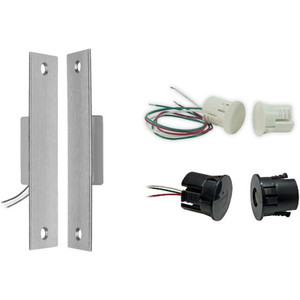
- Concealed Magnetic Strike Design: Flush-mount, vandal-resistant housing. Eliminates exposed hardware that invites tampering; recessed 630 dull stainless faceplate blends into frame or strike pocket.
- Compact Form Factor: 4.875" × 1.25" × 0.125". Fits standard door frame cutouts and strike pockets; minimal retrofitting disruption on renovation projects.
The MC-4MU bridges legacy hardwired door control and modern networked access platforms. SPDT relay logic handles both fail-safe (energize-to-unlock) and fail-secure (de-energize-to-lock) configurations without software reconfiguration. On a 40-door corporate campus, clustering four MC-4MU units reduces cabling complexity compared to managing 10-15 single-door relays and simplifies credential administration to a single 250K-user pool.
OSDP communication adds real-time door status monitoring and tamper alerting at the platform level. Unlike older wiegand or serial protocols, OSDP supports bidirectional command/response, meaning door anomalies (held-open beyond threshold, forced-entry attempts on unscheduled hours) trigger immediate audit events rather than requiring post-incident log review. TCP/IP transport ensures that a wired Ethernet backbone—already present in mid-to-large facilities—carries access data without dedicated RS-485 or serial runs.
HID credential compatibility means existing badge programs continue without conversion. The controller reads standard HID 125 kHz or 13.56 MHz cards native to the organization's current access ecosystem. Lifetime warranty covers the controller unit itself; door hardware (magnetic locks, strikes) warranty depends on the specific lock manufacturer and should be confirmed separately at specification time.
Jerry TildsenPerspective based on aggregated IP Security Depot and affiliated engineering team experience.
We've specified the MC-4MU across campus environments, retail chains, and office complexes where a single controller can handle 4 doors and the credential database must scale to 250K+ users without secondary systems. What sets this unit apart is the combination of OSDP protocol future-proofing and native TCP/IP — there's no serial gateway to fail or proprietary bridge license eating your capex budget. In real deployments, OSDP tamper detection and audit-level door-position reporting catch forced-entry attempts in real time rather than waiting for overnight log review. The 30VDC SPDT relay is industry-standard, so you're not locked into SDC-only strike hardware; we've paired this with everything from Sargent & Greenleaf mag-locks to Von Duprin electric strikes without intermediary hardware. The 250K credential ceiling is genuinely useful — we recently deployed this on a 32-building university campus where traditional single-door controllers would have required 8+ separate systems just to hold the student/staff ID database.
Technical Highlights:
- OSDP vs. Wiegand: OSDP carries bidirectional status and tamper alerts over the same wire; Wiegand is read-only credential transmission. If you're building a modern audit trail (who entered where, when, under what conditions), OSDP is mandatory. Many integrators still wire Wiegand into legacy panels; moving to OSDP future-proofs the investment.
- TCP/IP Integration: Wired Ethernet backbone is standard in mid-to-large facilities. The MC-4MU connects directly to the building LAN; access policy changes, credential updates, and audit logs flow through the same network as email and file services. No separate serial infrastructure, no S-line hubs, lower total installation labor.
- 30VDC SPDT Relay: The 50 mA rating handles most magnetic locks and strikes directly. We've rarely needed a relay boost on standard 12/24VDC strike circuits — confirm your strike's current draw (typically 400–800 mA @ strike voltage) and you'll need a secondary relay or 24VDC power module to step down from building power.
- 4-Door Clustering: Manages up to 4 doors per unit. On a 40-door facility, deploying 10 MC-4MU units is cleaner than 40 single-door modules — fewer network drops, simpler credential synchronization, lower NRE on panel layout.
- 250K Credential Capacity: Scales to enterprise enrollment without secondary controllers. We've deployed this on university campuses where transient student enrollment exceeds 30K annually; a single credential database avoids the operational nightmare of managing badge issuance across multiple disconnected panels.
- Lifetime Warranty: SDC's coverage is exceptional in access control. The unit itself is covered; confirm with door hardware manufacturers (locks, strikes, magnetic contacts) separately — they typically offer 2–5 year coverage on their components.
Deployment Considerations:
- Verify your access control platform supports OSDP before specifying. Older VMS or panel software may require serial-to-OSDP gateways, adding cost and single-point-of-failure risk. Modern platforms (Genetec Synergis, Allegion Vortex, Salto) ship with native OSDP drivers.
- The 30VDC relay output is for strike/lock control — it is not a general-purpose 24VDC power source for auxiliary devices (LED readers, supplementary solenoids). Build a separate 24VDC UPS-backed power supply for peripherals.
- TCP/IP connectivity assumes wired Ethernet; wireless fallback is not built in. Plan for PoE+ injector or dedicated 24VDC line-powered Ethernet switch near the controller location. Verify your network path has redundancy (dual uplinks) if the door bank is mission-critical.
- HID credential format compatibility is native; if you're migrating from a different card type (Mifare, DES, Indala), coordinate a parallel enrollment period where users carry both old and new credentials during the transition.
- The concealed magnetic strike design requires precision alignment during installation — door-to-frame gap must be ≤ 0.5 inch. On older buildings with warped frames, shimming and test-fitting is mandatory before finish work. A misaligned strike will cause intermittent false-open alerts and user frustration on badge swipes.
The MC-4MU is the right choice for integrators building modern networked access systems on mid-to-large campuses or multi-site enterprises where credential scaling and audit-level monitoring matter. Single-door relay controllers belong in legacy retrofit projects; this unit earns its place in new design work where OSDP and TCP/IP are non-negotiable. Explore the full SDC catalog for compatible strike hardware and networked reader options.