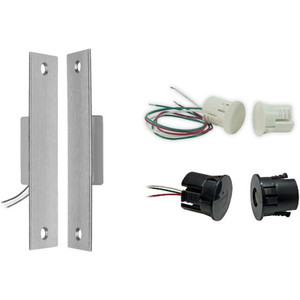
SDC MC-4 SPDT Concealed Magnetic Door Switch
Overview
The SDC MC-4 is a concealed magnetic door position switch engineered for integration into access control systems. Operating at 30VDC with a 0.5A contact rating, this SPDT (Single Pole Double Throw) switch monitors door state in real time — whether a door is open or closed — and delivers that signal directly to your access control panel or strike controller. The concealed magnetic construction means no visible hardware protruding from the door frame; the magnet mounts on the moving door edge, and the switch body nests into the frame itself. This form factor is standard in retrofit and new-build installations where aesthetics or tamper resistance matter.
Key Features
- SPDT Configuration: Provides both normally-open and normally-closed contacts from a single switch. This flexibility lets you wire the MC-4 to trigger different actions — open a relay for an alarm, energize a solenoid lock release, or both. No need for external relay logic.
- 30VDC Operating Voltage: Matches the standard control voltage in most electromagnetic lock and strike circuits. Direct integration without intermediate power conversion simplifies wiring and reduces points of failure.
- 0.5A Rated Current: Sufficient to switch low-current solenoid coils and control relays typical in door strike and magnetic lock applications. If your strike draws more than 0.5A, you'll need an external relay to isolate the MC-4 contacts — a common and inexpensive solution.
- Concealed Magnetic Design: No mechanical plunger or visible moving parts. The reed switch inside is actuated by magnet proximity alone, eliminating wear points and reducing the chance of debris jamming the mechanism. Particularly useful in high-traffic or harsh environments.
- HID Credential Integration: Factory-tuned for HID-based access control ecosystems. If your deployment uses HID readers, credentials, and controllers, the MC-4 wires directly into the door sensor input on your HID panel without adapter logic.
- Compact Form Factor: The switch body is slim enough to fit into standard 1¾-inch door frame mortises without requiring frame modification. Installation by certified integrators in both retrofit and new construction is straightforward — no cutting, minimal drilling.
Integration and Compatibility
The MC-4 integrates into any access control architecture that supports 30VDC door-state monitoring — most modern and legacy panels handle this. SPDT contacts mean you can wire the switch to perform dual functions: close a door-open alarm relay while simultaneously cutting power to an electronic strike, for example. Pair the MC-4 with standard electromagnetic locks, solenoid strikes, and HID credential readers. If you're retrofitting an existing system with different voltage or current requirements, confirm your panel's door sensor input rating before ordering.
Deployment Considerations
Installation alignment is critical. The magnet and switch body must be precisely spaced — typically 5/16 inch when the door is closed. Misalignment by more than 3/8 inch will prevent proper actuation. During installation, use the provided alignment jig (or verify alignment during commissioning) to avoid nuisance signals. In environments with external magnetic fields (large transformers, industrial motors nearby), test the installed switch to confirm no false triggers occur.
When to Choose a Different Model
If your application requires higher current switching (over 0.5A), consider an external relay module paired with the MC-4, or upgrade to a different SDC product line offering higher-current contacts. If you need wireless door monitoring to avoid running wires through existing construction, explore wireless door sensors in the broader magnetic door sensor category. For applications that do not use HID credentials, the MC-4 remains compatible but does not offer credential-specific features.
Frequently Asked Questions
Q: Is the MC-4 SPDT switch suitable for fail-safe or fail-secure strikes?
A: Yes. The SPDT contacts allow you to wire the normally-open or normally-closed leg based on your fail-safe or fail-secure requirement. Confirm your strike design and control logic to select the correct contact path.
Q: What is the typical response time between door movement and contact closure?
A: Magnetic reed switches are near-instantaneous (milliseconds). Practical door-open reporting latency depends on your access control panel's polling rate, typically 100–500 ms in standard installations.
Q: Can the MC-4 work with non-HID access control systems?
A: Yes. The MC-4 is a passive door position switch; it works with any 30VDC access control panel or controller that accepts a dry-contact door sensor input. HID compatibility is native, but not exclusive.
Q: What happens if the magnet separates from the door?
A: The switch will register an open-door state. Your access control panel will trigger whatever logic is assigned to that event — typically an alarm or log entry. This is by design: a separated magnet signals a tamper or malfunction condition.
Q: Is the MC-4 surface-mount or recessed?
A: The MC-4 is a concealed-mount design, recessed into the door frame. No surface hardware is visible when installed correctly.
Q: What voltage and current does the MC-4 itself consume?
A: The switch is passive and consumes negligible power. Current draw is determined by the load you switch (strike, relay coil, etc.), not by the MC-4 itself.
Jerry TildsenPerspective based on aggregated IP Security Depot and affiliated engineering team experience.
The SDC MC-4 is a straightforward, passive door-position sensor that belongs in any HID-based access control deployment where you need reliable state reporting without complexity. At 30VDC 0.5A, it's designed to fit directly into electromagnetic strike and magnetic lock circuits without adapter logic. The SPDT contact design is the real win here — you get both normally-open and normally-closed outputs from one switch, eliminating the need for external relay logic in many common installations.
Technical Highlights:
- 30VDC Operating Voltage: Direct match to standard access control strike voltage. No level shifting, no separate 12V supply — one control circuit powers both the lock and the sensor.
- SPDT Switching: Two independent contact legs from a single switch body. Pair one leg to a door-open alarm relay, the other to strike power cutoff. Cuts wiring runs and component count on small to medium deployments.
- 0.5A Contact Rating: Sufficient for low-current solenoid coils. If your strike draws 1–2A, use a standard 5A relay as a buffer — adds $3–5 and one terminal block to the circuit. This is not a limitation; it's a cost-reduction trade-off.
- Concealed Magnetic Design: Reed switch is sealed inside the body. No plunger, no wear surfaces, no dirt ingress. Magnet alignment is critical, but once set, the MC-4 delivers years of service without maintenance.
Deployment Considerations:
- Alignment tolerance is tight — magnet and switch body must be within 5/16 inch at door-closed position. During new construction, use an alignment jig. In retrofit work, test alignment before final installation; a misaligned switch will generate spurious open-door alarms.
- Concealed form factor requires frame mortise prep. If you're retrofitting aluminum frames or frames already in service, verify mortise depth and width before ordering. Standard 1¾-inch door frames accept the MC-4 without modification.
- In facilities with heavy industrial machinery or large transformer banks nearby, perform a site sweep for external magnetic fields. Proximity to motors or high-current runs can desensitize the switch or cause false closure reporting.
The MC-4 is the right choice for HID-based enterprise access control where you need low-cost, low-maintenance door monitoring. It integrates cleanly into standard 30VDC strike circuits and delivers reliable state reporting for alarm and audit logging. If you're already buying HID readers and controllers, the MC-4 completes the ecosystem without surprises.