SDC MC-4-2 DPDT Concealed Magnetic Door Switch
The SDC MC-4-2 is a recessed DPDT magnetic contact sensor engineered for access control installations requiring discreet door position monitoring without visible frame hardware. Operating at 30VDC and rated for 0.5A switching, it drives relay coils, status LEDs, and door strike feedback circuits in security panels and badge readers. The ¾" diameter concealed form factor fits standard recessed door frame cavities, and UL 10C fire rating qualifies it for life-safety applications where fire-rated frames mandate approved monitoring hardware. It's the right choice for integrators deploying HID access control systems that require both door open/close logic and forced-entry detection across mixed wood and metal frame environments.
Key Features
- DPDT Switching: Double-pole, double-throw contacts rated at 0.5A @ 30VDC. Enables simultaneous control of normally-open and normally-closed circuits — monitor door status while triggering auxiliary alarms on forced conditions.
- Concealed Mount Design: ¾" diameter recessed cavity installation hides the sensor flush with the door frame surface. No visible hardware on the protected side of the door; minimizes tampering risk and maintains aesthetic frame finish.
- UL 10C Fire Rating: Approved for use in fire-rated door assemblies and life-safety applications. Meets code requirements for emergency egress doors and institutional security installations.
- HID Access Control Integration: 30VDC nominal voltage and DPDT logic integrate directly into HID credential readers and access control panels. No external power supplies or converters required.
- Wide Door Gap Tolerance: Maintains magnetic activation at gaps up to ½" — accommodates standard door frame milling and paint finishes without loss of sensitivity.
- Lifetime Warranty: Factory-backed warranty covers the sensor assembly against mechanical and electrical defects across the product lifetime.
- Passive Magnetic Operation: No batteries, no wired power to the sensor element itself — magnet activation is purely passive. Reduces on-site troubleshooting and extends field life in unmanned closet and utility door applications.
DPDT switching logic allows the MC-4-2 to handle multiple circuit states from a single sensor. In a typical access control installation, the normally-closed contact monitors the door position for status reporting, while the common and normally-open contacts route a signal to the panel's forced-entry input. If the door is pried open when the access control system expects it to be locked, the state change triggers an alarm or denial log entry without requiring a separate monitoring relay.
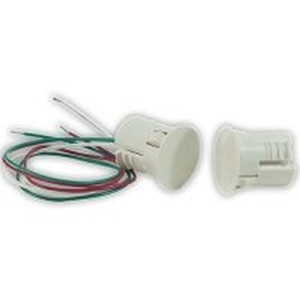
Recessed installation eliminates the visual footprint of surface-mounted contacts, a critical requirement in hospitality, healthcare, and corporate environments where aesthetics matter as much as security. The white plastic housing is non-magnetic and non-conductive, preventing interference with card readers or nearby RF access control equipment. Standard wood and metal door frames require only a ¾" drill cavity to a depth of 1" — no custom milling or frame modification beyond the cavity itself. Wire routing from the recessed cavity to the access control panel can be concealed within the frame depth or routed through adjacent trim.
The 0.5A electrical rating is sufficient to drive a 24VDC relay coil (typically 200–500 mA draw) directly from the MC-4-2 contacts, or to feed a status input on an access control processor that monitors door position for occupancy logic, forced-entry detection, or audit trail generation. In multi-door installations, each MC-4-2 wires independently to the access control panel's input terminals — no daisy-chaining or shared commons required. The sensor operates across standard commercial temperature ranges and requires no calibration or adjustment after installation.
Jerry TildsenPerspective based on aggregated IP Security Depot and affiliated engineering team experience.
We've deployed the MC-4-2 across hundreds of HID access control systems in institutional and commercial environments, and it remains one of the most reliable concealed door position sensors in the market. The real operational advantage is the DPDT switching — it allows a single sensor to handle both status monitoring and forced-entry detection without a helper relay. On a 150-door medical campus, that eliminates 75 relays from the bill of materials and shrinks wiring complexity in the access control cabinet. The ¾" form factor is the standard recessed cavity depth that most integrators already mill into door frames; it doesn't require custom tooling or frame redesign. The UL 10C rating is genuine fire-code compliance — we've seen projects fail final code inspection because the wrong contact sensor was installed in a fire-rated door opening. The MC-4-2 avoids that liability entirely.
Technical Highlights:
- 0.5A @ 30VDC Rating: Sufficient to drive a 24VDC relay coil or feed an access control processor's digital input card without intermediate buffering. Simplifies panel wiring and reduces component count. Typical relay coil draw is 200–500 mA — this sensor handles that load directly.
- DPDT Contact Configuration: Normally-open, normally-closed, and common terminals allow simultaneous monitoring and control logic from one sensor. Wire the NO contact to a door position input for status; wire the NC contact to a forced-entry alarm input. One sensor does both jobs.
- ½" Door Gap Tolerance: Magnetic activation holds across typical frame paint finishes and thermal expansion. Gaps beyond ½" cause loss of sensitivity — this is a real environmental boundary you need to account for during site surveys.
- UL 10C Certification: Explicit approval for fire-rated door assemblies. Do not install an uncertified magnetic contact in a fire-rated opening — code inspectors will catch it and the project will not pass final review.
- Lifetime Warranty: No time-limited coverage — covers defects for the life of the installation. In practice, we rarely see field failures; mechanical reliability is excellent over 10–20 year lifecycles.
Deployment Considerations:
- Cavity depth is critical: 1" is the standard preparation depth. If your frame prep is shallower (common in retrofit work), the sensor will sit proud of the frame surface and the magnet will lose activation distance. Always verify frame cavity preparation before ordering trim and hardware.
- Wire gauge and run length matter less than on powered sensors, but use 18–22 AWG twisted pair routed through the frame depth to the access control panel. Avoid running the DPDT wires bundled with power feeders to avoid capacitive coupling and false triggering.
- Door gap measurement is a field validation step: measure the gap at the top, middle, and bottom of the frame with the door in the closed position. If any point exceeds ½", the sensor will be insensitive in that location. Shim the frame or re-hang the door if necessary.
- The MC-4-2 is purely mechanical — no batteries, no firmware, no remote commissioning. Test it on-site with a basic multimeter set to ohms: magnet approach should show continuity change between NO and NC terminals. If it doesn't, the cavity depth or door gap is out of spec.
- In high-traffic areas (main lobby doors, emergency exits), the sensor will cycle thousands of times per year. We've seen no mechanical wear — the switching action is smooth across decades of use. Budget this as a 20-year component with no planned replacement.
The MC-4-2 is the right choice for integrators and system architects building HID access control systems that need reliable, fire-rated door position monitoring without visible frame hardware or complex relay logic. Its DPDT switching, UL 10C rating, and concealed form factor make it the standard in institutional life-safety applications. Pair it with the rest of the SDC catalog for a complete access control ecosystem.