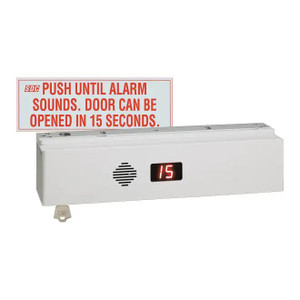
SDC 290 Micro Cabinet Lock
The SDC 290 is a wired micro cabinet lock engineered for distributed access control systems where space constraints and credential flexibility are non-negotiable. Unlike standalone mechanical locks, the 290 integrates directly into enterprise access control infrastructure, managing up to 250,000 user identities across 63 networked doors — a critical capability for multi-facility deployments where centralized provisioning and audit trails matter.
Key Features
- Enterprise-Scale User Database: Supports 250,000 maximum users across 63 networked doors. This means you can deploy a single logical security domain across a large warehouse, office campus, or manufacturing facility without segmenting user databases — reducing administrative overhead and eliminating credential sync delays between access control zones.
- Multi-Credential Support: Accepts DESFire, MIFARE, NFC at 13.56 MHz, and 125 kHz proximity cards. This flexibility lets you migrate card stocks incrementally (e.g., phasing in DESFire while legacy 125 kHz proximity cards remain functional), avoiding costly all-at-once reissue campaigns.
- Integrated Keypad Reader: Built-in PIN entry on the 290 eliminates the need for a separate external reader hardware — saves mounting time and reduces cabinet clutter, particularly valuable in retrofit scenarios where space behind the door is limited.
- OSDP and TCP/IP Communication: Native OSDP (Open Supervised Device Protocol) and TCP/IP connectivity ensure the 290 integrates seamlessly with modern access control systems and enterprise VMS platforms. OSDP is more secure than legacy Wiegand, supporting encrypted credential transmission and real-time reader status feedback — a real advantage if your facility requires PACS audit compliance.
- 24VDC Standard Power: Operates on 24VDC, the industry standard for security infrastructure. Most enterprise access control panels, power supplies, and hardwired circuits already supply 24VDC — no exotic voltage conversion or dedicated 12V rails needed.
- Compact Footprint: The 290's micro form factor fits inside cabinet cutouts and recessed installations where full-size electromechanical strikes won't fit. Ideal for server room cabinets, medication dispensers, evidence lockers, and secure storage in space-constrained environments.
Integration and Compatibility
The 290 communicates via OSDP and TCP/IP protocols, ensuring compatibility with major enterprise access control platforms that support these open standards. Credential provisioning happens at the controller level — cards and PINs are managed centrally and pushed to the 290 via the network connection, meaning you don't reprogram the lock itself when users are added or removed. This scales dramatically better than manually configuring individual locks.
The integrated keypad accepts PIN-based access in addition to card credentials, providing a fallback mechanism if your card system is temporarily unavailable or if a user forgets their credential.
When to Choose a Different Model
If you need a larger capacity (more than 63 networked doors) or are deploying on a single site with fewer than 10 controlled points, explore other models in the SDC cabinet lock family that may offer better size-to-cost ratio or require less complex networked infrastructure. If your facility uses older, non-OSDP access control panels (pure Wiegand-only systems), confirm backward-compatibility requirements with your integrator before committing to the 290.
Frequently Asked Questions
Q: Does the SDC 290 work with my existing 125 kHz proximity card system?
A: Yes. The 290 supports 125 kHz proximity cards natively, so existing card stocks will work. If you're migrating to DESFire or MIFARE (13.56 MHz), the 290 can accept both during a transition period.
Q: Is the 290 suitable for outdoor or high-humidity installations?
A: The 290 is designed as an indoor cabinet lock. If you need outdoor or humid-environment operation, consult your integrator for environmental housing options or alternative SDC models rated for those conditions.
Q: What happens if the network connection to the 290 drops?
A: The 290 maintains a local credential cache, allowing previously authenticated users to unlock the door for a defined offline period. The exact offline duration depends on your access control system's policy settings — discuss this requirement with your system designer during provisioning.
Q: Can I integrate the 290 with our existing Milestone or Axis VMS?
A: The 290 integrates via OSDP and TCP/IP, which are supported by most enterprise VMS platforms. Confirm OSDP support with your VMS vendor and ensure your access control panel bridges to the VMS correctly.
Q: What is the maximum number of networked doors the 290 supports?
A: The 290 supports up to 63 networked doors on a single access control system. If you have more than 63 doors, you'll need additional controller infrastructure or multiple 290 deployments on separate control zones.
Q: Does the 290 require special wiring or power conditioning?
A: The 290 operates on standard 24VDC — standard for enterprise security installations. Use appropriate 24VDC wiring (typically 18–20 AWG for runs under 500 feet) and ensure your power supply is sized for all connected locks and readers. No special conditioning is required beyond normal security-grade 24VDC infrastructure.
Ted PerryPerspective based on aggregated IP Security Depot and affiliated engineering team experience.
The SDC 290 solves a real problem: distributed cabinet security at scale without the complexity of individual wireless locks or the cost of replicated access control systems. Most integrators I work with overlook the 250,000-user ceiling and 63-door limit — it's not huge, but it covers a single large facility or 3–5 smaller sites comfortably. The built-in keypad and multi-credential support (125 kHz, DESFire, MIFARE, NFC) eliminate the need to pair external readers for most deployments.
Technical Highlights:
- OSDP/TCP-IP Native Integration: Unlike older Wiegand-only locks, the 290 speaks modern access control dialect — OSDP encrypts credentials in transit and provides real-time lock status feedback. If your panel and controller already support OSDP, provisioning the 290 is faster and audit trails are cleaner.
- Integrated Keypad Saves Hardware: No separate reader cutout, no additional wiring run — the 290's onboard PIN pad covers emergency access and fallback authentication. In retrofit cabinet installations where drilling new holes is expensive or time-consuming, this design wins.
- 24VDC Standard Power Footprint: Your existing 24VDC supply handles the 290 without dedicated infrastructure. Most enterprise access panels already provide 24VDC loop capacity — you're just adding a load, not designing a new circuit.
Deployment Considerations:
- The 63-door networked limit is real — if you're planning a 100-door warehouse, you'll need two controller zones or a larger access control system architecture. Confirm with your system designer early.
- Offline credential caching relies on your access control policy settings. If users need real-time enforcement (no cached access allowed), the 290 works, but the lock will request validation on every access — ensure your controller and network can support that frequency.
- Multi-credential support is powerful, but mixed-card deployments (legacy 125 kHz + new DESFire) complicate provisioning. Plan credential migration in phases and test the 290 with your actual card stock before full rollout.
Deploy the 290 when you're securing distributed cabinets (server, medication, evidence, secure storage) across a single large facility or small multi-site campus and your access control panel speaks OSDP. If you're building a credential-agnostic system or need to migrate card technologies incrementally, the 290's flexibility justifies the integration effort over cheap mechanical locks.