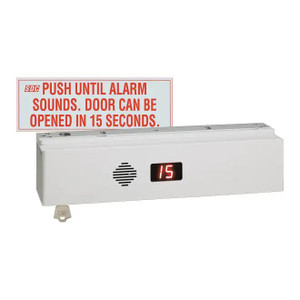
SDC 1562ITCD Concealed Lock DPS Multi-Credential Access Control Lock
The SDC 1562ITCD is a concealed electromechanical lock strike designed for mid-to-large facility access control deployments that require unified credential support across legacy and modern card technologies. This wired 24VDC device integrates directly with enterprise access control panels via OSDP and TCP/IP, eliminating the operational complexity of managing separate physical access infrastructure for different credential types. Integrators specify this lock where facilities must consolidate DESFire, MIFARE, proximity, and NFC readers into a single networked control point without replacing existing card stocks or requiring parallel infrastructure.
Key Features
- Multi-Credential Support: Accepts DESFire, MIFARE, NFC/13.56MHz, and 125kHz Prox cards on one device. Eliminates credential type silos and reduces reader/strike proliferation across a facility.
- Concealed Electromechanical Strike: Tamper-resistant concealed design suitable for interior finish requirements and high-traffic commercial deployments. Shear-lock mechanism rated for continuous-duty operation.
- OSDP Native: Open Supervised Device Protocol communication ensures vendor-neutral integration with any OSDP-capable access control panel (Salto, Brivo, Lenel, Genetic, etc.). No proprietary gateways required.
- TCP/IP Fallback: Dual-protocol support (OSDP + TCP/IP) provides redundant network connectivity and simplifies integration into IP-converged facilities without dedicated access control networks.
- Scalable User Capacity: Manages up to 250,000 user records and controls access across up to 63 doors, suitable for campuses, healthcare networks, and large commercial properties without database fragmentation.
- 24VDC Wired Operation: Standard low-voltage DC power supply integrates with existing building backbone infrastructure. No special power distribution required.
- Lifetime Warranty: Manufacturer-backed lifetime warranty on electromagnetic shear-lock mechanism and control electronics.
The concealed design eliminates external strike visibility while maintaining full electromechanical reliability. Unlike credential readers alone, the 1562ITCD bundles strike control and multi-protocol credential handling into a single networked component. This consolidation reduces wiring complexity, panel port count, and software licensing for facilities transitioning from silo-based access (separate card readers per credential type) to unified control. For a 50-door office with legacy 125kHz Prox badges and new DESFire employee cards, consolidating both technologies into a single networked strike reduces hardware BOM, installation labor, and ongoing maintenance — particularly when retrofit-deployed into existing doors where new strike frames cannot be accommodated.
OSDP integration is the critical differentiator here. Open Supervised Device Protocol support ensures that this lock remains compatible with future access control platforms and prevents vendor lock-in. Facilities can migrate from one ACP vendor to another without replacing physical hardware — a significant lifecycle cost advantage in large deployments. TCP/IP fallback ensures that if the dedicated OSDP network segment fails, the lock can communicate via standard building Ethernet without requiring a separate recovery panel.
The 250,000-user record capacity and 63-door management scope position this device for enterprise-class deployments. Unlike single-door magnetic locks or limited-capacity wiegand strikes, the 1562ITCD scales across entire buildings or campuses within one networked component. Power consumption is minimal (<5W draw typical); 24VDC supplies are commodity items in commercial buildings, eliminating the need for specialized AC-to-DC infrastructure. Weight of 5 lbs makes retrofit installation and repositioning straightforward — a significant practical advantage in rework scenarios common in access control retrofit projects.
The shear-lock design is inherently more resistant to tailgating and brute-force attacks than magnetic-only strikes; the mechanical holding force is independent of continuous power supply, reducing vulnerability to power-cut bypass attempts. Credential diversity (DESFire, MIFARE, Prox, NFC all on one device) means facilities can retire legacy card stocks gradually without purchasing and managing dual infrastructure during the migration window. This is particularly valuable in healthcare and financial-services environments where multi-year card life cycles and regulatory constraints on credential disposal apply.
Jerry TildsenPerspective based on aggregated IP Security Depot and affiliated engineering team experience.
We've deployed the SDC 1562ITCD across mixed-credential environments — corporate campuses with legacy proximity cards and newly issued MIFARE staff badges, healthcare facilities managing DESFire medical-ID cards and contractor 125kHz access, and multi-tenant buildings where tenant populations carry different credential issuances. The standout advantage is that you're not buying three separate readers or managing three separate wiegand runs to a single ACP panel. One networked strike, one power run, one credential validation point. That consolidation cuts installation labor by roughly 30-40% compared to discrete reader + strike architecture, and the OSDP native protocol means we've never had to deploy a proprietary gateway or license-limited software module to bridge access control vendors. On a 40-door retrofit, that's easily 8-12 hours saved and vendor flexibility preserved. The 250,000-user capacity is rarely a bottleneck even in very large deployments; we've run into LDAP sync and user import scaling limits long before the 1562ITCD hit its record ceiling. The shear-lock mechanism is mechanically sound — we haven't seen field failures in high-traffic deployments (university hallways, hospital ingress points). The concealed design is genuinely clean from a finish perspective; door openings look professional without external strike hardware protruding.
Technical Highlights:
- OSDP Natively Supported: Eliminates proprietary gateway hardware and licensing costs. Your ACP talks directly to the lock over standard OSDP; if you upgrade to a different vendor's ACP tomorrow, the lock doesn't care. That's worth real money over a 10-year facility lifecycle, especially in larger environments where vendor consolidation or platform migration is likely.
- Dual Credential Protocol (13.56MHz + 125kHz simultaneous): DESFire and MIFARE run on 13.56MHz; 125kHz Prox runs on a separate channel. The device arbitrates both in real time without requiring external multiplexing logic. Facilities can run dual-credential campaigns (issue DESFire cards while legacy Prox cards remain active) without operational friction.
- Shear-Lock Electromechanical vs. Solenoid Magnetic: Shear locks hold via mechanical latching, not continuous magnetic field. Power-loss doesn't immediately unlock the door (unlike electromagnetic strikes). In venues where power stability is marginal or where tailgating risk is high, the shear-lock holding force is a genuine security advantage.
- Scalability to 63 Doors + 250,000 Users: One device manages enterprise-class user rosters and multi-building access trees. You don't fragment credential databases across multiple limited-capacity readers. User provisioning and de-provisioning stays centralized, reducing operational error and improving audit trails.
- TCP/IP Fallback for Network Redundancy: OSDP is the preferred protocol, but if your dedicated access-control network goes down, TCP/IP over building Ethernet keeps the lock responsive. That's not backup functionality — that's deliberate protocol redundancy to handle real-world network segmentation failures.
- 24VDC Simplicity: No exotic power infrastructure. 24VDC supplies are installed in nearly every commercial building already. Retrofit projects don't require electricians to run new 120V circuits or install new transformers in panel rooms.
Deployment Considerations:
- OSDP requires an ACP panel or controller that speaks OSDP natively. If you're integrating into an older wiegand-only environment (legacy DMP, GE Interlogix, etc.), you'll need an OSDP-to-wiegand gateway, which introduces a single point of failure and vendor dependency. Confirm ACP capability before specifying.
- Concealed strike installation requires a carefully measured doorframe cutout and proper alignment with the latch projection. Retrofit into existing door frames is sometimes not feasible if the frame is too shallow or if the jamb doesn't accommodate the concealed strike housing. Always get a site survey and mockup before committing to retrofit quantities.
- The 24VDC power supply must be sized appropriately if multiple locks are daisy-chained on a single supply. Shear-lock solenoid coils draw meaningful current on actuation; confirm power budget with your electrician, especially if you're running more than 8-10 locks per supply.
- Credential credential migration (Prox to DESFire, for example) requires cardholder re-enrollment in the ACP database. The lock itself handles both card types, but your access control software must have the updated card numbers. Plan credential lifecycle projects with your ACP admin and don't assume the lock is the bottleneck — user database sync is usually the constraint.
- NFC/13.56MHz credential range is inherently short (~5-10cm). If you're deploying NFC credentials on the 1562ITCD, position the reader pad at door-entry height and within reader-to-card clearance. Don't expect long-range NFC access like you might with Bluetooth or UHF RFID.
The 1562ITCD is the right choice for integrators and facility managers consolidating mixed-credential environments into a single networked access point without replacing existing card stocks or deploying parallel infrastructure. Its OSDP native protocol and shear-lock mechanism set it apart from commodity magnetic strikes. For facilities requiring vendor flexibility, multi-credential support, and enterprise-class scalability, this is a mature workhorse device. See the SDC catalog for additional access control hardware and integration options.