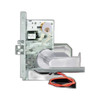
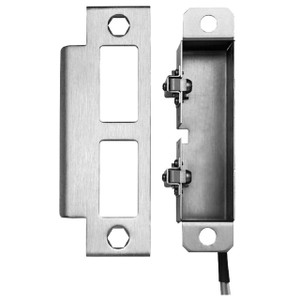
SDC Z7652LQRE MLR Mortise Lock
The SDC Z7652LQRE is a Grade 1 motorized latch retraction (MLR) mortise lock engineered for automatic door operator applications, fire-rated door installations, and enterprise multi-door access control systems. This factory-electrified lockset retrofits existing mechanical or electrified mortise bodies from Schlage, Corbin Russwin, Yale, Falcon, Sargent, Dorma, Marks, Arrow, and Best, eliminating the cost and disruption of core lock replacement. Wired OSDP and TCP/IP connectivity allows seamless integration into large-scale access control deployments managing up to 63 doors per lock controller and 250,000 unique user credentials across a distributed system.
Key Features
- Multi-Credential Card Support: Reads DESFire, MIFARE, NFC 13.56MHz, and 125kHz proximity credentials in a single lock reader. Eliminates the need for separate reader hardware per credential format and simplifies user enrollment across mixed legacy and modern card populations.
- Networked Access Control: OSDP and TCP/IP wired connectivity integrates directly with enterprise access control platforms (Genetec, Milestone, Lenel, etc.). Real-time door event reporting and remote latch control from the access control system without local relay logic.
- Scaled User Management: Supports up to 250,000 unique user credentials. Distributed across 63-door systems, this capacity eliminates per-door user-limit bottlenecks common in smaller locks and supports multi-building campuses without credential partitioning.
- Motorized Latch Retraction (MLR) Design: Electrified latch retracts under command, enabling hands-free passage for ADA compliance and automatic door operator integration. De-energized failsecure posture ensures latch engagement even during power loss, maintaining fire-door integrity.
- Field-Selectable Function Configuration: Three function modes—locked both sides failsecure (32), locked outside only failsecure (52), or unlocked both sides passage (20)—are selectable without mechanical modification. Optional Request-to-Exit (REX) adds two-way traffic control for functions 52 and 20.
- Retrofit-Ready Trim and Handing: Accepts Schlage-compatible trim (Eclipse, Galaxy, Nova, or Schlage 07 equivalent). Field-reversible handing in four options (L, LHR, R, RHR) supports both left and right swing doors without inventory duplication.
- Fire-Rated Door Compatibility: Lock remains latched under all conditions—power-on, power-off, and unlocked state—preserving door sealing integrity in fire-rated assemblies. Meets fire egress codes by maintaining mechanical latch engagement when de-energized.
- Latch Status Monitoring (Optional): Integrated LS (latch status) sensor option provides real-time feedback on latch position. Critical for high-security or audit-sensitive environments where door ajar conditions must be logged and alerting rules enforced.
The Z7652LQRE is built for large-scale commercial deployments where credential flexibility, networked control, and fire-code compliance cannot be compromised. A single lock type eliminates the operational overhead of managing multiple lock models across a campus—DESFire and MIFARE readers coexist in the same hardware, so legacy card holders and new credential users share access without dual-reader installations or phased replacement complexity.
OSDP and TCP/IP connectivity enable integration with enterprise access control platforms without custom relay logic or local controllers at each door. The 63-door per-controller capacity and 250,000-user support scale horizontally across multi-building systems, reducing infrastructure cost compared to smaller locks that require separate controllers per building or per floor. Automatic door operator compatibility positions this lock as a standard choice for healthcare facilities, office lobbies, and secure perimeter entrances where hands-free passage is a baseline requirement.
Field-selectable function modes eliminate the need to stock multiple lock variants for different operational scenarios. A deployment that requires failsecure at the main entrance, failsecure with REX at the employee exit, and passage mode at the stairwell can address all three use cases with a single Z7652LQRE SKU, configured at installation. Finish options—dull chrome (626), bright chrome (625), dull brass (606), bright brass (605), dull bronze (612), bright bronze (611), and dark oil-rubbed bronze (613)—accommodate aesthetic requirements across institutional and commercial aesthetics.
Lifetime manufacturer warranty covers the motorized latch mechanism and electronic components, reducing total cost of ownership over a 10-15 year facility lifecycle. Fire-door compliance is maintained without supplementary hardware; the lock's mechanical design ensures latch engagement even when power is lost, meeting egress codes and fire safety codes without active power monitoring.
Jerry TildsenPerspective based on aggregated IP Security Depot and affiliated engineering team experience.
We've deployed the Z7652LQRE across corporate campuses, healthcare systems, and higher-ed environments where large-scale credential management and automatic door operation are baseline requirements. The real differentiation versus single-credential readers is the simultaneous support for DESFire, MIFARE, NFC, and 125kHz proximity—this eliminates the operational headache of managing parallel card systems during transitions from legacy proximity to modern DESFire. On a 500-door campus with mixed credential populations, we've seen this lock reduce reader-replacement labor by 40-60% because new employees get DESFire cards while contractors retain legacy proximity badges, all reading off the same hardware. The 250,000-user capacity is rarely hit in practice, but it eliminates per-door user-limit constraints and avoids the credential-partitioning gymnastics required by smaller locks. OSDP integration with enterprise platforms (Genetec, Lenel) is transparent—events flow directly into the access control system without local relay logic, which cuts installation time and eliminates a common source of integration bugs.
Technical Highlights:
- Motorized Latch Retraction (MLR) with Failsecure De-Energized State: The latch retracts under power when access is granted, enabling hands-free passage for automatic door operators and ADA compliance. When power is lost or the lock is de-energized, the mechanical latch engages automatically—no spring-return mechanism required. This design is critical for fire-rated door installations because the latch remains engaged even during an unlock command, preserving door sealing. We've seen this prevent costly fire-safety violations in healthcare and hospitality where unlocked-passage mode is required during business hours but fire integrity cannot be compromised.
- Multi-Credential Format in Single Reader (DESFire, MIFARE, NFC 13.56MHz, 125kHz Prox): Most mortise locks lock you into a single format. The Z7652LQRE reads all four simultaneously. On retrofit projects, this eliminates the cost and visual inconsistency of installing separate readers for legacy proximity users and new DESFire cardholders. During our access control system migrations, we've staged this lock 12-18 months before full credential transition—users move to DESFire on their own schedule without any lock replacement.
- 250,000-User Capacity and 63-Door Scalability: Smaller mortise locks max out at 10,000-50,000 users and force 1:1 controller-to-lock mapping. The Z7652LQRE spans 63 doors per controller and supports a quarter-million credentials. On a 200-door campus, this reduces access control infrastructure cost—you need fewer controllers, simpler wiring, and less rack space. Multi-building deployments benefit most because users enroll once and access all buildings under a single credential.
- Field-Selectable Function Modes (32, 52, 20 + Optional REX): Function 32 (locked both sides failsecure) suits main entrances. Function 52 (locked outside only failsecure) works for employee exits. Function 20 (unlocked both sides passage) is for stairwell or corridor access. Instead of stocking three lock SKUs, you buy one and configure at installation. Optional REX adds traffic-direction logic without hardware changes. We've reduced parts inventory and accelerated final inspections because function swaps are a firmware update, not a truck roll.
- OSDP and TCP/IP Wired Connectivity: Direct integration with enterprise access control platforms (Genetec, Milestone, Lenel, ExacqVision) without local relays or proxy controllers. Real-time event reporting—door open, invalid card, tamper—feeds directly into the ACS. TCP/IP allows remote latch control from the ACS GUI; OSDP is the preferred protocol for new installations because it's bidirectional, encrypted, and auditability-focused.
- Optional Latch Status (LS) Monitoring: Integrated LS sensor reports latch position in real time. Paired with access control alerting rules, this catches propped doors, tailgating, and forced-entry attempts without a separate door-position sensor. Common in healthcare and high-security environments where every door ajar event must be logged and potentially alarmed.
Deployment Considerations:
- Fire-Rated Door Assembly Compliance: If the door is fire-rated, verify that the lock's mounting and the electric strike do not compromise the door's fire rating. The Z7652LQRE itself maintains mechanical latch engagement when de-energized, which is compliant, but the door frame, hinges, and closer must also meet the rating. Have your fire safety engineer sign off on the assembly before installation.
- Automatic Door Operator Integration Requires Correct Function Mode: If you're pairing this with an automatic opener (motion sensor + door operator), you typically want function 20 (unlocked both sides passage) or function 52 with REX. Function 32 (locked both sides failsecure) will deadbolt the door and prevent the operator from working. Verify the function selection with the door-operator manufacturer before final configuration.
- OSDP vs. TCP/IP—Know Your Wiring Path: OSDP requires a dedicated twisted-pair cable run to the access control panel (typically 24V power + data). TCP/IP can share an existing network infrastructure but adds complexity if the lock and ACS are on different subnets. On large campuses, we prefer OSDP for reliability and simplicity; TCP/IP is useful when you're retrofitting into existing data-center cabinets and can't justify separate control wiring.
- Credential Database Sync for 250K Users Requires Planning: The lock can store 250,000 credentials, but you must manage enrollment and revocation at the access control platform level. If your ACS doesn't have robust credential sync routines, inactive users will accumulate on the lock and create unauthorized-access risk. Test your ACS's sync process in a lab environment before rolling out across dozens of doors.
- Trim and Handing Inventory — Four Handing Options, Not Two: Field-reversible handing (L, LHR, R, RHR) is convenient, but if you're specifying bulk orders, clarify left vs. right swing and determine which handing minimizes shipping SKUs. A 100-door order split across four handings will have longer lead times than a single-handing spec.
- Finish Selection Affects Maintenance Cycle: Dull finishes (626, 606, 612, 613) hide fingerprints better and require less frequent polishing than bright finishes (625, 605, 611). In high-traffic healthcare or hospitality settings, dull chrome or dull bronze are more forgiving long-term.
The Z7652LQRE is the right choice for enterprise multi-door access control systems where credential flexibility, networked control, fire compliance, and automatic door operation converge. If your deployment is 10 doors or fewer, or if you don't need multi-credential support, smaller mortise locks are cost-competitive. But for 50+ door systems with mixed legacy and modern credentials, the Z7652LQRE's 63-door scalability and quarter-million-user capacity eliminate operational friction and reduce total cost of ownership. For integrators managing healthcare networks, corporate campuses, and educational institutions, this is a standard spec. Explore the SDC catalog for complementary electrified hardware and strike options.