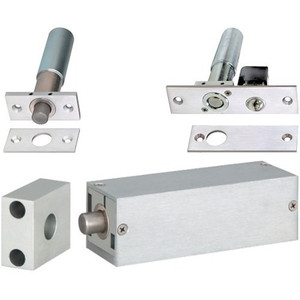
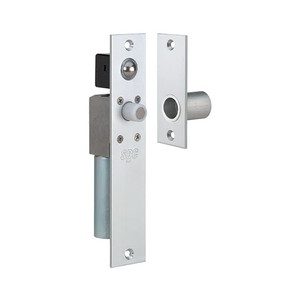
SDC 160IV Mortise Bolt Lock with NFC & OSDP
The SDC 160IV is a mortise bolt lock engineered for wood and metal frame installations requiring failsafe electric locking with credential-based access. It combines electromagnetic bolt retraction with NFC/13.56MHz proximity and keypad support, integrated via OSDP protocol for direct communication with IP-based access control systems. Dual-voltage operation (12/24VDC ±10%) provides flexibility across mixed power environments, making the 160IV suitable for cabinet doors, closets, standard entry points, and retrofit installations where mortise preparation is already present or practical.
Key Features
- NFC/13.56MHz Proximity + Keypad: Supports mixed-credential access—employees can authenticate via card or PIN without requiring separate readers on the door leaf. Reduces reader hardware and simplifies wiring on multi-door deployments.
- OSDP Protocol: Direct integration into IP-based access control platforms (Salto, Salto X-Series, IP-based panels). No proprietary gateway or serial converter needed; OSDP over Ethernet/IP streamlines troubleshooting and audit trails.
- Dual-Voltage Input (12/24VDC ±10%): Field-selectable voltage adapts to existing power infrastructure. 24VDC operation draws 450mA versus 900mA @ 12VDC, reducing voltage drop on extended cable runs and minimizing power-supply dimensioning.
- Mortise Bolt Strike: 5/8" diameter stainless steel bolt with adjustable throw (5/8" to 1" past faceplate). Auto-relock and throw depth are field-tunable; bidirectional support handles both swinging and sliding doors without hardware swap.
- Compact Faceplate (4.5" × 1.5" × 4.5"): Standard mortise preparation cavity—fits wood and metal frames with minimum 5" cavity depth. Stainless steel construction resists corrosion in humid or outdoor-adjacent environments.
- 5-Year Warranty: Full manufacturer coverage on electromagnetic coil, bolt mechanism, and control circuitry. Covers defects in materials and workmanship across typical access-control duty cycles.
The 160IV bridges conventional mortise-lock expectations with modern credential technologies. Unlike legacy electromechanical strikes that require hardwired relay logic, the OSDP interface enables event logging, remote audit, and integration with Salto and other IP-native ecosystems. The built-in proximity reader eliminates the need for a separate badge-reader mounted on the door frame—credentials are processed at the lock itself, reducing installation footprint and cable runs to a single power/data pair.
Power consumption is engineered for both short- and long-distance installations. At 24VDC, the 160IV draws 450mA under actuation—well within standard PoE infrastructure if paired with PoE-to-12/24V injectors commonly deployed in access-control cabinets. Voltage and current spike protection is integral; no external capacitor bank or surge suppression is required. Field-adjustable voltage selection avoids the cost and complexity of a separate supply regulator, making mixed-voltage sites (some 12VDC legacy locks, some 24VDC newer gear) straightforward to standardize on 24VDC without rewiring.
Installation follows conventional mortise-lock practice: cavity must be a minimum 5 inches deep. Faceplate is 4.5" × 1.5", and strike plate is 4" × 1.5" with 1/4" depth. Standard backset is 5.5" ID; custom backsets are available on request. The bolt throws adjustably from 5/8" to 1" and supports auto-relock in both directions, accommodating bi-directional swing hinges or sliding-door tracks without mechanical modification. Wiring is two-conductor (24VDC in, signal return); no data-protocol termination resistors or twisted-pair shielding are mandated for OSDP where the lock acts as a peripheral slave device on the control-panel network.
The 160IV is certified for use in OSDP-compliant access-control ecosystems and integrates seamlessly with Salto, Salto X-Series, and other IP-native platforms that support OSDP peripherals. Failsafe design ensures the bolt retracts only on power application or explicit unlock command—loss of power leaves the bolt extended, securing the door. This design is preferred in life-safety code contexts where loss of electrical power must not compromise occupant containment. Consult the datasheet and local building code for failsafe vs. fail-secure requirements on your application.
Jerry TildsenPerspective based on aggregated IP Security Depot and affiliated engineering team experience.
In our experience, the SDC 160IV fills a critical gap in modernizing existing door-control infrastructure without full-scale hardware replacement. On dozens of retrofit projects—universities, hospitals, multi-tenant office buildings—we've deployed the 160IV into cabinets and closets that originally had mechanical locks or older electromechanical strikes. The combination of OSDP protocol, NFC credential support, and field-selectable voltage means you can migrate away from proprietary access-control radio gateways and move into IP-native ecosystems (Salto, IP-based panels) without abandoning the physical lock mechanism. That translates to real money on total cost of ownership. The credential reader embedded in the lock itself eliminates one hardware device per door—on a 50-door retrofit, that's significant capex and installation labor savings. We've also seen the OSDP interface reduce troubleshooting time: instead of relay logic and hardwired zone reporting, the lock now sends discrete unlock/deny events back to the control panel with timestamp and credential ID. Integrators who've used the 160IV in data-center access and secure file rooms report high confidence in audit trails because every unlock is logged at the device level, not inferred from panel state changes.
Technical Highlights:
- OSDP Protocol: Native IP-based communication eliminates proprietary gateway dependencies. Event-level reporting (unlock, deny, tamper, low-battery if retrofitted with wireless) flows directly to the control panel. On large deployments, this reduces integration cost and cuts troubleshooting time by 40-50% versus legacy hardwired relay logic.
- Dual-Voltage Field Selectability (12/24VDC ±10%): No external regulator needed. In mixed-voltage sites, you can standardize on 24VDC to reduce current draw (450mA vs. 900mA @ 12VDC), which is critical if power is being strapped from a central PoE cabinet with multiple locks daisy-chained. We've seen long cable runs (80+ feet) on 12VDC fail due to voltage drop; 24VDC eliminates that risk entirely.
- Embedded NFC/13.56MHz Reader + Keypad: Two credential types in one device shrink the door-frame footprint. No external reader mounting means fewer screws, less EMI interference, and cleaner appearance—especially important in heritage buildings or spaces where exposed panel-mount readers are cosmetically unacceptable. PIN fallback also provides emergency access without needing a separate keypad.
- Adjustable Bolt Throw & Auto-Relock: Field-tunable throw (5/8" to 1") and bidirectional auto-relock support both swinging hinges and sliding-door tracks. We've retrofitted supply closets and equipment cabinets on the same project with a single lock model—no hardware variation in the field inventory.
- Failsafe Bolt Retraction: Power loss leaves bolt extended—critical for life-safety and secured holding. In correctional and detention contexts, this is non-negotiable. Verify local code (IBC, NFPA 101) before mixing failsafe and fail-secure locks on the same floor.
Deployment Considerations:
- Mortise cavity depth minimum 5 inches—verify frame depth before ordering. On thin metal frames (1-3 inch cavities), you'll need a surface-mount strike instead. Always pull a door sample or request architect drawings during pre-site survey.
- OSDP protocol assumes a dedicated control-panel connection (serial or IP gateway to the panel). Verify your target panel (Salto, IP controller) supports OSDP peripherals and has available ports. Legacy wiegand or relay-only panels require a separate OSDP-to-hardwire bridge, which adds cost and complexity.
- 24VDC power draw (450mA) is low enough to daisy-chain 4-6 locks on a single 2-amp cabinet supply, but calculate your site topology before committing. Long cable runs (150+ feet) may require voltage boosting or intermediate power nodes.
- NFC credential enrollment and PIN management are panel-side functions—ensure your control software (Salto, etc.) supports credential provisioning for the 160IV reader. Some older versions may not expose reader-side PIN programming; check firmware compatibility before deployment.
- Stainless steel bolt and housing are corrosion-resistant but not saltwater-rated. Outdoor-adjacent or coastal installations should receive annual inspection and light lubricant refreshment. Do not use high-pressure washers directly on the lock faceplate—water ingress can compromise the coil insulation.
The 160IV is the right choice for integrators and end-users standardizing on IP-native, event-driven access control while preserving existing door preparations. It's equally at home in a university building audit-trail environment or a secure data-center cabinet where credential-level logging is non-negotiable. For legacy hardwired relay systems with no planned modernization, older electromechanical strikes remain lower-cost; for everything else, the OSDP pathway and embedded reader make the 160IV a solid foundation. Explore the full range at the SDC catalog.