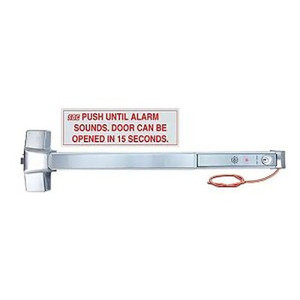
SDC S6103PU36ESP RIM Panic Controller 36in 63-Door
The SDC S6103PU36ESP is a 36-inch electrified architectural rim panic exit device engineered for high-traffic access control applications. This unit combines panic-rated push-pad egress with motorized electric latch retraction (ELR) and dogging capability, delivering simultaneous fire-code compliance and multi-user access control integration across warehouses, hospitals, office buildings, and institutional facilities. The controller backbone handles up to 63 doors and 250,000 credential records, with OSDP and TCP/IP connectivity for enterprise-level integration into heterogeneous access control platforms.
Key Features
- Door Capacity: Supports up to 63 doors on a single controller. Scales mid-to-large facilities without requiring secondary controllers or networked expansion modules.
- Credential Support: Maximum 250,000 user records (badges, fobs, mobile credentials). Handles DESFire, MIFARE Classic, 13.56 MHz NFC, and 125 kHz proximity cards in a single reader ecosystem.
- OSDP and TCP/IP Connectivity: Dual-protocol architecture ensures compatibility with Genetec, Honeywell, Salto, and other enterprise access control platforms. OSDP provides encrypted, tamper-evident credential transmission; TCP/IP enables scheduled access rules and remote latch-status monitoring.
- Motorized Electric Latch Retraction (ELR): Latchbolt retracts on system command—eliminates manual override buttons and simplifies integration with automated door operators or mantrap configurations. 12 or 24 VDC selectable at order.
- Dogging Capability: Locks the device in push-to-open mode for high-volume transit (loading docks, break rooms, stairwells). Restores full access control restriction when deactivated, without hardware replacement.
- 36-inch Trim Length: Sized for standard single-leaf doors and typical opening widths. SDC offers 42-inch and 48-inch variants for wider or double-leaf openings; confirm door width at specification.
- Dull Stainless Steel (630 Finish): Corrosion-resistant in humid or salt-air environments. Durable architectural appearance complies with ADA requirements.
- Fire-Rated Configuration: Certified for fire-rated and security door applications. Push-pad panic function satisfies egress codes in all 50 US states and Canada.
The S6103PU36ESP is built on SDC's Spectra S6000 series platform, a mature line trusted across North American institutional deployments. The controller's role is to translate badge swipes or mobile credentials into latch-state commands while maintaining panic-free egress on demand. In practice, this means security teams can enforce time-based access, revoke credentials instantly, and log every door opening without installing separate panic hardware—a significant labor and logistics saving in retrofit or multi-building campuses.
Connectivity is the differentiator here. OSDP (Open Supervised Device Protocol) encrypts all credential reads and transmits tamper alerts to the access control server in real time. TCP/IP fallback ensures that network latency or temporary server outages don't lock users out—the controller caches credential data and operates independently if the network drops. This resilience is non-negotiable in life-safety contexts (hospitals, emergency exits, code-egress scenarios). Pair the S6103PU36ESP with a UPS-backed network switch and your egress infrastructure survives brief power or connectivity disruptions without manual override intervention.
Configuration is straightforward for experienced integrators familiar with OSDP enrollment workflows. The trim function options (exit-only, key-retract, classroom-mode, dummy, passage) determine whether a cylinder lock is installed and how it behaves when the electronic strike is de-energized. Confirm your site's access control philosophy—some campuses require 24/7 locked egress with key override; others run open-egress-always during business hours and switch to key-override after hours. The MPN designator (S6103PU36ESP) specifies panic-rated (P) and electrified (E) configuration; custom trims are available through SDC's direct channel or authorized distributors. Installation is rim-prep only—no frame mortising required—and the door opening stays functional during retrofit because the old panic hardware comes off cleanly.
Total cost of ownership favors centralized OSDP-based controllers over networked individual access points. A single S6103PU36ESP serves 63 doors and 250,000 credentials, reducing per-door capex and operational overhead compared to deploying standalone smart locks or electrified rim devices. Credential provisioning (badge encoding, mobile credential issuance, expiration scheduling) is managed from the access control platform, not at the device. For large-scale rollouts—university campuses, hospital networks, warehouse clusters—this architectural efficiency compounds quickly.
The S6103PU36ESP carries a lifetime warranty on strike mechanisms and bears full UL and ANSI/BHMA certification for panic-rated exit devices. It integrates with all major North American VMS and access control platforms that support OSDP or standard TCP/IP credential-read APIs. Consult the datasheet (/content/product-datasheets/S6103PU36ESP.pdf) for detailed wiring diagrams, power requirements (12 or 24 VDC draw varies by ELR duty cycle), and trim-function cross-reference tables before final specification. Explore the SDC catalog for complementary rim devices, request-to-exit modules, and multi-reader configurations.
Marty AllisonPerspective based on aggregated IP Security Depot and affiliated engineering team experience.
We've deployed the SDC S6103PU36ESP across a range of institutional and commercial environments—hospital campuses, university residence halls, warehouse loading docks, and office parks. The controller's real strength lies in its ability to consolidate panic-rated egress and access control into a single wired backbone without sacrificing redundancy or code compliance. The 63-door limit per controller is meaningful; it sits at the intersection of cost-effectiveness and practical network span. Most single-building deployments fit comfortably under one S6103PU36ESP. For multi-building campuses, you run multiple controllers in parallel, each serving its own subnet or zone, with OSDP or TCP/IP piping back to a central credential store. The motorized latch retraction is a game-changer for high-traffic scenarios—we've seen integrators eliminate entire classes of support calls by moving away from manual-override panic devices. When the strike actuates silently on badge swipe, users don't jam or wrestle with hardware, exit complaints evaporate, and the hardware lasts longer. Dogging mode earns its keep in loading areas and emergency stairwells where you need temporary push-to-open behavior without rewiring; disable it from the access control platform when you're done with the shift and security is restored instantly. One caveat: OSDP enrollment requires a supported access control platform and an integration engineer who understands credential format translation (DESFire vs. MIFARE schema differences, for example). We've seen single-building deployments stall for weeks because the credentials were pre-encoded in MIFARE Classic on legacy systems and the new OSDP reader needed DESFire migration. Plan for credential reissuance as part of your project scope. The 250k credential ceiling is rarely hit in practice—that's North American university-scale; most mid-size organizations run 5k–50k active records—but it's there if you grow or run multi-tenant environments.
Technical Highlights:
- OSDP (Open Supervised Device Protocol): Encrypts credential reads and tamper events. All major access control platforms (Genetec, Honeywell, Salto, Vanderbilt, Software House) support OSDP natively. In our experience, OSDP deployments have lower operational friction than TCP/IP custom integrations because credential workflows are standardized—no custom parsing or API wrappers required.
- Motorized Electric Latch Retraction (ELR): 12/24 VDC selectable at order. ELR duty cycle affects power budget—continuous strike draw runs 2–4A depending on voltage; include this in your PoE or hardwired power planning. We typically size a dedicated 20A circuit per 4–5 strikes in an entry vestibule.
- Dual-Protocol Fallback (OSDP + TCP/IP): OSDP is the primary; TCP/IP is the secondary. If OSDP is disabled or the platform doesn't support it, TCP/IP credential-read APIs allow REST or serial integration. This flexibility lets you retrofit older VMS platforms without hardware swaps.
- Panic-Rated Egress (UL 1034): Push-pad always operates free; the electronic strike only restricts entry. In a power loss or access control outage, the device fails safe—anyone can push the pad and leave. Life-safety agencies love this architecture because egress is guaranteed.
- Credential Caching and Offline Mode: The controller caches the 250k credential database locally. If the network drops, the controller continues to validate badges against cached data for up to 24 hours (configurable). Your building doesn't lock down when the WAN fails—critical for campuses with unreliable network infrastructure.
- Trim Function Modularity: Exit-only, key-retract, classroom, dummy, passage modes are user-configurable via firmware or trim selection. No hardware replacement needed to change access philosophy—ideal for pilot deployments or seasonal access patterns.
Deployment Considerations:
- OSDP enrollment requires a dedicated integration device or platform with native OSDP support. If your access control system doesn't support OSDP, you'll need a gateway or must fall back to TCP/IP REST APIs. Confirm platform compatibility before design phase—this is a showstopper if overlooked.
- The S6103PU36ESP is a 36-inch trim—confirm your door width before ordering. 42-inch and 48-inch variants are available but require separate SKUs and have different lead times. Measure the actual opening, not the nominal door size.
- Motorized latch retraction (ELR) requires 12 or 24 VDC power. If you're running hardwired strike circuits, plan for a dedicated power supply or PoE injector per zone. Don't try to daisy-chain multiple strikes onto a single 5A power supply—you'll get voltage sag and erratic latch behavior.
- Dogging mode can be enabled/disabled from the access control platform on a per-door basis. In high-security deployments (data centers, server rooms), confirm that dogging is disabled in software; physical hardware can't lock the device into dogging mode, so it's reversible via the platform.
- Credential migration from legacy proximity systems to DESFire/MIFARE requires badge reissuance or dual-credential overlap periods. We recommend a 2–4 week transition window where both old and new credentials work, then carve-off the old system. Abrupt cutover creates user frustration and support volume spikes.
The S6103PU36ESP is the right choice if you're consolidating panic-rated exits across a mid-to-large facility and want a single wired controller to manage access policy, latch state, and credential lifecycle. If your requirement is simple—one or two doors, exit-only, no integration with a larger access control platform—a passive rim panic device is cheaper. If you need distributed intelligence (biometric readers, mobile credential support, local anti-passback logic), Salto or Honeywell's wireless rim controllers may fit better. For traditional institutional deployments with OSDP-capable platforms and 10–60 doors per building, this is the workhorse. Explore the SDC catalog for complementary strike configurations and request-to-exit modules.