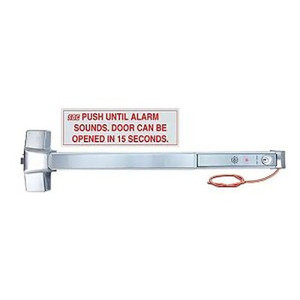
SDC S4101PU36RE 36-inch RIM Panic Exit Device Controller
The SDC S4101PU36RE is a 36-inch RIM-mounted electrified panic exit device engineered for multi-door access control deployments in high-traffic commercial, institutional, and industrial facilities. Unlike standalone panic hardware, this controller-grade device integrates directly with access control systems via OSDP and TCP/IP, managing up to 63 doors from a single control architecture while supporting 250,000 user credentials across DESFire, MIFARE Classic, NFC/13.56MHz, and 125kHz proximity readers. Purpose-built for perimeter egress, loading docks, emergency exits, and any door where panic-bar compliance must coexist with electronic access control and audit logging.
Key Features
- Multi-door Management: Manages up to 63 doors from one control infrastructure. Consolidates wiring and credential administration—single database for all panic-controlled egress points.
- Credential Capacity: Supports 250,000 user credentials. Scales across large facilities (hospitals, universities, office parks) without segmentation into separate panels.
- Multi-credential Support: DESFire, MIFARE Classic, NFC/13.56MHz, 125kHz Proximity. Accepts existing card stock and reader hardware—no forced card-replacement cycle.
- Fingerprint Reader Integration: Native biometric support via fingerprint reader modules. Adds touchless credential without separate gateway hardware.
- OSDP and TCP/IP Protocols: OSDP for secure wired reader communication; TCP/IP for networked panic controllers across campus or distributed facilities. Works with Genetec, Milestone, and vendor-agnostic access control platforms.
- Grade 1 Construction: Stainless steel (630 Dull finish standard), corrosion-resistant design. Rated for high-traffic use and low-energy automatic door operator compatibility on accessible entrances.
- Electric Latch Retraction (ELR) Ready: Modular ELR and Request-To-Exit (REX) modules wired independently. Supports panic-only, panic+ELR, or full strike control configurations—spec exactly what you need.
- Lifetime Warranty: Factory warranty covers manufacturing defects across the product lifecycle. Reduces planned obsolescence and long-term capex uncertainty.
Deployment Architecture & Integration
The S4101PU36RE operates as a distributed panic controller rather than a peripheral to a remote access panel. Each 36-inch RIM device wired to a door carries its own credential processing logic, reducing latency and single-point-of-failure risk on geographically dispersed entrances. OSDP reader communication is encrypted and tamper-logged; TCP/IP networked variants integrate into Ethernet infrastructure for campus-scale deployments. REX (Request-To-Exit) monitoring provides audit trails on every emergency unlock event—critical for compliance (ADA egress verification, fire-code audit) and post-incident review. In high-traffic loading docks or hospital emergency departments, the panic bar remains unlocked by default; access control restricts re-entry via the same door, enforcing one-way egress without requiring staff intervention on every cycle.
Trim function options (Exit Only, Dummy Trim, Nightlatch, Classroom, or Passage lever) accommodate various hardware configurations—a single panic device can be configured for egress-only scenarios (locked stairwell), or dual-function (entry and exit controlled). Escutcheon trim choices (Eclipse EK, Galaxy GK, Saturn SE) match architectural finishes and branding standards across institutional campuses. Compatible with multi-reader deployments: card readers, keypads, and biometric modules can be wired in parallel to the same controller for credential layering (card + fingerprint, for example) on sensitive doors.
Total cost of ownership scales favorably on large installations: 63-door consolidation eliminates per-door control modules, centralizes credential management into a single database, and reduces wiring labor on retrofit projects. Modular ELR/REX means you don't pay for strike control on panic-only exits—common on stairwell deployments where mechanical panic suffices. Corrosion resistance (stainless steel trim, sealed electronics) lowers maintenance on perimeter doors exposed to salt spray or washdown environments.
Real-World Scenarios
A 200-bed hospital specifies S4101PU36RE on all emergency exits, patient egress stairwells, and loading dock doors (18 doors total). Each panic device credentials-gates staff access; REX monitoring confirms egress count during shift changes. A manufacturing plant uses the same controller on 12 perimeter doors across three buildings, networked via TCP/IP—one facility manager dashboard logs all panic bar usage, detects propped-door anomalies via REX sensor data, and generates compliance reports for insurance audits. A university consolidates 40 classroom panic bars and lab emergency exits: panic-only on lower-risk classrooms, ELR+panic on secure labs. Fingerprint reader modules on select doors add biometric egress logging without retrofit.
The modular architecture also supports phased rollouts: install panic bars on all doors year one (mechanical baseline, no electronics), add ELR and credential readers on tier-1 security doors year two, expand fingerprint integration year three. This stagewise approach matches budget cycles and avoids forced replacement of working hardware.
Compliance & Management Platform Integration
The S4101PU36RE operates within OSDP and TCP/IP standards, ensuring compatibility with any OSDP-certified access control platform (Genetec Security Center, Milestone Husky, Honeywell ProWatch, Salto, Openpath, and others). REX monitoring satisfies ADA egress verification requirements and NFPA 101 Life Safety Code audit trails. Fire-code egress documentation is automated—timestamp logging on every panic activation and emergency unlock provides irrefutable compliance records without manual inspection. Credential support (DESFire, MIFARE Classic, NFC) is vendor-neutral, preventing lock-in to proprietary card systems. The lifetime warranty and corrosion-resistant construction eliminate planned replacement cycles, supporting long-term total cost of ownership predictability on 20+ year building lifecycles.
Marty AllisonPerspective based on aggregated IP Security Depot and affiliated engineering team experience.
We've installed the SDC S4101PU36RE across a range of facility types—hospitals, manufacturing plants, university campuses, and office parks—and the appeal is consistent: it's one of the few panic controllers that truly consolidates egress management without forcing a rip-and-replace retrofit. The 63-door capacity from a single control node eliminates the per-door module redundancy you see with legacy setups; on a 40-door hospital project, that's significant wiring labor and capex savings. The modular ELR/REX design is the real differentiator—you install the panic bar mechanically on day one (baseline compliance, no power required), then layer in credential control, fingerprint integration, and strike management on your own schedule. We've seen facilities leverage this approach to spread capital spend across three budget cycles without stranding hardware. OSDP and TCP/IP support means no proprietary lock-in; the device talks to Genetec, Milestone, Honeywell, and any OSDP-certified platform. On credential side, support for DESFire, MIFARE Classic, NFC, and 125kHz proximity means you can absorb existing card stock and reader infrastructure—you're not forcing a wholesale cardholder population migration. The 250K credential capacity is overkill for most facilities, but on large multi-building campuses it removes the complexity of segmented credential stores.
That said, there are deployment nuances worth understanding. The base S4101PU36RE is a 36-inch RIM-mounted device—it's not universally retrofit-compatible. If you're replacing narrow or outswinging doors, verify door frame geometry before spec'ing. Electric Latch Retraction (ELR) wiring requires low-voltage control runs from the panic device back to your access control panel; in retrofit projects with conduit constraints, that's a labor multiplier. REX wiring (request-to-exit sensors) adds another run; on existing doors without raceways, surface-mounted sensor housing can be cosmetically intrusive. We've seen integrators underestimate this on dense multi-floor buildings. Fingerprint reader integration is a real capability, but it's an add-on module—don't assume it ships with the base controller. Verify module availability and reader certification before quoting biometric features. On corrosion-resistant finishes: stainless steel is standard, but if your site is salt-spray or high-washdown (food processing, automotive plants), confirm escutcheon material specs with the datasheet—trim options vary.
Technical Highlights:
- 63-Door Consolidation: Single control node eliminates per-door modules and wiring complexity. On a typical 40-door hospital deployment, that's 3–4 fewer access control cabinets, lower cable plant costs, and simplified credential provisioning. Fewer control points also reduces single-point-of-failure exposure on geographically distributed facilities.
- OSDP + TCP/IP Dual Protocol: OSDP provides encrypted, tamper-logged reader communication (AES-128); TCP/IP allows networked panic controllers across campus buildings without proprietary gateways. This flexibility is rare in panic hardware and avoids future vendor lock-in on platform upgrades.
- 250K Credential Capacity: Sufficient for large healthcare systems, universities, and industrial parks. No segmentation into credential "pools" per building—single database synchronization scales gracefully. Contrast this with legacy setups that cap out at 10K–50K credentials per controller, forcing distributed architecture complexity.
- Multi-Credential Support (DESFire, MIFARE, NFC, 125kHz): Accepts existing card stock and reader hardware. We've seen facilities with a decade of MIFARE Classic cards continue using them without replacement—real money on large populations. NFC support future-proofs for smartphone-based access without separate hardware.
- Fingerprint Reader Integration: Native biometric support via discrete modules. No separate gateway, no credential bridge appliance. Adds touchless egress verification and reduces tailgating audit burden on sensitive doors without ecosystem fragmentation.
- Modular ELR/REX Architecture: Panic-only installations skip strike control entirely (lower capex on mechanical-egress-only doors). ELR and REX are wired independently, allowing phased deployment. On a 60-door mixed facility, you might spec panic on 40 doors, panic+ELR on 15, and panic+ELR+biometric on 5—avoiding overspec on low-risk exits.
Deployment Considerations:
- 36-inch RIM Form Factor is Not Universal: RIM-mounted devices are retrofit-friendly on outswinging egress doors with standard 36-inch frames, but inswinging or non-standard widths require alternative hardware. Verify door swing direction and frame width before committing to S4101PU36RE—substitution on-site is expensive.
- ELR and REX Wiring Are Separate Runs: Unlike integrated strike devices, the S4101PU36RE requires discrete low-voltage control runs back to your access panel (ELR strike control + REX sensor input). On retrofit projects without existing conduit, surface-mounted wiring and sensor housings can be cosmetically intrusive—budget for in-wall runs or conduit concealment.
- Fingerprint Modules Are Add-On: Biometric integration requires separate fingerprint reader modules (not included in base device). Verify module availability from your distributor and OSDP certification before quoting biometric features to end-users. Lead times on specialized readers can delay project timelines.
- Corrosion Resistance Is Grade-Dependent: Stainless steel is standard, but escutcheon trim options (Eclipse, Galaxy, Saturn) vary in material and corrosion rating. If your site is exposed to salt spray, washdown, or chemical environments, confirm trim material specs in the datasheet—some finishes may require periodic maintenance or protective coatings.
- Panic-Only vs. Full Strike Control: Right-Size Your Spec: It's tempting to add ELR and biometric readers to every panic bar for "future-proofing." In practice, many egress doors need only mechanical panic compliance. Specifying strike control and credential readers on stairwell exits you'll never electronically unlock adds cost without operational benefit—consult the end-user on actual access-control intent before building the BOM.
- REX Sensor Wiring and Maintenance: REX (request-to-exit) sensors on strike-controlled doors require dedicated wiring and occasional cleaning to avoid false-positive tamper alerts. On high-traffic loading docks with dust or humidity, plan for preventive sensor maintenance—cleaning contacts every 6–12 months reduces nuisance alerts.
The SDC S4101PU36RE is the right choice for healthcare systems, large office parks, and industrial facilities managing 40+ egress doors that require panic compliance plus integrated access control audit logging. Its 63-door consolidation, multi-credential support, and OSDP/TCP/IP flexibility eliminate the architectural complexity and per-door module cost of distributed legacy setups. Phased deployment (panic now, strike and biometric later) makes it budget-cycle friendly. If your project is a single-door panic retrofit or you need inswinging specialty hardware, look elsewhere—but for campus-scale egress standardization and long-term total cost of ownership, the S4101PU36RE delivers measurable operational and financial advantage. Explore the full range of SDC panic and access control solutions in our SDC catalog.