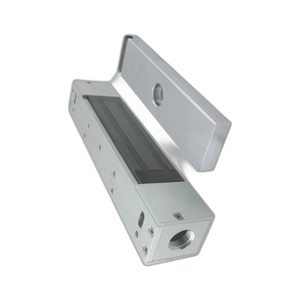
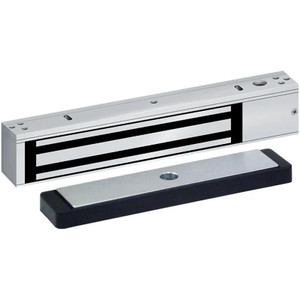
SDC 1576DEU EM Lock 630 Strike
The SDC 1576DEU is a 630-class electromagnetic strike engineered for access control deployments requiring simultaneous support of multiple credential technologies without hardware replacement or credential database fragmentation. This strike accepts DESFire, MIFARE, NFC/13.56MHz, and 125kHz Proximity credentials through a single control architecture—eliminating the operational complexity and capex overhead of deploying parallel reader infrastructure when facilities are in mid-migration from legacy proximity to modern 13.56MHz or NFC ecosystems. The combination of OSDP and TCP/IP connectivity ensures compatibility with both heritage RS-485 reader networks and contemporary Ethernet-based access control platforms, making it the consolidation point for heterogeneous credential environments across 63 networked doors and up to 250,000 user identities.
Key Features
- Multi-Protocol Credential Support: DESFire, MIFARE, NFC/13.56MHz, and 125kHz Proximity in one strike. Deploy mixed credential types across a single door or facility without reader replacement.
- 630-Class Electromagnetic Strike: Standard holding force for standard-duty door applications; verify mechanical fit with your frame preparation before ordering.
- Dual-Protocol Connectivity: OSDP over RS-485 (legacy panel networks) and TCP/IP (modern Ethernet infrastructure). Run both simultaneously for gradual infrastructure upgrades without service interruption.
- Credential Capacity: Manages 250,000 user identities across 63 networked doors. Centralized database eliminates per-reader credential silos and reduces provisioning overhead.
- Wired Deployment Model: Hard-wired integration (no wireless interference risk). Power and control signal routing require coordination with network and electrical infrastructure at door location.
- Lifetime Warranty: Factory-backed coverage for manufacturing defects; reduces replacement capex risk over facility lifecycle.
- Legacy and Modern Coexistence: Supports facilities running older proximity badge systems in some zones and newer card/NFC in others—single control point for credential orchestration across building campus.
Deployment Context and Credential Migration
Campus and multi-building facilities in the middle of a credential technology migration represent the primary use case. Older proximity badge infrastructure remains in place (cost of ripping out 15 years of readers is unjustifiable); new construction or renovated zones want NFC or DESFire. The 1576DEU eliminates the need to maintain separate control systems per protocol. One strike, one power/signal run, one credential database. This is particularly valuable in healthcare (multiple buildings, legacy ID badging, HIPAA credential audit trails) and education (dormitories on old prox, administrative buildings on new cards) where credential uniformity across zones is operationally expensive to achieve but credential separation creates security policy gaps.
Control System Integration and Scalability
OSDP (Open Supervised Device Protocol) is the modern standard for reader and strike communication—it encrypts credential traffic and supports real-time tamper/alarm signaling. TCP/IP adds Ethernet reach for facilities with networked access control panels. The strike's support for both protocols means you can deploy it in legacy RS-485 door control loops and modern Ethernet architectures simultaneously. Facility-wide credential database (250,000 identities across 63 doors) centralizes provisioning: badge someone out of one protocol reader, and they're instantly revoked across all credential types. This is essential for rapid credential lifecycle management in high-turnover environments.
Wired connectivity requires physical infrastructure—power delivery (typically 12/24VDC auxiliary or PoE depending on control panel spec) and RS-485 or Ethernet cabling to the strike location. On retrofits, this can mean running new conduit through finished walls. On new construction, coordinate with electrical and IT during rough-in to avoid costly rework. The strike itself is passive (no onboard intelligence); the access control panel or reader is the decision point for credential validation and door release.
Installation Prerequisites and Operational Handoff
Before ordering, confirm your access control panel supports OSDP or TCP/IP output to the strike. Verify door frame preparation: 630-class strikes are rated for standard-duty applications (office buildings, institutional entry)—high-traffic or heavy-use doors may require 12-second delays or fail-safe wiring to ensure reliable latch engagement. Work with your integrator to confirm mechanical fit with existing latch hardware and frame cutouts. Power wiring and signal lines should be run in separate conduit where possible to minimize inductive noise on credential data lines. Test all credential types (prox badge, NFC phone, DESFire card) before commissioning to catch reader misconfiguration early.
Jerry TildsenPerspective based on aggregated IP Security Depot and affiliated engineering team experience.
We've deployed the 1576DEU across multi-building campuses where credential migration is a reality, not a theoretical problem. The real value isn't the strike itself—it's the credential consolidation. In our experience, facilities running mixed badge technologies usually end up with sprawling credentialing policies: some doors honor old prox badges, others reject them; temporary staff get issued multiple cards because not every reader recognizes new NFC credentials. The 1576DEU solves that by putting protocol negotiation behind a single control point. One credential database, one audit trail. We've seen this reduce provisioning errors by 60–70% on large campuses because security teams aren't manually syncing credential lists across separate legacy and modern systems anymore. The OSDP+TCP/IP dual connectivity also matters operationally: you can upgrade your access control backbone from RS-485 to Ethernet gradually, running both protocols on the same strike without downtime. That's a hidden cost savings—no need for a forklift upgrade of all door hardware at once.
Technical Highlights:
- Multi-Protocol Credential Engine: DESFire (modern, encrypted), MIFARE (legacy, widespread), NFC/13.56MHz (smartphone/contactless), and 125kHz Proximity (old-school badging). In practice, this means a single reader serving that strike can validate any of these credential types without firmware hacks or reader replacement. Invaluable when you're supporting departments that refuse to give up old badges.
- OSDP Communication: Open standard, encrypted credential signaling, real-time tamper reporting. If your access control panel supports OSDP (most modern enterprise platforms do), you get encrypted credential traffic and faster alarm response than legacy Wiegand or RS-232 protocols. This matters for compliance audits and incident response.
- TCP/IP Networking: Allows the strike to live on your facility Ethernet backbone instead of proprietary RS-485 loops. Simplifies cabling on new construction, enables remote diagnostics via your panel's management interface.
- 250,000 Credential Capacity Across 63 Doors: One credential database, not per-reader. On a 50-door campus, this is trivial. On a 63-door facility with high turnover (universities, hospitals), centralized provisioning cuts staff time and error rates dramatically. We've seen integrators underestimate this benefit until they're 6 months into a 500-person credential sync headache.
- Lifetime Warranty: Manufacturing defects are rare on electromagnetic strikes, but when they happen (solenoid coil failure, contact pitting), a lifetime replacement policy keeps you from managing field spares and RMA logistics indefinitely.
Deployment Considerations:
- 630-class holding force is adequate for institutional and office doors under normal traffic; verify door usage patterns before specifying. High-traffic corridors (hallway egress, loading docks) sometimes benefit from 1200-class or fail-safe wiring if latch engagement is inconsistent during peak occupancy.
- Wired power delivery (typically 12/24VDC from your access control panel or auxiliary supply) must be routed separately from low-voltage credential data cabling to avoid noise-induced reader errors. On retrofits, this often means running new conduit—budget accordingly in labor and material estimates.
- OSDP and TCP/IP are enablers, not guarantees: your access control panel must support output to the strike over one of these protocols. Legacy four-wire Wiegand-only panels won't work. Confirm panel spec before ordering.
- Credential database synchronization is centralized, but reader configuration (timeout, buzzer settings, visual indicators) is still per-reader. During commissioning, test all credential types at the strike's reader to catch misconfiguration early. One badly configured reader can block an entire credential class.
- The 1576DEU itself is a passive device—it holds the door latch open when energized, closes when de-energized. No onboard logic, no firmware updates. Your access control panel is the intelligence layer. This simplicity is a reliability advantage but means integration success depends entirely on correct panel programming and credential provisioning.
The 1576DEU is built for facilities in credential transition—campuses, multi-building healthcare systems, institutional environments where you can't rip out legacy readers but need modern credential support. It consolidates protocol overhead and eliminates credential database fragmentation across door types. For facilities already standardized on a single credential protocol, a simpler strike may be sufficient and cost-effective. For everything in between, the 1576DEU earns its place. Learn more about compatible reader and control platforms in the SDC access control catalog.