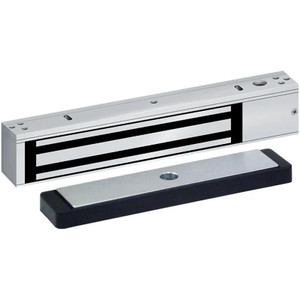
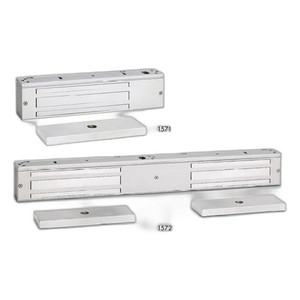
SDC CBP-EM-81 Electromagnetic Lock Strike
The SDC CBP-EM-81 is an electromagnetic lock strike package designed for distributed 4-door access control installations where fail-safe or fail-secure locking is required across multiple entry points. This is a complete kit that bundles two 1581VD electromagnetic locks, multiple push buttons, and a dedicated 631RFXUR-1 power supply—eliminating the need to run individual strike wiring back to a central controller for every door. Deploy this when your access control system architecture relies on networked door controllers with relay outputs and you need synchronized, coordinated locking across multiple secured entries.
Key Features
- 4-Door Capacity: Supports up to 4 doors per networked installation. Multi-controller deployment extends capacity across larger facilities without daisy-chaining single-strike logic.
- Credential Capacity: Supports up to 250,000 user credentials. Suitable for mid-to-large enterprise deployments, multi-tenant buildings, and facilities requiring high cardholder turnover.
- OSDP / TCP-IP Connectivity: Wired networked integration with OSDP and TCP/IP protocols. Distributed architecture eliminates long analog strike runs and simplifies troubleshooting on modern access control networks.
- HID Credential Compatibility: Works with HID reader and credential ecosystems. Standard integration point for organizations with existing HID card or mobile credential infrastructure.
- Complete Package: Includes 2x 1581VD electromagnetic locks, CB401-AU and CB401-B push buttons, and 631RFXUR-1 power supply. No hunting for compatible components—everything needed for a 4-door deployment ships together.
- Fail-Safe / Fail-Secure Configurable: Electromagnetic strike logic can be configured for fail-safe (unlocked on power loss) or fail-secure (locked on power loss) per door or globally across the package, depending on your facility's life-safety and security policies.
The CBP-EM-81 integrates into OSDP and TCP-IP-based access control architectures, leveraging networked door controllers or embedded relay outputs. Verify that your control panel or distributed door controller supports 12/24VDC or dry-relay strike signaling before deployment. HID credential systems and standard networked access control platforms with relay outputs are the typical deployment anchors. The dual electromagnetic locks draw significant simultaneous power—confirm your power supply and controller infrastructure can handle the combined load without voltage sag or brownout conditions affecting reader operation.
Installation requires standard door frame modification for strike mounting (typical on aluminum or wood frames). Unlike retrofit lever-lock conversions, electromagnetic strikes demand clean electrical runs and stable 12/24VDC power delivery. If your facility has noisy or unstable power (manufacturing floor, high-RF environments), consider inline surge protection or isolated supply circuits to prevent nuisance lock failures. The push buttons included in the kit provide both request-to-exit and manual override capability—essential for emergency egress and maintenance access during power events or system outages.
This package is not a retrofit accessory for every lock type. Existing mechanical locks (cylinder mortise, rim deadbolts) cannot simply swap to electromagnetic strikes—door frame and electrical infrastructure must be assessed and upgraded. Sites with existing hardwired access control and individual strike runs per door may be better served by modular strike controllers rather than a bundled package. The CBP-EM-81 delivers best value in new construction, full-system deployments, or facility expansions where the 4-door footprint aligns with your network topology and credential load.
The CBP-EM-81 carries a manufacturer lifetime warranty on the electromagnetic lock mechanisms. Integration with Genetec, Milestone, Avigilon, and other OSDP-compliant VMS platforms is supported via standard relay and event gateway logic. SDC is a mature access control OEM with deep installed base in commercial and government facilities; parts and support are readily available through authorized distributors and integrators.
Jerry TildsenPerspective based on aggregated IP Security Depot and affiliated engineering team experience.
We've deployed the SDC CBP-EM-81 on a variety of mid-market access control projects—office parks, medical facilities, secure document archives, and multi-tenant buildings where 4-door synchronized locking made operational sense. The real strength of this package is that it's a complete kit: you're not piecing together strikes, push buttons, and power supplies from different vendors and hoping they'll play nicely. The 1581VD locks are bulletproof workhorses that have been in SDC's lineup for years, and the 250K credential capacity keeps you from outgrowing the system in the first few years of operation. The OSDP/TCP-IP connectivity is the differentiator—it lets you manage locking logic at the network level rather than hardwiring relay chains, which cuts installation labor and makes troubleshooting dramatically simpler. That said, this is not a plug-and-play retrofit. If you're replacing existing mechanical locks or swapping from older 24VDC hardwired strikes, you'll need structural assessment, electrical certification, and possible UPS integration. Don't underestimate the power budget—two EM locks pulling simultaneously can sag a marginal supply, which will cascade into reader dropout and failed transactions. We've seen sites where that lack of margin turned a Monday-morning unlock into a Tuesday afternoon service call. Choose the CBP-EM-81 when you're building from the ground up or doing a major system refresh, not when you're patching one or two doors onto an existing infrastructure.
Technical Highlights:
- Electromagnetic Strike Type (1581VD): Solenoid-driven, mono-stable design with manual override. Fail-safe or fail-secure configuration per relay contact closure. Real advantage: zero moving parts to wear out compared to motorized latches, and the audible click confirms lock engagement on every cycle—useful for troubleshooting silent failures on remote doors.
- 250K Credential Capacity: Adequate for multi-tenant or large single-site deployments. Reduces the need for networked reader cardholder databases to sync frequently. If you're running a 200-person office, you'll have 50K margin for turnover and contractors; if you're a 2000-person campus, you'll want to assess cardholder lifecycle and provisioning cadence before pushing toward the ceiling.
- OSDP Protocol: Distributed event messaging—every unlock/tamper event is time-stamped and logged at the reader, then forwarded to the controller. Eliminates the "black hole" problem of hardwired relay-only systems where you know the door opened but not when or why. Compliance and forensics improve measurably.
- Dual Lock Package: Two strikes in one box simplifies procurement and warehouse tracking. If you need 8 doors across two CBP-EM-81 packages, you order two SKUs instead of hunting for matching strike pairs. Standardization on site reduces spares inventory and training overhead.
- Push Button Integration (CB401-AU / CB401-B): Request-to-exit + manual override buttons are bundled. No separate procurement or wiring labor. The CB401-AU is ADA-compliant; CB401-B is standard. Verify your door layout against button placement requirements before installation.
Deployment Considerations:
- Power Budget Assessment Required: Two 1581VD locks drawing simultaneously can exceed 2A at 12VDC (or 1A at 24VDC). Confirm your 631RFXUR-1 supply is sized appropriately and that your UPS/backup power can sustain both locks during mains failure. A marginal supply causes reader brownout, which cascades into transaction failures and false alarms.
- Door Frame Compatibility: Electromagnetic strikes require mortise or surface-mount installation on the strike pilaster. Wood, aluminum, and steel frames all support different mounting hardware. Have a site architect or integrator verify your doors can accommodate a strike before ordering—some commercial frames have conflicting hardware that requires modification or alternative locking solutions.
- Fail-Safe vs. Fail-Secure Policy: Decide at design time whether your facility requires doors to unlock (fail-safe) or remain locked (fail-secure) when power is lost. Life-safety codes often mandate fail-safe on egress paths; security policies often prefer fail-secure on restricted zones. The CBP-EM-81 supports both—but the relay contact configuration must be correct at installation. Changing it later requires electrical rework.
- Network Topology: OSDP/TCP-IP means these strikes talk to networked controllers. If your facility has isolated VLAN or DMZ access control networks, plan IP addressing and firewall rules upfront. A misconfigured route can leave 4 doors unable to process credentials until IT resolves the routing.
- Maintenance Access: The CB401 push buttons provide manual unlock during power outages or system lockdown. Ensure your operations team knows the button locations and that they're accessible—we've seen installations where the override button was blocked by a desk or fire extinguisher, defeating the purpose.
The CBP-EM-81 is the right choice for integrators and end users deploying new multi-door access control where networked coordination and credential scale matter. It's particularly valuable on campuses, office parks, and multi-tenant facilities where 4-door packages can be deployed modularly across zones. For retrofit work, single-door security upgrades, or facilities with legacy hardwired infrastructure, evaluate modular strike controllers or single-lock packages instead. Explore the SDC catalog for complementary readers, power supplies, and control panels that integrate with the CBP-EM-81.