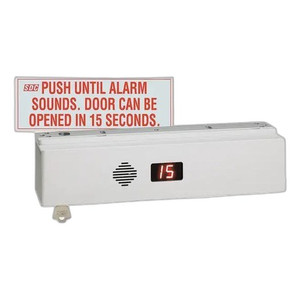
SDC 1511SNAKV Delayed Egress EM Lock
The SDC 1511SNAKV is a 24VDC delayed egress electromagnetic lock engineered for mid-to-large enterprise access control deployments. It integrates directly with OSDP and TCP/IP-based security platforms, supporting credential flexibility across DESFire, MIFARE, NFC (13.56 MHz), and 125 kHz proximity readers. The system architecture scales to 250,000 user accounts and 63 doors in a single installation, making it practical for multi-tenant facilities, institutional campuses, and complex commercial environments where centralized credential management matters.
Key Features
- 24VDC electromagnetic lock mechanism: Requires a dedicated auxiliary power supply (standard in most access control installations). The 24V standard is industry-conventional, reducing integration complexity and ensuring compatibility with legacy and modern control panels alike.
- OSDP and TCP/IP protocol support: Enables direct communication with access control systems without proprietary gateways. OSDP (Open Supervised Device Protocol) is increasingly required by federal procurement and reduces single-vendor lock-in, while TCP/IP integration works with IP-centric security architectures.
- Multi-credential technology: Accepts DESFire, MIFARE, NFC (13.56 MHz), and 125 kHz proximity credentials in the same reader ecosystem. This matters if you're consolidating card formats across multiple buildings or migrating from legacy proximity to modern encrypted credentials without wholesale hardware replacement.
- Up to 250,000 user accounts per system: Eliminates the need for distributed controllers in large facilities. A single platform manages access for entire enterprise or multi-site operations, simplifying audit trails and reducing administrative overhead.
- Supports 63 doors per system: Practical for warehouse, distribution, and office environments where perimeter and zone-based access strategies require coordinated lock management.
- Glass door, aluminum frame, and metal frame compatibility: Mounts on standard commercial door hardware. Verify mounting surface dimensions against your specific installation before ordering — electromagnetic locks require solid mechanical purchase points.
Integration & Compatibility
The 1511SNAKV integrates with leading integrator platforms that support OSDP and TCP/IP credential readers. Verify your access control system's reader compatibility before deployment — not all platforms support all four credential technologies simultaneously. If you're replacing an older magnetic lock, confirm that your power supply can deliver sufficient 24VDC current; undersized supplies are a common installation failure.
Installation requires standard auxiliary power wiring and network connectivity (TCP/IP deployments). Delayed egress functionality requires proper system configuration within your access control software — the lock itself is hardware-ready, but egress timing and emergency override logic must be enabled in the platform.
Frequently Asked Questions
Q: Does the SDC 1511SNAKV work with Milestone or other major VMSs?
A: The 1511SNAKV is a lock, not a camera, so VMS compatibility is not directly applicable. It integrates with access control platforms (not video systems) that support OSDP or TCP/IP readers. If your access control system feeds event data to your VMS via middleware, that depends on your platform's access control plugin, not the lock itself.
Q: What happens if power is lost to the 1511SNAKV?
A: The lock will de-energize and unlock. For fail-secure behavior (locked on power loss), specify a fail-secure electromagnetic lock variant. Confirm your safety and emergency egress requirements before selecting lock type — this is a critical decision point.
Q: Can I use the 1511SNAKV on a glass door?
A: Yes. The lock accommodates glass doors via standard surface-mount hardware. Ensure the glass frame and mounting surface are rated for the holding force of the lock — structural integrity is your responsibility during installation design.
Q: How many credentials can a single reader support with the 1511SNAKV?
A: The system supports up to 250,000 user accounts across all 63 doors. Reader-level credential limits depend on your specific reader model, not the lock.
Q: Is the 1511SNAKV NDAA Section 889 compliant?
A: Not stated in manufacturer evidence. Contact the manufacturer or your integrator for compliance documentation if federal procurement requirements apply.
Q: What's the warranty on the 1511SNAKV?
A: Not specified in available documentation. Request warranty terms directly from the manufacturer or authorized integrator.
Ted PerryPerspective based on aggregated IP Security Depot and affiliated engineering team experience.
The SDC 1511SNAKV addresses a genuine pain point in enterprise access control: scaling credential formats without ripping out door hardware. Too many teams inherit a mix of 125 kHz proximity cards and newer encrypted credentials, then face the choice of dual readers or expensive hardware replacement. The 1511SNAKV's multi-credential support across DESFire, MIFARE, NFC, and proximity means you can standardize on one lock type while readers handle format diversity — that's real architectural flexibility.
Technical Highlights:
- 250,000 user account capacity: Eliminates distributed controller sprawl. A single platform manages access across 63 doors, which is sufficient for most mid-market and large enterprise facilities. Centralized credential management cuts audit and revocation overhead significantly compared to networked lock clusters.
- OSDP protocol support: Open Supervised Device Protocol is increasingly mandated by federal and institutional procurement. If you're bidding government contracts or working within enterprises with OSDP requirements, this is non-negotiable compliance — proprietary protocols will disqualify your solution.
- 24VDC standard power: No exotic voltage requirements. Any integrator can source 24VDC auxiliary supplies from stock inventory. This reduces lead time and keeps spare parts in standard warehouses, lowering total cost of ownership.
Deployment Considerations:
- Delayed egress requires platform configuration: The lock is hardware-ready, but the actual delay logic, exit button override, and emergency unlock behavior must be configured in your access control software. This isn't a plug-and-play install — budget time for control panel programming and functional testing.
- Power supply sizing is critical: Electromagnetic locks draw steady-state current. Undersized auxiliary supplies are the leading cause of installation failure. Confirm your power supply's current rating before deployment; a 1A supply will choke a lock requiring 2+ amps.
- Mounting surface integrity matters: Whether installing on glass, aluminum, or steel, the mounting structure must absorb the lock's holding force. Cheap frames or improperly reinforced mounting will cause the lock to fail under load. This is your integrator's responsibility to verify during design.
The 1511SNAKV is the right choice for enterprises consolidating mixed credential formats and require centralized, OSDP-compliant access control across institutional or multi-tenant facilities. It's not a fit if you need fail-secure behavior (locked on power loss) — you'd need a different electromagnetic lock variant for that. If you're building a small single-door installation, over-engineering with a 63-door system is wasteful; consider a simpler lock with a local controller. For warehouse or distribution environments with high personnel churn and frequent credential revocations, the 250,000 user capacity and OSDP audit trail will save significant operational friction.