SDC 1581SNDV Delayed Egress Electric Strike
Overview
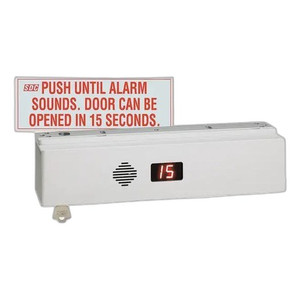
The SDC 1581SNDV is a 24VDC electric strike purpose-built for delayed egress applications where controlled egress time is a code or security requirement. This wired unit delivers a 15-second hold time, integrating into networked access control systems that support OSDP and TCP/IP protocols. The 1581SNDV accepts multiple credential formats — DESFire, MIFARE, NFC/13.56MHz, and 125kHz Proximity — making it compatible with existing badge or mobile credential deployments without requiring new reader infrastructure. A single system can manage up to 63 doors with 250,000 user capacity, useful for larger facilities where per-door manual configuration isn't practical.
Key Features
- 24VDC Operating Voltage: Standard DC power simplifies wiring in most commercial installations. Verify your power supply can deliver sufficient current for all strikes on the circuit — this avoids voltage sag that could weaken lock engagement.
- 15-Second Hold Time: Meets delayed egress requirements for emergency exits in healthcare, corporate, and high-security facilities. The hold interval gives occupants time to find an alternative route or receive instruction before the door unlocks, reducing panic.
- OSDP Protocol Support: OSDP (Open Supervised Device Protocol) provides encrypted, bidirectional communication between the access control panel and reader devices. This eliminates the vulnerability of Wiegand protocol and allows real-time supervision — you can confirm a reader is online and responsive before granting access.
- TCP/IP Integration: Networked systems allow centralized credential and configuration management across your facility. Changes to user permissions or holiday schedules propagate instantly rather than requiring manual updates at each door.
- Multi-Credential Support (DESFire, MIFARE, NFC, 125kHz Prox): The ability to accept multiple card and mobile credential technologies means you're not locked into a single vendor ecosystem. This matters if you phase in mobile credentials without immediately retiring legacy proximity badges.
- 63-Door Capacity; 250,000 Users Per System: Scaling across dozens of doors under one system reduces administrative overhead. With 250,000 user slots, you have room for employee turnover, contractor access, and integration with visitor management systems without needing secondary hardware.
Integration & Compatibility
The 1581SNDV works with any access control platform that publishes OSDP or TCP/IP reader integration APIs. Before ordering, confirm your control panel vendor has tested or published integration notes for this strike model — some manufacturers require firmware updates or custom configuration to properly supervise strike status or activate delayed egress timing.
For delayed egress specifically, your panel must support timed lock release or egress delay logic. This is standard in enterprise and healthcare systems but uncommon in basic small-business panels. Verify your system can configure the hold time and, ideally, supports local override (manual unlock button or wireless fob) if building code requires it.
Installation requires a 24VDC power supply rated for the total draw of all strikes on the circuit. Oversizing the supply by 20–30% prevents voltage sag under load. Wiring runs between the control panel, power supply, and strike should use appropriate gauge cable — typically 18/2 or 16/2 depending on distance and total current.
Frequently Asked Questions
Q: Does the SDC 1581SNDV work with wireless or cloud-based access control systems?
A: The 1581SNDV is wired and requires OSDP or TCP/IP connectivity to a local or networked control panel. If your system is purely cloud-based with no local infrastructure, the strike cannot operate. Hybrid systems that include an on-premises panel or edge controller can integrate the 1581SNDV.
Q: What happens if power is lost to the strike?
A: A de-energized electric strike defaults to fail-safe (unlocked). This is a deliberate safety feature for life-safety egress. In a power loss, occupants can exit the door freely. Your facility backup power (UPS) should cover the 24VDC supply to maintain security during brief outages.
Q: Can I retrofit the 1581SNDV into an existing access control system without reprogramming?
A: The strike itself requires integration at the panel level — the panel must send a circuit control signal to energize or de-energize it. If your panel doesn't already have a spare auxiliary output, or if the panel firmware doesn't support timed egress logic, you may need a firmware update or a supplemental egress delay controller. Test compatibility with your system vendor before purchase.
Q: Is the 628 finish corrosion-resistant?
A: 628 is a satin finish with no explicit corrosion protection stated in standard documentation. For high-humidity, coastal, or outdoor-adjacent installations, ask your supplier about nickel-plated or stainless-steel variants to avoid rust on the strike face.
Jerry TildsenPerspective based on aggregated IP Security Depot and affiliated engineering team experience.
The SDC 1581SNDV is a straightforward choice for multi-door delayed egress deployments, but it's not a plug-and-play retrofit. The 24VDC requirement and hard-wired OSDP/TCP/IP dependency mean integration planning is as important as the strike itself. I've seen installs delayed because the control panel didn't have the egress timing logic built in, or because someone underestimated the power supply load across a dozen strikes.
Technical Highlights:
- 15-Second Hold Time: Fixed timing meets most building codes for delayed egress (NFPA 101 / IBC). If you need variable delay or conditional override (e.g., longer hold during off-hours), confirm your panel supports programmable egress delay rather than assuming the strike enforces the timing.
- OSDP Protocol: Eliminates Wiegand vulnerabilities and gives you real-time supervision of reader status. That encrypted, bidirectional handshake is worth the extra cost versus older proximity-only strikes — you can't spoof it with a captured credential replay.
- 63 Doors / 250,000 Users: The per-system capacity matters if you're consolidating multiple smaller systems. That said, 63 doors is a ceiling, not a typical deployment — actual performance depends on your panel's backend and network bandwidth. Test before betting your entire facility on one control instance.
Deployment Considerations:
- Power budget is real. Calculate the total in-rush current for all strikes when a panic alarm triggers simultaneous egress. A standard 24VDC supply may not handle the surge. Oversizing and soft-start or staggered release logic is not optional.
- Fail-safe default (unlock on power loss) is a safety feature, not a limitation. But it means you cannot use the strike as a held-egress barrier during a sustained power event — occupants will exit whether you want them to or not. Plan your UPS strategy accordingly.
- The 1581SNDV itself doesn't verify door position or strike engagement — it only energizes the solenoid. You still need door position switches if you want to log whether the door actually opened after the strike released. That's a common oversight in speccing delayed egress systems.
Best fit: healthcare campuses, corporate office towers, and multi-tenant buildings where centralized access control, credential diversity, and code-compliant egress timing justify the integration complexity. Avoid if your existing panel lacks OSDP/TCP/IP reader outputs or egress delay programming — the cost of a panel firmware update or supplemental controller will exceed the strike itself.