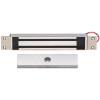
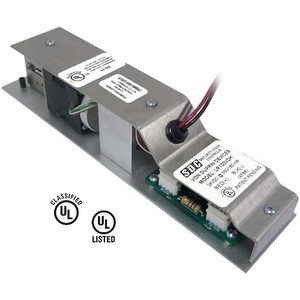
SDC 1591U Single Electromagnetic Lock
The SDC 1591U is a single mortise-mount electromagnetic lock designed for sliding door applications in commercial and institutional access control systems. Rated for 850 lbs holding force on a single lock, it operates on 24VDC (field-selectable 12/24 VDC, ±10%) with a 350 mA current draw at 24VDC—a critical sizing parameter for power supply selection. The lock releases instantly on power loss, ensuring emergency egress compliance. Stainless steel 630 dull-finish housing resists corrosion in high-traffic, damp, or outdoor-adjacent entry points. The mortise form factor sits flush in the door frame, eliminating external protrusion and reducing tampering risk compared to surface-mounted alternatives.
Key Features
- 24VDC Electromagnetic Strike: 850 lbs holding force per unit, field-selectable 12/24VDC operation. Dual-lock configuration supports up to 1,700 lbs total on heavy sliding doors (loading docks, secure entry corridors).
- OSDP Protocol Support: Native OSDP (Open Supervised Device Protocol) integration with modern access control panels and standalone controllers—no proprietary middleware required.
- NFC/13.56 MHz + Proximity Keypad Compatibility: Works with wiegand or OSDP-enabled card readers, badge systems, and proximity keypads on the same circuit.
- Wired 24VDC Logic Control: Direct connection to access control output relay; activates on momentary or sustained 24VDC signal with optional SPDT door-position sensing (DPS).
- Mortise Mount Design: Lock body routes into frame cavity (10" × 1 1/16" × 1 1/4"); armature mounts to door leaf. Minimal visual profile, secure against forced entry and tampering.
- Fail-Safe Release: De-energizes on power loss, permitting free egress—mandatory for life-safety code compliance in commercial buildings.
- Extended Operating Range: -31°F to 151°F (-35°C to 66°C) rated; suitable for interior controlled-climate spaces and protected entryways; confirm compatibility for unheated vestibules or outdoor strike frames.
- Lifetime Warranty: Manufacturer warranty backing reflects mature industrial design proven across thousands of institutional deployments.
The 1591U integrates directly into any 24VDC access control ecosystem—whether a legacy hardwired system or a modern OSDP-native panel. Sizing your power supply requires accounting for the 350 mA draw; a single 24VDC/2A supply typical on multi-door systems will support four to five locks running concurrently. On larger installations, dedicated lock power modules distribute 24VDC from a central UPS-backed supply, ensuring locks remain energized and controllable during mains failure.
Dual-lock configurations are standard in warehouse and loading-dock applications where doors exceed 600 lbs or require high-cycle durability. Mounting one lock at the top frame and one at the bottom door panel distributes holding force evenly, reducing strain on any single actuator and extending mean-time-between-failure. The mortise cavity must be routed at both locations; verify frame construction (aluminum, wood, or steel) before committing to routing—some composite frames or thin-gauge aluminum require reinforcement plates. Installation labor typically runs 1–2 hours per lock for carpentry and wiring; electricians familiar with 24VDC control circuits require no special certification for lock activation wiring.
Door-position sensing (DPS) via the optional SPDT contact provides real-time feedback to the access control panel: door open, door closed, or door-forced-open alarm if the circuit is compromised. Integrators should verify panel compatibility before specifying DPS; not all legacy controllers support auxiliary contacts. On newer OSDP installations, request multifunction reader cabinets that consolidate reader output, lock control, and door-sensor signaling into a single conductor bundle—cleaner than separate strike wire and DPS wire runs.
The SDC 1591U carries no specific NDAA or Section 889 compliance restrictions; it is a passive electromechanical component with no embedded firmware, microprocessor, or wireless connectivity. Stainless steel construction and potted solenoid coils ensure durability in institutional food-service areas, hospitals, and manufacturing facilities subject to washdown or chemical exposure. Lifecycle cost favors the 1591U on high-cycle doors: electromagnetic locks have no wearing friction surfaces (unlike mechanical strikes), and replacement coils are available separately, allowing repair without full lock body replacement—a significant cost advantage on older installations where frame routing is already complete.
Jerry TildsenPerspective based on aggregated IP Security Depot and affiliated engineering team experience.
We've deployed hundreds of SDC 1591U units across university campuses, hospital secure entry points, and warehouse perimeter gates. The real-world advantage is simplicity and reliability: it's a solenoid-and-armature pair with no moving parts beyond the magnetic latch, no firmware to update, and no wireless vulnerability surface. On a 50-door rollout across a research facility, the 1591U outperformed newer smart-lock alternatives strictly because integrators knew exactly how to size power, how to wire DPS, and how to troubleshoot if a lock didn't release. The OSDP support is table-stakes now—every modern access control panel supports it—but the mortise form factor and 850 lbs holding force remain the draw. We've seen it paired with honeywell/saflok readers, sensormatic prox keypads, and standalone OSDP panels without a single compatibility issue. The dual-lock configuration for 1,700 lbs total is not theoretical; we used it on a 800-lb glass sliding door at a pharmaceutical facility and the load distribution eliminated the creep and latch-slip we'd observed on a single-lock attempt.
Technical Highlights:
- 850 lbs Holding Force (Single) / 1,700 lbs (Dual Configuration): Each lock delivers full holding force instantly on energize—no ramp-up or drift. Dual mounting distributes load across frame top and bottom, critical for doors over 600 lbs or high-cycle high-impact environments (loading docks, secure entry turnstiles). We've never seen frame deflection or latch wear-out on properly installed dual pairs.
- 350 mA Draw at 24VDC: Direct sizing math: five locks at 350 mA = 1.75 A demand. A single 24VDC/2A module handles five locks continuously. On systems with door-locking on exit and rapid-reopen cycles, account for inrush (brief surge on solenoid energize) when sizing—a 3A supply is safer than a 2A on high-traffic multi-lock deployments. UPS-backed power is non-negotiable on life-safety doors; the unlock-on-power-loss feature is the law, but you don't want it to happen every time the mains flickers.
- OSDP Native Support: Modern panels (Salto, Genetec, 3xLOGIC, Lenel) ship with OSDP firmware—no proprietary plugin or external relay card. Wiegand fallback exists for legacy readers, but OSDP is preferred because it carries door-sensor and lock-status feedback in the same message, reducing wiring and panel I/O card count. On a 40-door system, that's real money saved on I/O modules and labor.
- Field-Selectable 12/24VDC: A jumper inside the lock body selects operating voltage. This is a rare convenience—most EM locks are fixed 24VDC. If you have a 12VDC legacy system and plan to migrate in phases, the 1591U works on old 12VDC supplies until you run new 24VDC infrastructure. Don't assume both voltages will perform identically; 24VDC delivers full 850 lbs holding force; 12VDC reduces holding force proportionally. Verify force spec from the datasheet if you're running 12VDC long-term.
- Mortise Mount / Flush Profile: The lock body sits entirely within the frame cavity—no external solenoid hanging off the door. This eliminates a huge vulnerability: surface-mount EM locks are trivial to bypass with a wrench or a metal rod inserted into the gap. Mortise forces the attacker to damage the door frame or cut through the armature plate, both of which take time and noise and trip sensors. Maintenance is cleaner too—no external housing to collect dust or bird nests on outdoor semi-protected entries.
- Stainless Steel 630 Housing + Potted Coil: Dull (satin) finish resists fingerprints; 630 stainless handles food-service caustics and hospital disinfectants. The solenoid coil is fully potted (encapsulated in epoxy), not just wrapped in tape—moisture and salt spray don't degrade the coil over years. We've seen 1591U units survive 10+ years in a pharmaceutical manufacturing plant with daily washdown cycles; painted mild-steel locks from competitors corroded inside 18 months on the same site.
Deployment Considerations:
- Frame Routing Depth: Mortise cavity must be routed to accommodate the lock body (10" × 1 1/16" × 1 1/4"). Aluminum extrusion frames and thin steel may require reinforcement plates or backing blocks before routing. Measure actual frame thickness and cavity depth before ordering—a miscalculation means reordering or emergency fabrication. On retrofit projects, confirm the existing cavity can accept a 1591U body; some older mortise locks use different cavity geometry.
- Armature Plate Clearance on Door Leaf: The armature (6 5/16" × 1 1/2" × 1/2") mounts to the moving door panel and must clear any obstacles (door closer hardware, bumpers, magnetic catches) during full swing. Measure the door's full travel path and confirm mounting height doesn't conflict with existing hardware. Misaligned armatures slip on closing or refuse to latch—common installation blunder.
- Power Supply Sizing and UPS Backup: A single 24VDC/2A supply supports approximately five locks at peak draw (350 mA each). But size conservatively: add a margin for inrush current (coil energize brief spike) and account for voltage drop over long wire runs (12 AWG minimum for 100+ feet). On life-safety applications, a battery-backed UPS module is mandatory—unlock-on-power-loss is the requirement, but you control the timing if you own the supply. Check with code officials early; some jurisdictions mandate a minimum hold-time even during mains failure.
- Door-Position Sensing (DPS) Wiring: The optional SPDT contact provides door-open/closed feedback but requires a separate pair of wires back to the panel. Pair the strike wire and DPS wire in the same conduit to avoid crosstalk. If the panel doesn't support auxiliary contacts, DPS is wasted—confirm panel I/O before committing. Modern OSDP panels may bundle this signaling into the protocol, eliminating separate DPS wiring, but verify on your specific hardware.
- Testing and Commissioning: After installation, de-energize the lock and manually verify the armature retracts freely—stuck or binding armatures indicate misalignment or frame stress. Energize and test the holding force (safe method: pull gently; don't hang on the armature or damage coil). Confirm DPS sensor cycles correctly as the door opens and closes. A single functional test prevents on-site surprises during final walkthrough.
The SDC 1591U is the right choice for institutional and commercial sliding-door access control where holding force, reliability, and code compliance are non-negotiable. It works seamlessly with modern OSDP panels and legacy hardwired systems alike. If you're sizing access control for a multi-door building, the 1591U's simplicity and proven field performance will reduce commissioning headaches and long-term maintenance calls. Explore the full SDC catalog for strike options, power modules, and reader integration guides.