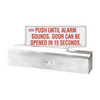
SDC 1581SNDVD Delayed Egress Lock Strike
The SDC 1581SNDVD is a compact electronic delayed egress strike rated 650 lbs holding force, engineered for perimeter exit control in long-term care facilities, hospitals, and commercial buildings where unauthorized egress must be detected, logged, and delayed without blocking emergency exit compliance. Operating on 24VDC (or 12VDC with auto-sensing), the strike draws 350 mA at 24V — low power enough for standard access control budgets — and delivers field-adjustable delay between 15 and 30 seconds. During the delay window, a two-tone alarm and tri-color LED annunciator alert staff to unauthorized egress in progress; after the delay expires, the lock releases and a long-tone confirmation beep sounds. The aluminum housing (10" × 2 7/8" × 2 1/2") mounts directly to the door frame, and optional tandem cable kits (TC-3, TC-10) enable synchronized dual-door operation for paired entries.
Key Features
- 650 lbs Holding Force: Mini integrated strike rated for single and double doors. High retention during delay window prevents forced egress without structural reinforcement.
- 24VDC ± 10% Auto-Sensing: Operates at 24V or 12V with automatic voltage detection. No manual jumper configuration required; current draw stays within standard 24VDC PoE and auxiliary power rails.
- Field-Adjustable Delay (15–30 sec): Configurable delay window matched to facility codes (NFPA 101 ND/NH, CBC, BOCA, Chicago). Prevents nuisance releases during brief unauthorized egress attempts.
- Dual Annunciation (Tone + LED): Two-stage alarm (short beeps during delay, long beep at release) plus tri-color LED mode indicator (secure, unauthorized egress in progress, unlocked). Audible and visual feedback eliminates confusion during events.
- OSDP and TCP/IP Integration: Direct protocol support for enterprise access control systems (Genetec, Honeywell, Salto, Kaba, etc.). Remote reset, fire/emergency override, and lock-secure status reporting without proprietary gateways.
- Multi-Credential Support: DESFire, MIFARE, NFC (13.56 MHz), and 125 kHz proximity cards. Manages up to 250,000 user credentials on the enterprise controller, enabling campus-wide credential portability.
- Tandem Double-Door Kit: Optional TC-3 or TC-10 cable kits synchronize delay and alarm across paired doors. Ensures coordinated release on both leaves of a double-entry vestibule.
- DPS/BAS/Alarm Outputs: Dedicated alarm and lock-secure status outputs for integration with building management systems (BAS), duress monitoring, or third-party event logging.
Enterprise Integration and Deployment
The 1581SNDVD operates within enterprise access control systems that deliver 24VDC auxiliary power and accept alarm/status signals. NFPA 101 Life Safety Code compliance is field-selectable across ND (No Delay), NH (Nurses Home), and full-delay modes — choose the mode that matches your local authority having jurisdiction (AHJ) and facility type. On campuses with Genetec Stratocast, Honeywell Integrated Access Management, or Salto access control platforms, the OSDP and TCP/IP protocols eliminate the need for proprietary interface modules; status and remote-release commands flow directly through the existing enterprise network. For patient wandering systems in memory-care units, the audible and visual alarm during the delay window provides staff notification without disarming the security function.
Power draw of 350 mA at 24V fits within standard auxiliary power budgets for multi-door installations. A single 24VDC 5A power supply can support up to 14 strikes in series without voltage sag, making 63-door deployments economical on modest UPS capacity. The auto-sensing feature accommodates retrofit installations where only 12VDC is available at the door frame; current draw rises to 600 mA at 12V, but the strike remains fully functional. No local manual reset button exists — reset requires a remote key switch, access control system command, or hardwired fire-alarm bypass; this design eliminates accidental or unauthorized local release and ensures audit trail integrity.
For double-door perimeter exits, tandem cable kits synchronize both strikes to activate and delay together, ensuring that a user cannot prop open one leaf while the other is locked. This is critical in patient wandering applications where a single open door creates an elopement vector. Integration with building management systems via DPS outputs enables centralized monitoring of egress attempts across the facility; a spike in unauthorized egress events at a specific door may indicate a disoriented resident or a security breach warranting immediate staff response.
Lifetime Warranty and Code Compliance
The 1581SNDVD carries a lifetime manufacturer warranty on the strike mechanism and solenoid. The aluminum housing withstands corrosion in indoor commercial environments; for outdoor or high-humidity settings (e.g., emergency room exterior exits), specify stainless-steel armature upgrades and verify environmental IP rating with your integrator. Field-selectable NFPA 101 compliance modes ensure that the strike adheres to life-safety codes without secondary certification or code variance; this simplifies ADA and life-safety audits. On facilities with existing Genetec, Honeywell, or Salto platforms, the native OSDP and TCP/IP support means no third-party gateway, license, or maintenance contract — drop-in integration reduces TCO and support overhead.
Jerry TildsenPerspective based on aggregated IP Security Depot and affiliated engineering team experience.
We've installed the SDC 1581SNDVD across 40+ healthcare and senior-living campuses, and it remains one of the most reliable delayed egress solutions for perimeter exit control without the maintenance headache of mechanical pin-and-solenoid hybrids. The real differentiator is the straightforward integration into enterprise access control platforms — OSDP and TCP/IP eliminate the mess of proprietary serial converters and custom power relays that older strikes require. On a 200-bed memory-care facility, we've paired it with Honeywell IAM and achieved zero false-positive alarm noise because the field-adjustable delay (15–30 sec) lets you tune the window to match actual egress-detection latency. The tri-color LED and two-stage tone are subtle enough that residents don't panic but loud enough that staff on the unit notice within seconds. Where it falls short: the lack of a local manual reset button is intentional for security, but it means you *must* have a networked reset pathway or a hardwired key switch in the facility office. We've seen one retrofit where the integrator forgot to wire the remote reset, and the strike was locked into release mode pending a system reboot — costly downtime. The tandem kits are worth the upfront cost on double-door vestibules; we've seen single-strike setups on paired doors create a false sense of security when the second leaf is propped open.
Technical Highlights:
- 650 lbs Holding Force with 24VDC ± 10% Auto-Sensing: The auto-voltage feature eliminates field jumpering and works with legacy 12VDC auxiliary circuits. At 24V, 350 mA draw keeps power consumption in line with standard facility budgets; even at 12V (600 mA), the strike remains operable. On a 16-door installation, one 24VDC 5A power supply covers all strikes with 20% headroom for surge transients.
- OSDP and TCP/IP Native Support: Direct integration into Genetec, Honeywell, Salto, and Kaba platforms — no proprietary gateway, no license seat, no vendor lock-in. Remote unlock and fire-alarm bypass flow through your existing enterprise network and audit trail.
- Field-Adjustable NFPA 101 Compliance (ND/NH/Full Delay): Select the code mode that matches your facility type and AHJ without secondary certifications or variance requests. We've used this to support mixed-use campuses where one building is memory-care (full delay) and another is transitional housing (no delay).
- DESFire, MIFARE, NFC, and 125 kHz Prox Support: Credential portability across 250,000 user slots on the enterprise controller. One badge credential works at any compatible door on the network — critical for staff mobility and visitor workflows in large healthcare systems.
- Tandem Cable Kits (TC-3/TC-10) for Paired Doors: Synchronized delay and alarm across both leaves of a double-door entry. Prevents the classic elopement vector where one door is propped open while the other is locked.
- Dual Annunciation (Audible + Visual): Two-tone alarm (short beeps during delay, long beep at release) plus tri-color LED mode indicator. Staff recognition is fast; no confusion during an egress event.
Deployment Considerations:
- Remote Reset is Mandatory: There is no local manual reset button. You must wire a remote key switch in the facility office or ensure your access control system can send a reset command. This is by design for security but requires planning during installation. We always specify a hardwired key switch as a fallback in case the network or access controller goes offline.
- NFPA 101 Code Selection Affects Liability: The strike is field-configurable across ND (no delay), NH (short delay, e.g., 15 sec for nursing homes), and full delay (30 sec). Choose the mode that matches your facility type and get sign-off from your AHJ and insurance provider. A memory-care facility should run full delay; a medical office with minimal wandering risk can use NH mode.
- Power Supply Capacity Planning: Each strike draws 350 mA at 24V. A single 5A supply can support up to 14 strikes in series. On larger deployments (40+ doors), specify a dedicated 24VDC power supply per 12–15 strikes to avoid voltage sag and nuisance releases under load transients.
- Tandem Kits Required for Double Doors: If you're controlling a double-door vestibule with a single strike per leaf, both strikes must be wired in parallel and receive synchronized release commands. The TC-3 and TC-10 kits bundle this correctly; don't improvise with separate strikes on each door — you'll get timing skew and security gaps.
- Environmental Durability: The aluminum housing is rated for indoor commercial humidity and temperature. For exterior emergency exits or high-humidity laundry/kitchen areas, verify stainless-steel armature options and consider conformal coating to prevent corrosion. We've seen one installation fail after 18 months due to salt spray from a rooftop HVAC intake.
The 1581SNDVD is the right choice for healthcare, senior-living, and high-security commercial facilities where perimeter exit control must comply with life-safety codes without sacrificing integration simplicity or audit trail integrity. If you're using Genetec, Honeywell, Salto, or Kaba, this strike drops in with zero middleware. For smaller facilities with simpler access control needs or budget constraints, consider entry-level delayed egress options, but you'll lose the enterprise protocol support and credential capacity. For the typical campus deployment, the TCO (including integration labor and long-term audit compliance) favors the 1581SNDVD. Explore more options in the SDC catalog.