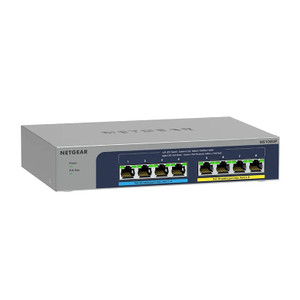
NETGEAR RN31661E-100NAS ReadyNAS 316 6-Bay Network Storage
The NETGEAR RN31661E-100NAS is a 6-bay network-attached storage appliance designed for surveillance recording, data backup, and multi-site file consolidation in small-to-medium deployments. It arrives with 6×1TB SATA drives pre-installed for 6TB raw capacity and two empty bays for future expansion, eliminating procurement and configuration overhead. A single Gigabit Ethernet port connects to your network infrastructure; RAID 1, 5, and 6 options allow you to prioritize either capacity or fault tolerance depending on your uptime requirements and budget.
Key Features
- 6TB Pre-Installed Capacity: 6×1TB SATA drives shipped and configured. No bare-drive installation; unbox, rack, and connect — production-ready in under 30 minutes.
- RAID 0/1/5/6 Support: RAID 5 provides single-drive fault tolerance with 4TB usable (2 parity); RAID 6 offers dual-drive redundancy at 3TB usable for mission-critical deployments. Trade capacity for uptime as site requirements evolve.
- Gigabit Ethernet (1× RJ45): Standard 125 MB/s throughput — sufficient for 4–8 concurrent camera streams or general-purpose NFS/SMB file serving. No 10GbE complexity for small-to-medium sites.
- 2U Rack or Shelf Mount: Compact form factor fits standard 19" racks or sits on shelves in comms closets. Minimal footprint for distributed storage nodes at remote sites.
- Low Power Envelope: 40–50W typical draw (120V AC) — operates efficiently in always-on surveillance workflows without significant facility cooling overhead.
- Two Empty Bays: Upgrade from 6TB to 8TB or 10TB by installing standard 3.5" SATA drives without replacing existing disks. Non-disruptive capacity scaling.
- ONVIF & Standard Protocols: NFS, SMB/CIFS, and iSCSI support — works with any NVR, VMS, or backup application (Milestone, Genetec, Hikvision, Exacq, etc.) without vendor lock-in.
- Web Management Interface: Built-in HTTP/HTTPS admin portal for RAID monitoring, disk status, user quotas, and scheduled backups — no separate management software.
The RN31661E-100NAS is a stateless storage tier in surveillance and backup architectures where cameras or NVRs push video to the appliance via standard network protocols. Unlike dedicated video recorders, it has no built-in analytics, streaming, or VMS features — it is purely a data container. This simplicity translates to lower capex, easier troubleshooting, and seamless interoperability across heterogeneous camera and recorder vendors.
Typical deployments pair this appliance with IP cameras recording to on-site NVRs that offload 24-hour archives to the NAS over Gigabit Ethernet. A retail chain might place one unit in each store, centralizing footage retention for forensic analysis without burdening the NVR's internal drives. Alternatively, a multi-site corporate office uses the ReadyNAS as a backup target for critical NVR snapshots and metadata, synchronized every four hours via rsync or SMB replication. The two empty bays allow in-place capacity expansion as retention periods lengthen — add two 4TB or 5TB drives to double usable capacity without re-racking hardware.
RAID selection directly impacts budget and fault tolerance. RAID 5 (single-parity) is standard for surveillance — a single drive failure does not interrupt service, and you retain 4TB usable from 6TB raw. For deployments where drive replacement within 24 hours is impractical (remote sites, high-security facilities), RAID 6 (dual-parity) costs 2TB of usable capacity but tolerates simultaneous failure of any two drives. RAID 1 mirroring (3TB usable, 100% redundancy) suits critical backup workflows where an extra copy of every block is required; RAID 0 (6TB usable, no redundancy) should be avoided in production — it offers no fault tolerance and a single drive failure destroys the entire volume.
Power and networking are minimal friction points. Standard 120V AC power consumption of 40–50W means you can run it 24/7 without dedicated UPS infrastructure on most commercial circuits; however, uninterruptible power supply protection is strongly recommended for any surveillance deployment (even a small 1500VA unit ensures graceful shutdown during a mains failure). The single Gigabit Ethernet port saturates at 125 MB/s; sustained write load from 4–6 concurrent H.264 camera streams typically requires 8–20 MB/s, leaving sufficient headroom. If you exceed 10 concurrent streams or require 10GbE iSCSI offload, this appliance is undersized — step up to Synology RackStation or QNAP TS-432PX for multi-Gigabit or 10GbE architectures.
The NETGEAR ReadyNAS ecosystem includes cloud sync and snapshot features (ReadyCloud) for disaster recovery, though these are optional. The appliance itself has no built-in encryption at rest — sensitive footage should be stored on encrypted volumes or in FIPS-certified data centers if regulatory compliance requires it. Operating temperature range of 0–40°C mandates placement in climate-controlled environments; outdoor pole-mounted or unheated warehouse locations will void warranty and risk drive failure in extreme heat or cold.
Marty AllisonPerspective based on aggregated IP Security Depot and affiliated engineering team experience.
In our experience, the ReadyNAS 316 fills a specific and practical niche: small-to-medium surveillance deployments where you need centralized archival storage separate from the on-site NVR, but you don't want to manage a full SAN or hire a storage specialist. We've deployed these units in 15–50 camera environments — retail chains, warehouse clusters, corporate multi-site networks — where the NVR records to internal disk for hot forensic access, and the ReadyNAS captures a 30–90 day rolling archive via SMB or NFS replication. The real value is operational: you buy it, it ships pre-configured with drives already installed, you bolt it into the rack, and it works with any camera vendor without licensing or integration headaches. RAID 5 is the sensible default for these deployments — a single drive failure doesn't interrupt service, and the cost-per-TB is lower than RAID 6.
That said, the Gigabit Ethernet bottleneck is worth understanding upfront. On paper, 125 MB/s sounds adequate, but if you're streaming 8 concurrent 5MP H.265 cameras at 20 Mbps each (2.5 MB/s aggregate), plus NFS replication traffic from the NVR, you're pushing 80–90% of link saturation. Latency spikes become visible during peak recording hours, and you risk dropped frames or temporary buffering if network congestion occurs. We've seen customers underestimate this and then call back asking why camera streams occasionally stall during backup windows. The fix is to schedule replication off-peak or upgrade to a 10GbE-capable NAS, but that's a retrofit conversation. Know your bandwidth budget before you commit.
Technical Highlights:
- RAID 5 vs. RAID 6 Trade-off: RAID 5 yields 4TB usable from 6TB raw, recovering from any single drive failure within a rebuild window (typically 4–8 hours on 1TB drives). RAID 6 uses two parity blocks, dropping usable capacity to 3TB but tolerating simultaneous failure of any two drives. For surveillance archives where you can replace a failed drive within 24 hours, RAID 5 is economical; for remote or unmanned sites, RAID 6 justifies the 1TB penalty.
- Pre-Installed 6×1TB Configuration: Ships ready to use — no bare-drive procurement, no manual installation labor. Two empty bays let you expand to 8TB or 10TB by adding matching drives without disrupting the existing RAID volume (hot-spare expansion).
- Gigabit Ethernet Throughput: Maxes at 125 MB/s (theoretical). Suitable for 4–6 concurrent H.264 archive streams at 5–10 Mbps each; H.265 deployments can handle 8+ streams on the same bandwidth. Sustained multi-gigabit workloads require 10GbE hardware (outside this appliance's spec).
- 40–50W Power Draw: Low enough for continuous 24/7 operation on standard circuit power. UPS protection still recommended to gracefully shut down during mains failure and protect data integrity during RAID rebuild cycles.
- Standard NFS/SMB/iSCSI Protocols: No proprietary interfaces — any NVR, VMS, or backup software that speaks NFS or SMB can target this appliance. Vendor interoperability is guaranteed; migration out of the ReadyNAS ecosystem carries minimal risk.
Deployment Considerations:
- Schedule Replication Off-Peak: The single Gigabit link can become saturated during simultaneous live recording and NAS replication. Configure your NVR backup jobs to run during low-traffic windows (2 AM–6 AM) to avoid frame-dropping on live camera streams.
- RAID Rebuild Window Extends Downtime Risk: A 6TB RAID 5 volume with failed 1TB drives can take 4–12 hours to rebuild, depending on disk load and rebuild priority settings. During rebuild, the array is vulnerable to a second drive failure. RAID 6 or hot-spare configuration (add a 7th empty bay and configure spare) reduces this risk, but at the cost of usable capacity or additional hardware investment.
- No Encryption at Rest — Plan Accordingly: The appliance itself does not encrypt data on disk. If your security policy requires encrypted storage (FIPS, HIPAA, PCI-DSS), either encrypt the NFS/SMB mountpoint at the NVR/client level, or store sensitive footage in a different system. Don't retrofit encryption to an existing deployment — the performance penalty will be significant.
- Climate Control is Non-Negotiable: Operating range is 0–40°C; anything outside that window voids warranty and accelerates drive wear. Place it in a comms closet or rack room with climate monitoring, not an unconditioned warehouse or outdoor enclosure. Thermal monitoring via the web interface will alert you if ambient temperature drifts.
- Two Empty Bays Allow Expansion Without Data Loss: You can grow from 6TB to 10TB by adding two 2TB or two 4TB drives and letting the appliance rebalance the RAID. This is a non-disruptive operation — no need to power down or reconfigure existing volumes. Plan for this when specifying initial capacity.
The ReadyNAS 316 is well-suited for integrators and end-users seeking a no-nonsense storage appliance that bolts into any surveillance stack. It's not a specialized video recorder, a managed SAN, or a cloud backup service — it's a straightforward Gigabit-connected file server with RAID protection. If your site has multiple NVRs and you want to pool archives into a single searchable repository, or if you're building a backup tier for compliance retention, this appliance delivers solid capex economics and zero integration friction. For larger deployments (100+ cameras) or sites requiring 10GbE throughput, look at enterprise-class alternatives; for the 4–50 camera sweet spot where operational simplicity matters, the ReadyNAS 316 punches above its weight. Explore our full NETGEAR catalog for complementary storage and networking products.