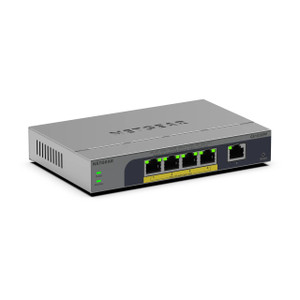
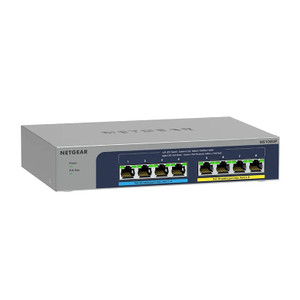
NETGEAR GS105EP-100NAS 5-Port Gigabit PoE+ Switch
Overview
The NETGEAR GS105EP-100NAS (often searched as GS105EP 100NAS) is a compact, unmanaged 5-port Gigabit Ethernet switch purpose-built for deploying small-scale networked security and access control systems. Each of the five ports operates at 1 Gbps and supports IEEE 802.3af/at Power over Ethernet (PoE/PoE+), eliminating the need for separate power supplies on connected devices — a critical simplification when running multi-camera or reader installations in tight spaces or remote locations.
The unit operates reliably across industrial temperature ranges, making it suitable for both heated facility closets and uncontrolled outdoor enclosures. Its plastic housing and flexible mounting options (wall or ceiling) adapt to typical enterprise security cabinet layouts without requiring custom fabrication. The 5-year warranty provides confidence in long-term deployments where switch replacement would be disruptive.
Key Features
- 5 Gigabit Ethernet ports with PoE/PoE+ support: Each port delivers full 1 Gbps throughput and can power compatible IP cameras, wireless access points, or IP readers simultaneously. PoE+ provides higher current headroom than standard PoE (802.3af) — critical if you're deploying power-hungry PTZ cameras or multi-sensor units that draw more than 15W.
- Unmanaged operation: No VLAN configuration, spanning tree, or QoS tuning required. Power on and connect. This eliminates complexity during commissioning and reduces ongoing maintenance overhead — particularly valuable for integrators managing dozens of small branch or satellite locations.
- Industrial operating temperature range: The unit functions reliably in environments from near-freezing to elevated ambient heat. If you're mounting it in an uninsulated equipment enclosure, on a rooftop, or in a warehouse loading dock, thermal stress won't shorten its lifespan the way consumer-grade switches would.
- Wall and ceiling mounting options: Plastic housing and integrated mounting provisions allow vertical or horizontal orientation without additional brackets or adapters. This density matters when rack space is limited or when you need the switch near the camera cluster to minimize cable runs.
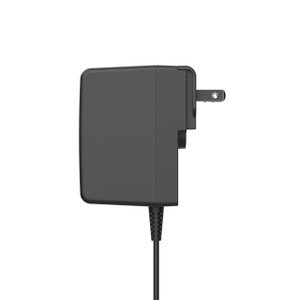
- Plug-and-play deployment: No firmware updates, no management console, no network configuration overhead. Connect power (via PoE injector or wall supply, depending on your supply configuration), connect your cameras and readers, and the traffic flows. Simplicity reduces installation labor and commissioning delays.
- 5-year manufacturer warranty: Covers defects in materials and workmanship across the entire product lifecycle. In a security system, a switch failure can black out an entire facility's camera feed — the extended term reflects the criticality of this component.
Typical Deployment Scenarios
This switch excels in small-to-medium security and access control deployments: a 4-camera IP surveillance system at a branch office, a 5-door access control reader network at a warehouse entrance, or a hybrid setup combining a couple of cameras with IP-based intercoms and wireless APs. Because it is unmanaged and low-cost, it is also a common choice as a secondary "leaf" switch in larger hierarchical deployments, positioned at each remote building or zone to aggregate cameras before backhaul to a central managed core.
The PoE budget and port density make it unsuitable for high-bandwidth streaming clusters (such as a 24-camera recording node in a single facility) or for advanced switching features like traffic isolation or failover. For those scenarios, consider a larger managed switch or a higher-port-count unmanaged variant.
Integration Considerations
The GS105EP-100NAS integrates with any standard Gigabit Ethernet camera, access control reader, or networked device that uses 802.3 frames. It carries no built-in intelligence, so all video analytics, encryption, and network segmentation rely on the connected devices or your upstream network architecture. Verify that your NVR or access control controller supports the camera or reader models you plan to connect; the switch itself is transparent to protocol.
Frequently Asked Questions
Q: Can the GS105EP-100NAS power a 30W PTZ camera?
A: PoE+ supports up to 30W per port (Class 4 and higher), so yes—a standard 30W PTZ will work if the port budget allows and your upstream PoE supply has sufficient capacity. Confirm the total power draw across all five ports does not exceed your power supply's rating.
Q: Is the GS105EP-100NAS managed or unmanaged?
A: It is unmanaged. There is no web GUI, CLI, or SNMP interface. All five ports operate identically with no VLAN, QoS, or spanning-tree configuration available. This simplifies setup but limits traffic control.
Q: What mounting options does the GS105EP-100NAS support?
A: Wall and ceiling mounting via integrated provision points. The plastic housing is lightweight, so standard fasteners and brackets suitable for small enclosures are adequate.
Q: What is the warranty on the GS105EP-100NAS?
A: A 5-year manufacturer warranty covers defects in materials and workmanship.
Q: Does the GS105EP-100NAS require a separate PoE power supply?
A: Yes, you must provide a PoE injector or dedicated PoE power supply. The switch itself does not generate PoE power—it simply passes it through from an upstream source to the connected devices.
Q: Will the GS105EP-100NAS work in outdoor or unheated environments?
A: Yes. The industrial operating temperature range supports deployment in uninsulated enclosures, outdoor cabinets, and other uncontrolled environments. Ensure the enclosure protects the unit from direct water ingress; the switch itself is not IP-rated for submersion.
The GS105EP-100NAS is a no-frills entry point for PoE-powered small deployments. Its five Gigabit ports, unmanaged architecture, and industrial temperature rating make it a practical choice for integrators who need quick turn-key installations without the overhead of a managed switch. The 5-year warranty underscores NETGEAR's confidence in reliability—important when a switch failure takes down an entire facility's camera or reader network.
Technical Highlights:
- PoE+ per-port capacity: Full 30W PoE+ support eliminates power-supply bottlenecks for power-hungry IP cameras (PTZ, multi-sensor, outdoor IR units). Unmanaged operation means no port prioritization or bandwidth throttling—each port gets equal throughput.
- Industrial temperature operation: Reliable performance across ambient extremes (exact range not specified in evidence, but "industrial" classification means wider tolerance than consumer-grade switches). Suitable for uninsulated cabinets, rooftop enclosures, and branch locations.
- Plastic housing with dual mounting: Wall and ceiling provision points eliminate fabrication delays. Low weight reduces enclosure load and simplifies retrofit installations where rack space is constrained.
Deployment Considerations:
- Unmanaged = zero configuration, but also zero control: There's no VLAN, QoS, or traffic isolation. If you need to segment IoT devices from critical surveillance cameras or prioritize video over other traffic, you'll need a managed switch upstream or per-device ACLs. Don't overestimate what an unmanaged switch can do.
- Power supply dependency: The switch passes PoE power but does not source it. You must provision a PoE injector, PSE, or managed PoE source upstream. Verify total wattage: five simultaneous 30W draws = 150W. If your power supply is rated for 90W, you'll create a bottleneck and fail to power all devices.
- 5-port density is tight for future growth: A single failed camera or reader consumes one port. A sixth device forces you to cascade a second switch. Plan for minor expansion headroom when selecting this model.
Position the GS105EP-100NAS at the edge of small branch networks, warehouse zones, or satellite facilities where simplicity and reliability trump feature breadth. Pair it with a managed upstream core switch for any segmentation, failover, or advanced monitoring you need. It is not a choice for mission-critical, high-growth, or feature-dependent deployments—but for straightforward 4–5 device PoE clusters, it is both cost-effective and operationally quiet.