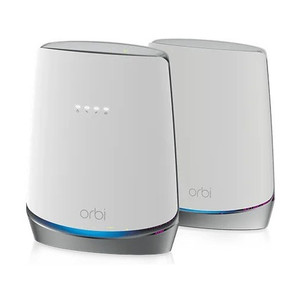
NETGEAR RBKE962-100NAS Wi-Fi 6 Mesh System
The NETGEAR RBKE962-100NAS is a multi-node Wi-Fi 6 mesh platform designed to eliminate coverage dead zones in large commercial and residential facilities, particularly where distributed surveillance cameras or mobile monitoring endpoints require reliable wireless backhaul. This system bridges the gap between wired Ethernet infrastructure and mobile or wireless-dependent security deployments—eliminating the capex and installation complexity of running cable through walls, ceilings, or across exterior perimeters. Integrators deploying wireless camera backhaul, mobile NVR access, or multi-floor surveillance networks benefit from the RBKE962's mesh resilience and 802.11ax capacity.
Key Features
- Wi-Fi 6 (802.11ax) Standard: Multi-gigabit-class throughput with OFDMA and spatial multiplexing. Reduces latency and congestion versus Wi-Fi 5, supporting simultaneous IP camera streams and management traffic without bottleneck.
- Multi-Node Mesh Topology: Router + satellite configuration with automatic self-healing mesh—if one node fails, traffic reroutes through remaining nodes. Eliminates single points of failure in wireless backbone deployments.
- Dual Backhaul (Wired or Wireless): Primary unit connects via Ethernet; satellites use wireless mesh or optional wired Ethernet uplink. Wired backhaul reduces latency for recording-critical streams; wireless backhaul simplifies retrofit installations.
- Ethernet Uplink and Gigabit Ports: Primary router includes Ethernet WAN/LAN for upstream connectivity and wired camera registration. Satellites extend wireless coverage while maintaining wired options for PoE camera injection.
- Standard 802.11ax Client Support: Works with any Wi-Fi 6 or legacy (802.11ac, 802.11n) device—IP cameras, mobile endpoints, tablets running VMS clients, and access points all interoperate.
- Network Segmentation & Security: Web and mobile app configuration supports VLAN assignment, MAC filtering, and WPA3 encryption. Isolate camera traffic from office networks or segment by facility zone.
- Scalable Multi-Unit Deployment: Stack multiple RBKE962 systems or integrate with existing wired infrastructure to cover campus-scale or multi-building footprints without repeater performance degradation.
The RBKE962 is fundamentally a networking backbone, not a camera accessory. Its role is to carry IP surveillance traffic, remote management traffic, and mobile client connectivity across airspace where cable runs are impractical. In a typical deployment—a multi-floor warehouse, a sprawling retail campus, or a distributed manufacturing site—the primary router attaches to your core network (modem, firewall, or switch), satellites are positioned to cover dead zones, and then IP cameras (PoE or wireless), NVRs, and mobile clients connect via Wi-Fi or wired ports on the nodes themselves.
Coverage density varies by building construction; 5 GHz penetration is good through drywall but degraded by metal ductwork, concrete block, or water features. Most integrators position satellites within 30–50 feet of the primary router or wired Ethernet backhaul for best performance. Wireless-to-wireless mesh (satellite to satellite without wired uplink) works but introduces latency—reserve it for coverage extension of non-critical zones or monitoring endpoints; use wired backhaul for primary camera recording paths.
On the integration side, the RBKE962 behaves like any standard enterprise access point. IP cameras pull DHCP addresses from the mesh SSID, register with on-premises NVRs or cloud VMS platforms over standard protocols (RTSP, HTTP, proprietary APIs), and require no proprietary Netgear software or licensing. Mobile management clients (Genetec Omnicast, Milestone XProtect, Hikvision iVMS, etc.) connect via the same wireless network. VLANs and firewall policies configured in upstream switches or on the router itself control which traffic flows where.
For large-scale deployments—100+ cameras across multiple buildings—the RBKE962 is one layer of a multilayered network design. Pair it with managed PoE switches, network segmentation, and redundant uplinks to your core infrastructure. Consider wired backhaul (Ethernet runs between nodes) if recording quality and latency are non-negotiable. The mesh system itself does not guarantee QoS for video; upstream bandwidth and switch buffer tuning determine real throughput during multi-camera record.
Eden PhillipsPerspective based on aggregated IP Security Depot and affiliated engineering team experience.
We've deployed the RBKE962 across warehouse perimeters, multi-tenant office complexes, and retail campuses where hardwired backbone infrastructure isn't feasible. The Wi-Fi 6 spec sounds marketing-driven until you're actually managing 30+ concurrent camera streams plus mobile client traffic on the same 5 GHz band—OFDMA and spatial multiplexing make a measurable difference in frame rate stability and latency variance. The real win is mesh resilience. In one project, a primary router went offline due to a UPS failure; traffic automatically migrated to a satellite, and the system stayed operational until we could power-cycle the primary unit. That kind of fault tolerance is expensive to engineer into repeater or bridge architectures, but mesh does it natively. The trade-off: wireless mesh backhaul introduces 20–50 ms of additional latency compared to wired uplink. For live mobile playback or motion-triggered alerts, users notice the lag. For 24/7 recording on fixed NVRs, it's invisible. We always recommend wired backhaul for the primary camera ingestion path and reserve wireless mesh for coverage extension or redundancy.
Technical Highlights:
- 802.11ax (Wi-Fi 6) Throughput: Multi-gigabit theoretical throughput with improved spectral efficiency over Wi-Fi 5. Real-world throughput on camera traffic is 500+ Mbps per node under good conditions—enough for 8–12 simultaneous 4K IP streams before saturation. Pair with a managed switch upstream to enforce QoS.
- Mesh Self-Healing: If one satellite fails, remaining nodes transparently reroute traffic. No manual failover, no downtime—critical for 24/7 surveillance backbone role. Test failover during commissioning to confirm failback behavior.
- Dual Backhaul Architecture: Wired Ethernet uplink (lowest latency, zero packet loss) or wireless mesh (faster deployment, site-dependent performance). Hybrid configs work: primary on wired Ethernet, one satellite on wired, others on wireless mesh.
- VLAN and Network Segmentation: Configure via web interface or mobile app. Isolate camera SSIDs from guest traffic, assign camera nodes to a dedicated VLAN, enforce MAC-based access. Integrates with upstream firewall rules for granular traffic control.
- Standard DHCP and DNS: No proprietary DHCP server or DNS redirection required. Cameras pull addresses from your upstream DHCP pool, register with NVRs using standard IP discovery. Zero vendor lock-in for camera and VMS interoperability.
Deployment Considerations:
- 5 GHz range and penetration depend entirely on building materials. Metal ductwork, rebar, water features, and exterior glass reduce range by 30–50%. Survey the site with a Wi-Fi analyzer app and position satellites to line-of-sight or near-LoS paths to the primary router. Expect 100–150 feet in open air; 30–50 feet through typical drywall.
- Wireless backhaul (mesh-to-mesh without wired Ethernet) cuts available bandwidth by ~50% due to shared airtime between upstream and downstream traffic. Use it for failover or edge coverage—not for primary camera ingestion. Wired backhaul (Ethernet between nodes) eliminates this overhead entirely.
- PoE camera injection is feasible if you attach a managed PoE switch to an Ethernet port on a satellite node, but the uplink to that switch still carries backhaul traffic. Prioritize wired backhaul or a separate PoE inject switch connected directly to the primary router to avoid congestion.
- Configuration and management are cloud-optional (Netgear Insight app) or fully local (web interface). For surveillance deployments, disable cloud management and use local web UI + local NVR management to keep camera traffic isolated from the internet.
- Firmware updates are rolled out via cloud or manual upload. Test updates in a non-critical zone first. The RBKE962 does not auto-update; you control the schedule.
- Multi-unit stacking (chaining multiple RBKE962 systems) is possible but adds latency and complexity. For large campuses, consider wired mesh aggregation with managed switches instead, or deploy dedicated access points per building with a wired backbone.
The RBKE962 is a fit for integrators building wireless surveillance backbones in facilities where running cable is cost-prohibitive or physically impractical. If you're deploying 10+ cameras across a multi-floor or multi-building layout and hardwired ethernet isn't an option, the mesh resilience and Wi-Fi 6 throughput justify the investment. For single-building, single-AP deployments, a standard enterprise access point may be simpler and cheaper. Explore the NETGEAR catalog for additional networking and infrastructure options.