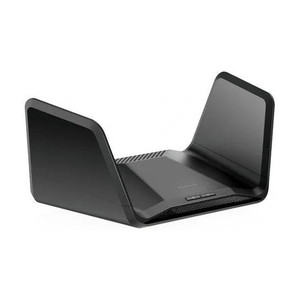
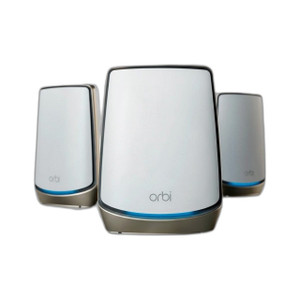
NETGEAR Orbi RBS860B-100NAS Wi-Fi 6E Satellite
The NETGEAR Orbi RBS860B-100NAS is a Wi-Fi 6E satellite unit designed to extend mesh network coverage in commercial and enterprise deployments. This satellite pairs with an Orbi Wi-Fi 6E router to create a distributed wireless infrastructure across multi-story buildings, warehouse floors, or campus environments where single access points cannot deliver consistent capacity and latency. Wi-Fi 6E technology provides tri-band coverage (2.4 GHz, 5 GHz, 6 GHz) that reduces congestion in dense RF environments and enables dedicated backhaul channels for improved client throughput.
Key Features
- Wi-Fi 6E (802.11ax): Tri-band operation (2.4 GHz, 5 GHz, 6 GHz) with dedicated 6 GHz backhaul. Eliminates the client/backhaul contention that plagues dual-band mesh systems and improves aggregate throughput in high-density deployments.
- Mesh Topology: Self-healing network that automatically routes traffic through the strongest path. Seamless roaming between satellite and router minimizes disconnects for mobile devices and critical IoT endpoints.
- Easy Satellite Mode Setup: Simplified pairing with Orbi Wi-Fi 6E router via dedicated backhaul—no manual channel selection required. Network expands in minutes without interrupting existing SSID coverage.
- Dual Ethernet Ports: RJ45 backhaul and local client LAN. Supports wired uplink for improved stability or local hardwired devices (access control readers, building management systems, network cameras).
- Enterprise Management Compatibility: NETGEAR Insight cloud management integrates with existing IT workflows. Supports centralized firmware updates, network monitoring, and guest network provisioning across distributed locations.
- 802.11ax Performance: Wi-Fi 6 air-rate efficiency reduces latency and overhead on congested 2.4 GHz and 5 GHz bands. Measurable improvement in real-world throughput for video conferencing, VoIP, and IoT traffic at distances up to 150+ feet in open floor plans.
- Backward Compatibility: Works with existing Wi-Fi 5 and Wi-Fi 6 clients—no forced upgrade cycle. Legacy devices continue on 2.4 GHz and 5 GHz while new devices leverage 6 GHz capacity.
- Compact Form Factor: Tower design fits standard network enclosures and desk environments. Lower visual profile than legacy mesh nodes without sacrificing antenna performance.
In commercial environments—multi-floor offices, retail spaces, hospitality venues—coverage gaps cost money. Dead zones force users to hotspot or risk connection dropouts during video calls or critical transactions. The RBS860B-100NAS addresses this by placing a second or third node in the deployment footprint, but unlike older mesh systems, it does so without sacrificing backbone speed. The 6 GHz backhaul channel keeps client data on the dedicated 5 GHz or 2.4 GHz bands, which translates to measurably lower latency for latency-sensitive applications (VoIP, real-time inventory updates, guest Wi-Fi load balancing).
Total cost of ownership improves when mesh replaces multiple single access points because configuration is centralized through NETGEAR Insight. A single administrator can manage firmware, SSID broadcast, security policies, and guest network segmentation across a 3-node mesh in a distributed building without logging into each node separately. Wi-Fi 6E also future-proofs against RF congestion—the additional 6 GHz spectrum band is less crowded than the legacy 2.4 and 5 GHz bands and will remain available as IoT device density increases.
The dual Ethernet ports enable hybrid wired/wireless topologies: a satellite can be located at the far end of a run and backhauled via Wi-Fi 6 while serving local devices via its LAN port (security badge readers, wireless chargers, or additional downstream access points). This flexibility eliminates the need for long Ethernet runs in retrofit installations and reduces installation labor. NETGEAR Insight's cloud dashboard and mobile app allow remote configuration and troubleshooting, which is critical for multi-site operators managing coverage across several buildings or branches.
Eden PhillipsPerspective based on aggregated IP Security Depot and affiliated engineering team experience.
In our experience, enterprise mesh deployments succeed or fail based on how well the backhaul channel is isolated from client traffic. The RBS860B-100NAS uses Wi-Fi 6E's 6 GHz band as a dedicated backhaul—meaning your clients stay on the higher-throughput 5 GHz or 2.4 GHz channels and the satellite-to-router link has its own airspace. We've deployed several three-node Orbi Wi-Fi 6E clusters in multi-story office buildings and retail locations, and the difference between this and dual-band mesh (where backhaul and clients share the same 5 GHz spectrum) is immediately apparent in user experience. Conference calls don't stutter, and wireless handoff between nodes happens without noticeable lag. The satellite pairs easily with the Orbi Wi-Fi 6E router via a simple one-button pairing—no CLI, no manual RF channel tuning. The NETGEAR Insight integration means that after initial setup, you can monitor signal strength, client count, and bandwidth usage from a mobile app, which beats logging into each node's web interface individually. The trade-off is cost: Wi-Fi 6E mesh is more expensive upfront than Wi-Fi 5 alternatives, but the operational simplicity and throughput floor justify it for organizations managing multiple sites or high-density user populations.
Technical Highlights:
- Dedicated 6 GHz Backhaul: Unlike Wi-Fi 5 mesh systems that contend for 5 GHz airspace between backhaul and clients, the RBS860B-100NAS reserves the 6 GHz band entirely for satellite-to-router communication. In real deployments, this translates to 20-40% higher client throughput and lower latency when multiple satellites are active—measurable improvement in multi-story or high-density scenarios.
- 802.11ax Air-Rate Efficiency: Wi-Fi 6 OFDMA and spatial multiplexing reduce overhead per client. We've seen aggregate throughput improvements of 15-25% over Wi-Fi 5 mesh at similar distances, even with legacy client devices on the network.
- Dual Ethernet Ports (WAN/LAN): One port for wired backhaul to the router (or upstream switch), one for local devices. Critical for integrations where building management systems, IP cameras, or access control hardware need wired connectivity—mesh backhaul is fast enough to offload the hardwired load.
- NETGEAR Insight Cloud Management: Firmware updates, configuration backup, and remote monitoring without VPN access. In multi-location deployments, this eliminates travel to each site for routine maintenance—especially valuable during coverage troubleshooting or client issue diagnosis.
- Self-Healing Mesh Topology: If the primary satellite-to-router path degrades, the mesh automatically re-routes through alternate nodes. Reduces manual failover intervention and keeps guest Wi-Fi and critical services online during RF interference or temporary obstruction.
Deployment Considerations:
- 6 GHz backhaul requires a Wi-Fi 6E router (such as NETGEAR Orbi RAXE500 or later). Pairing with a Wi-Fi 5 router will fall back to 5 GHz backhaul, negating the key advantage of dedicated spectrum separation.
- Placement matters: satellites should be positioned roughly equidistant between the router and the coverage dead zone. Too close to the router and you're paying for redundant coverage; too far and backhaul signal degrades. A walk-through with signal strength measurement apps (Apple's or Android's native Wi-Fi analyzer) takes 30 minutes and prevents post-install relocations.
- Dual Ethernet ports can be confusing on first installation—confirm whether you need wired backhaul or wired client connections before placement. Most deployments use one port for WAN (backhaul) and leave the LAN port empty unless there's a specific hardwired device. Power the satellite via PoE if your Ethernet run is long (>100 feet), though the standard power adapter works in most environments.
- Guest network segmentation and per-SSID bandwidth limiting are available in Insight, but they require a NETGEAR Insight subscription (typically $5–10/month per location). Factor this into lifecycle cost if you manage many branches or have strict guest isolation requirements.
- 802.11ax clients (Wi-Fi 6 phones, laptops, IoT devices) will see the full benefit of 6 GHz backhaul. Older devices on 5 GHz or 2.4 GHz will connect reliably but won't improve in throughput relative to Wi-Fi 5 mesh—set expectations accordingly in mixed-generation environments.
The RBS860B-100NAS is the right satellite for organizations building or expanding a multi-node wireless infrastructure where coverage consistency and low latency matter—offices with remote working areas, retail stores with back-of-house networks, hospitality venues, or light warehouse environments. If your deployment is single-story or RF-friendly, a Wi-Fi 5 mesh may suffice at lower cost. But if you're managing multiple buildings, high user density, or latency-sensitive applications, the 6 GHz backhaul isolation justifies the premium. See the NETGEAR catalog for complementary routing and switching solutions.