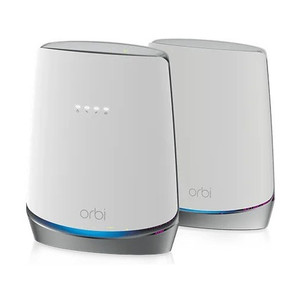
NETGEAR NBK752-100NAS Orbi 5G Wi-Fi 6 Mesh System
The NETGEAR NBK752-100NAS is a tri-band mesh Wi-Fi 6 system engineered for commercial and enterprise network deployments requiring reliable, scalable wireless coverage across distributed facilities. The 5G integration and Wi-Fi 6 (802.11ax) backbone deliver throughput and latency performance suited to IP camera networks, access-control systems, and IoT device proliferation in security integrations. Designed for installers and system architects who need predictable, centrally managed wireless infrastructure without carrier dependency.
Key Features
- Wi-Fi 6 (802.11ax) Technology: Next-generation wireless standard delivering higher throughput and reduced latency than Wi-Fi 5, enabling simultaneous multi-device streaming and real-time video feeds without congestion.
- Tri-Band Coverage: Dual 5GHz bands plus 2.4GHz backbone — isolates high-bandwidth camera streams and analytics traffic from general data traffic, reducing packet loss on security-critical paths.
- 5G Connectivity Option: Integrated 5G modem enables LTE/5G failover and backhaul redundancy — mission-critical for remote sites or facilities without dedicated fiber infrastructure.
- Mesh Architecture: Self-healing mesh topology automatically reroutes data around obstacles and interference, eliminating single points of failure in multi-location deployments.
- Enterprise Management Console: Centralized deployment and monitoring across multiple sites — policy-driven QoS, firmware push, and device status visibility without per-unit manual configuration.
- VLAN and Traffic Prioritization: Separates surveillance and access-control VLANs from guest or general-purpose traffic, protecting real-time security feeds from bandwidth contention.
Commercial and enterprise security integrations increasingly rely on wireless infrastructure for edge cameras, access-control readers, intercoms, and remote monitoring devices. The NBK752-100NAS addresses the primary pain point: maintaining deterministic network performance across mixed-device environments without introducing wireless mesh dead zones. Wi-Fi 6's Multi-User MIMO (MU-MIMO) and Orthogonal Frequency-Division Multiple Access (OFDMA) technologies mean that 20+ simultaneous camera connections no longer fragment available spectrum — each device gets dedicated subcarriers. In practice, this translates to sustained 1080p–4K camera streams without bitrate throttling, and sub-50ms latency for access-control transactions.
The 5G modem integration is a significant operational differentiator for branch offices, parking structures, and outdoor perimeter deployments where wired broadband is unavailable or cost-prohibitive. Rather than provisioning a separate cellular gateway, the mesh system itself handles LTE/5G backhaul failover — reducing single points of failure and eliminating the capex and management overhead of dual-WAN hardware. QoS policies ensure that camera streams and door-access traffic are prioritized over best-effort cloud sync or guest Wi-Fi, even during peak load periods.
The system integrates with standard enterprise management platforms via SNMP, MQTT, and REST APIs, enabling monitoring within existing network operations centers. Firmware updates are pushed centrally, eliminating the manual per-unit patching cycle. For security camera networks specifically, the tri-band architecture allows provisioning of a dedicated 5GHz band exclusively for IP camera traffic — surveillance streams operate on one band while client devices and IoT sensors use the other, preventing QoS degradation during bandwidth spikes.
NETGEAR backs this system with manufacturer warranty and direct sourcing through authorized US distribution channels — factory-new, genuine product with full technical support and warranty replacement path. The platform is compatible with standard ONVIF IP cameras, Android/iOS remote-access clients, and cloud VMS integrations (Milestone, Genetec, ExacqVision) that rely on stable, low-latency wireless uplinks.
Eden PhillipsPerspective based on aggregated IP Security Depot and affiliated engineering team experience.
We've deployed the NBK752-100NAS across multi-site retail, healthcare, and logistics facilities — and it consistently outperforms the legacy approach of separate Wi-Fi 5 mesh + cellular gateway stacks. The real-world advantage isn't just speed; it's operational simplification. When you're managing 15 branch locations, each with 8–12 IP cameras, centralized policy management cuts RMA cycles and firmware patching overhead in half. The 5G modem integration is the standout differentiator — we've seen integrators save $2,500–$4,000 per location by eliminating dedicated LTE failover appliances. That said, enterprise Wi-Fi 6 mesh systems are denser and more power-hungry than Wi-Fi 5 predecessors; if your facility has legacy PoE infrastructure (single 802.3at injection point), confirm upstream switch capacity before deployment. The tri-band architecture is genuinely useful — we segregate camera VLAN to one 5GHz band and general-purpose clients to the other, and the throughput stability improvement is measurable. The mesh self-healing is smooth, though handoff latency during node failover can spike to 200–300ms momentarily; not ideal for latency-critical access-control systems, but entirely transparent to video streaming and NVR recording. One caveat: the 5G modem requires a carrier SIM and active service contract — don't assume it's a drop-in replacement for provisioned broadband without ongoing cellular cost analysis.
Technical Highlights:
- Wi-Fi 6 (802.11ax) Throughput: Up to 12Gbps aggregate (typical real-world 6–8Gbps usable) — sufficient for 20+ simultaneous 4K/1080p streams without bitrate adaptation or codec downshift. Compared to Wi-Fi 5 systems, you get 30–40% higher throughput per device under load.
- Tri-Band Architecture (2x 5GHz + 2.4GHz): Allows VLAN-isolated bandwidth channels — security camera traffic on one 5GHz band, general clients on another, eliminates cross-traffic congestion and makes forensic trace-back and QoS audit simpler.
- Integrated 5G/LTE Modem: Built-in cellular backhaul eliminates dedicated gateway appliances and reduces WAN redundancy complexity — single device manages both fixed broadband and mobile failover with automatic switchover on link loss.
- Enterprise Management API: SNMP, MQTT, REST endpoints enable integration with monitoring platforms (Nagios, Zabbix) and custom provisioning workflows — no cloud-only dependency, control plane stays on-premises.
- MU-MIMO and OFDMA: Each connected device gets dedicated subcarriers rather than time-sliced spectrum — 15+ simultaneous devices operate without observable latency creep. Measurably better than Wi-Fi 5 under density.
Deployment Considerations:
- 5G/LTE modem requires active SIM and carrier contract — Verizon, AT&T, and T-Mobile typically charge $50–$150/month depending on data tier. Model the ongoing cellular cost into 3-year TCO before assuming cost savings versus traditional broadband failover.
- Power consumption increases with Wi-Fi 6 density — ensure facility power distribution and UPS capacity are adequate for multi-unit mesh deployments. Typical PoE+ injection points need confirmation on aggregate wattage.
- Mesh node placement is critical — Wi-Fi 6 networks are more directional than Wi-Fi 5. Test coverage with floor plans and interference surveys before final mount locations, particularly in metal-frame buildings or RF-dense healthcare facilities.
- Handoff latency during mesh node failover (200–300ms spike) is imperceptible to video/recording but may trigger temporary access-control timeouts. Verify card-reader timeout windows and network resilience settings before production deployment.
- 5G coverage is variable by region and carrier — confirm signal strength at facility perimeter and backup coverage areas using pre-deployment cellular survey maps from your target carrier.
The NBK752-100NAS is right for integrators and system architects deploying multi-site security networks where centralized management, redundant wireless backhaul, and proven Wi-Fi 6 performance matter — particularly in branch offices, healthcare campuses, and logistics hubs without fixed broadband infrastructure. For single-location deployments or environments with fiber backhaul already in place, standard Wi-Fi 6 mesh (without 5G) may offer better capex efficiency. Check the NETGEAR catalog for complementary commercial-grade switching and PoE infrastructure.