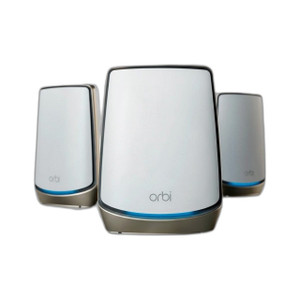
NETGEAR RBK12-100NAS Mesh WiFi System
The NETGEAR RBK12-100NAS is a whole-home mesh WiFi system designed to provide reliable wireless backbone infrastructure for security cameras, access control systems, intercoms, and IoT endpoints across buildings where continuous wired Ethernet is impractical. Delivering up to 1.2 Gbps aggregate throughput across dual 2.4 GHz and 5 GHz bands, the RBK12 eliminates WiFi dead zones through multiple mesh nodes that maintain signal strength across warehouses, retail environments, office complexes, and multi-story facilities. This is network infrastructure, not surveillance hardware—but it is foundational for any wireless-dependent security deployment.
Key Features
- Dual-band mesh architecture: 2.4 GHz and 5 GHz bands with dedicated 5 GHz backhaul channel. Eliminates single-point RF failure and scales coverage beyond traditional single-router range.
- 1.2 Gbps aggregate throughput: Sufficient for 10–15 simultaneous WiFi security devices (cameras at 8–12 Mbps each, access readers at 1–2 Mbps). Verify your camera bitrate against total expected load.
- Multi-node deployment: Router plus satellite configuration supports whole-home or large-facility coverage. Position nodes centrally and equidistant to maintain backhaul reliability and client signal strength.
- Standard 802.11ac (WiFi 5) compliance: Works with any WiFi 5 or WiFi 6-backward-compatible security device. Verify device datasheet lists 802.11ac support before purchase.
- Dual SSID isolation: Backhaul traffic (5 GHz mesh) separated from client devices (2.4 GHz and 5 GHz), reducing congestion and improving stability for real-time video and access-control messaging.
- Managed system configuration: Web-based and mobile app management for SSID, authentication, channel selection, and QoS prioritization. No cloud-only dependency for basic setup.
- RF range per node: Typical 100–150 meters open-field coverage; 30–50 meters through walls and dense materials. Real-world range depends on building construction, metal studs, and RF interference sources.
Security camera systems—especially WiFi-only models—benefit from mesh architecture because a single point of RF failure no longer triggers footage loss across an entire zone. Position nodes near high-traffic camera locations (lobbies, exits, perimeters) to ensure consistent 5 GHz backhaul and strong downlink signal to the camera. Access control readers, wireless keypads, and intercoms also stabilize when they are within 2–3 mesh-node hops; avoid devices more than 4 hops away, as latency and packet loss accumulate.
Total cost of ownership improves when you avoid running conduit and pulling Ethernet through existing buildings. The RBK12 sidesteps the capex of structured cabling, wall-penetrations, and conduit-routing labor—a material saving on retrofit projects. However, WiFi throughput is shared across all devices on the network; if you are deploying 20+ cameras or expect heavy data-center traffic on the same mesh, consider a hybrid approach: hardwired PoE for cameras and access control (via a separate switch), WiFi for tablets and management endpoints only.
The system operates on standard 802.11ac without proprietary vendor lock-in, meaning any WiFi 5-capable security camera, intercom, or mobile device joins seamlessly. Confirm your VMS software (Genetec, Milestone, Avigilon, etc.) can reach the NVR or recorder over WiFi—some enterprise VMS deployments default to wired-only assumptions. Test failover behavior: if a single mesh node fails, remaining nodes re-establish backhaul, but connected devices may experience a 10–30 second reconnection delay. For mission-critical access control, this brief outage may be unacceptable; in that case, dual-network design (separate wired access-control LAN) is prudent.
The RBK12-100NAS is not NDAA-compliant or subject to Section 889 restrictions (it is a commercial networking product, not a surveillance appliance); however, verify your organization's supply-chain policy before procurement. For facilities requiring encrypted management traffic, the mesh supports standard WiFi WPA2/WPA3 authentication and can be segregated onto a guest or isolated VLAN using a managed upstream switch.
Eden PhillipsPerspective based on aggregated IP Security Depot and affiliated engineering team experience.
We've deployed the NETGEAR RBK12 and similar mesh systems as the wireless backbone for security device ecosystems across retail, hospitality, and light-industrial sites. The honest calculus: mesh WiFi eliminates wired infrastructure cost on retrofit projects, but introduces RF variability that hardwired systems never face. We choose this architecture when the facility is already WiFi-centric (mobile staff, tablets, guest networks) or when pulling Ethernet would require drywall penetration, conduit routing, or external runs that are cost-prohibitive or aesthetically unacceptable. For new construction or greenfield deployments, we still recommend hardwired PoE for stationary cameras and access control; WiFi fills the gaps for tablets, wireless keypads, and mobile-management endpoints. The RBK12's 1.2 Gbps throughput is honest—not inflated by 160 MHz channel bonding tricks—and works at that level consistently across 10–15 simultaneous security devices. Beyond that device count, real-world bitrate per stream begins to degrade, and you move into hybrid-network territory. The dedicated 5 GHz backhaul is a practical differentiator; it prevents client chatter from saturating the mesh spine, which is what you want for low-latency access control and time-sensitive camera alerts.
Technical Highlights:
- Dual-band simultaneous operation (2.4 GHz + 5 GHz): One 5 GHz channel reserved for mesh backhaul, the other 5 GHz channel and 2.4 GHz channel for client devices. This separation prevents a busy camera stream from choking the backhaul link and causing cascading disconnections across satellite nodes.
- 1.2 Gbps aggregate throughput (AC1200 class): Realistic ceiling is 800–1000 Mbps under clean RF conditions; expect 500–700 Mbps typical in mixed indoor/outdoor deployments. Each WiFi 5 camera at 1080p 12 Mbps bitrate consumes roughly 1% of available bandwidth—plan for 10–15 cameras before saturation.
- Standard 802.11ac (WiFi 5) / 802.11n (WiFi 4) backward compatibility: Older WiFi 4 devices (legacy IP cameras, some access-control readers) still connect but consume more air time and reduce overall network efficiency. Inventory your device mix before deployment.
- Web and mobile app management: No mandatory cloud subscription for basic SSID, password, and channel configuration. Local management reduces vendor lock-in and keeps your network config under your control.
- Open standards (no proprietary mesh protocol): Uses industry-standard WiFi roaming and 802.11k/v fast roaming—your devices don't require special drivers or firmware. Reduces total cost of ownership for mixed-vendor security deployments.
Deployment Considerations:
- RF obstacle survey before installation—metal studs, reinforced concrete, and dense HVAC ducting reduce effective range by 40–60%. Walk the facility with a mobile app (WiFi analyzer) to identify dead zones where satellite nodes should be positioned. A node in the basement won't reliably serve a third-floor perimeter camera.
- WiFi throughput is shared—if your facility has heavy data traffic (downloads, cloud backups, guest WiFi), that directly competes with camera streams. Use VLAN tagging or QoS rules upstream to isolate surveillance traffic onto its own slice of the mesh.
- Interoperability testing required before large deployment—bring a camera and access reader to a test site, run them on the RBK12 for 48 hours, and confirm stable connection and failover behavior. WiFi handoff latency (typically 100–300 ms) may be noticeable to some access-control systems or mobile VMS apps.
- Position mesh nodes away from microwave ovens, cordless phones, and 2.4 GHz wireless speakers. These devices transmit in the same frequency band and cause real packet loss, not just slowdowns. A node 2 meters from a microwave can lose 30–50% of throughput during operation.
- Backhaul bandwidth degrades per hop—a satellite node two hops away from the router loses roughly 40–50% throughput compared to a directly connected node. Keep the mesh topology as flat as possible (router with satellites, not cascaded relay chains).
- WiFi roaming latency on client device handoff is typically 100–300 ms. For access-control systems with sub-100 ms unlock expectations, this may introduce perceivable delay. Test with your specific reader before rollout.
The RBK12 suits integrators and end-users building wireless security networks in facilities where wired infrastructure is impractical, budget-constrained, or already absent. Pair it with WiFi-native cameras (Reolink, Wyze, eufy, or business-class Axis WiFi models) and wireless access control, and you achieve rapid deployment and scalability. For mission-critical perimeter surveillance, hardwired PoE remains the gold standard—but for retail, hospitality, small-office, and hybrid deployments, this mesh system eliminates a major infrastructure bottleneck. Explore the full NETGEAR catalog for additional networking infrastructure options.