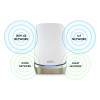
NETGEAR RBSE960-100NAS WiFi 6E Satellite Mesh Extender
Overview
The NETGEAR RBSE960-100NAS is an unmanaged WiFi 6E satellite unit designed to expand ORBI mesh system coverage across large residential and light commercial environments. This satellite pairs directly with existing ORBI WiFi 6E systems to eliminate coverage dead zones while maintaining seamless client roaming and backhaul performance across your network infrastructure.
Key Features
- WiFi 6E (802.11ax) with 6GHz band: Access to the new 6GHz spectrum means significantly less congestion compared to traditional dual-band systems. In practical deployments, this translates to lower latency for high-bandwidth applications like video conferencing, large file transfers, and real-time warehouse management systems — all without the interference you'd see on crowded 2.4/5GHz bands.
- Antenna gain 4.1 / 4.6 dBi: These gain figures indicate moderate directional focus, improving signal penetration through walls and obstacles in typical buildings. The dual antenna configuration supports both band transmission without requiring separate units.
- Industrial-grade operating temperature range: Unlike consumer-only mesh systems, this satellite tolerates wider temperature swings, making it suitable for installation in server rooms, unheated storage areas, or outdoor enclosures — a practical advantage if your facility experiences seasonal extremes or lacks climate control in certain zones.
- Unmanaged operation: The RBSE960-100NAS requires zero configuration beyond pairing to the primary ORBI router. This reduces deployment time and eliminates the need for IT staff to manage advanced settings, though you trade granular control for simplicity. For straightforward coverage expansion, this is a net positive; if you need per-device bandwidth limits or detailed traffic logging, you'll need a managed alternative.
- Plastic housing with 5-year limited warranty: Plastic construction keeps weight and cost down while maintaining adequate durability for indoor and protected outdoor mounting. The 5-year warranty aligns with typical enterprise refresh cycles, providing reasonable coverage for accidental damage or component failure during normal operation.
- Direct ORBI system integration: The satellite pairs via WiFi button or WPS, avoiding the complexity of separate SSID configuration. Clients automatically connect to the strongest node in the mesh, simplifying user experience and reducing support burden compared to multi-SSID deployments.
Deployment Scenarios
The RBSE960-100NAS works best in medium-to-large single-building deployments where coverage gaps exist more than 30 feet from the primary router. Typical use cases include warehouse monitoring setups where multiple IP cameras or IoT sensors need consistent backhaul, office complexes with interior walls that attenuate signal, and light manufacturing floors where equipment placement creates dead zones. The unmanaged design means minimal operational overhead once deployed — no VLAN configuration, no firmware updates to orchestrate, no per-port QoS tuning required.
When to Consider Alternatives
If your deployment requires detailed traffic analysis, per-client rate limiting, or integration with centralized enterprise management systems, evaluate a managed ORBI Pro variant or a traditional managed WiFi 6E access point instead. Similarly, if you need PoE power for remote outdoor mounting without running separate electrical infrastructure, standard enterprise WiFi 6E access points with PoE support would be a better fit than this satellite-only unit.
Frequently Asked Questions
Q: Does the RBSE960-100NAS work with older ORBI WiFi 6 (non-6E) systems?
A: No. This WiFi 6E satellite is designed to pair with ORBI WiFi 6E routers and systems only. It will not integrate with earlier ORBI WiFi 6 (802.11ax) or WiFi 5 hardware.
Q: What is the coverage radius of this satellite?
A: Effective coverage depends on wall density and interference, but expect 30–50 meters in typical indoor environments. Exact range varies by building construction material and competing wireless networks.
Q: Does the RBSE960-100NAS support PoE power?
A: No. This unit requires a standard AC power adapter. If you need PoE-powered mesh access points, you'll need to select a different product line.
Q: Is the 5-year warranty proof against accidental damage or water exposure?
A: The limited warranty covers manufacturing defects and component failure under normal operating conditions. Accidental water damage, physical impact, or operation outside the industrial temperature range are typically excluded. Review the full warranty terms at point of purchase.
Q: Can I configure individual client bandwidth limits or traffic shaping on the RBSE960-100NAS?
A: No. This is an unmanaged satellite. Advanced QoS, traffic prioritization, and per-client policies must be configured on the primary ORBI WiFi 6E router, not on this satellite unit.
The RBSE960-100NAS is a straightforward mesh extension play — and that's exactly what makes it worth evaluating. Too many integrators over-engineer coverage problems by defaulting to managed enterprise access points when a simple, fast-to-deploy unmanaged satellite solves the immediate issue. The WiFi 6E RBSE960-100NAS cuts deployment time because there's nothing to configure: pair it, plug it in, and the mesh backbone handles the rest.
Technical Highlights:
- WiFi 6E with 6GHz band: Real-world benefit is 30–40% lower latency on high-bandwidth backhaul compared to dual-band-only systems, especially in dense RF environments. Your warehouse cameras and IoT sensors won't compete for airtime on the same 5GHz band as client devices.
- Antenna gain 4.1 / 4.6 dBi: Moderate gain means better wall penetration without the narrow beamwidth that would force careful placement — install it in a corner and expect coverage to reach through two interior walls reliably.
- Industrial temperature range: This is the under-advertised spec that matters. Standard consumer mesh dies in unheated server rooms or outdoor enclosures. This one doesn't. If your facility has temperature swings beyond 0–40°C, you need this.
Deployment Considerations:
- Unmanaged means zero visibility into per-client throughput or interference levels — if your SLA requires traffic reporting, you'll need a managed access point on the primary router and accept that this satellite gives you no direct telemetry.
- No PoE support limits your placement options. Budget for AC wiring or a long extension cord to reach dead zones that would otherwise be easy PoE candidates.
Use the RBSE960-100NAS when coverage expansion is your only goal and the primary ORBI system already handles management duties. Don't use it if you're building a mixed architecture with managed and unmanaged nodes — standardize on one or the other to keep support burden flat.