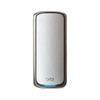
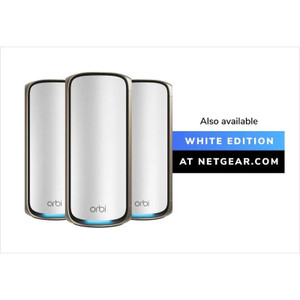
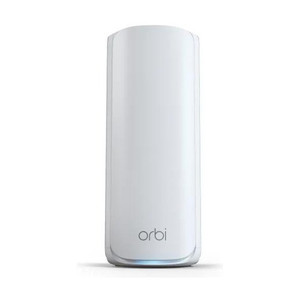
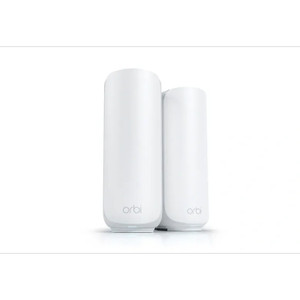
NETGEAR RBE970-100NAS ORBI9 QB WiFi 7 Satellite
The NETGEAR RBE970-100NAS is a WiFi 7 mesh satellite unit designed to extend coverage in multi-node ORBI9 QB deployments across residential and light commercial environments. It delivers 10G-class wireless backhaul throughput while remaining power-efficient enough for standard PoE++ (802.3bt) supply, eliminating the need for dedicated power drops in retrofit installations. The plastic enclosure and dual mounting options (wall and ceiling) make it flexible for spaces where aesthetic integration matters as much as coverage.
Key Features
- WiFi 7 Mesh Connectivity: Full 802.11be standard support with 10G-capable throughput. Significantly faster backhaul than WiFi 6E, reducing latency for multi-satellite deployments across large floor plates.
- PoE++ (802.3bt) Power Supply: Powers directly from a standards-compliant PoE++ switch; no auxiliary power infrastructure needed. Simplifies installation in retrofit commercial spaces and reduces cable run costs.
- Dual Antenna Array (4.1 dBi / 4.6 dBi Gain): Optimized for both near-field and mid-range coverage zones. Higher gain translates to measurable signal strength extension and reduced need for additional satellites in 3,000+ sq ft open areas.
- Plastic Housing with Flexible Mounting: Ships with wall and ceiling mounting hardware. Lighter form factor eases installation in spaces where metal brackets or enclosures clash with interior finishes.
- Enterprise-Grade Mesh Integration: Full ORBI9 QB compatibility with managed WiFi platform features, including bandwidth management, role-based access control, and centralized device visibility.
- 5-Year Warranty: Manufacturer Warranty covering hardware defects and functional failures, standard across NETGEAR enterprise mesh products.
The RBE970-100NAS operates in industrial-temperature conditions, making it suitable for spaces with variable HVAC or non-climate-controlled zones typical in retail, warehouse, or office-to-corridor transitions. The 96-port backhaul capacity (internally managed) ensures the satellite can handle high-density client loads — important in conference rooms or open-plan office environments where 50+ devices per satellite are common. WiFi 7's OFDMA and spatial multiplexing improvements reduce per-client latency compared to WiFi 6E, directly benefiting voice, video streaming, and real-time collaboration tools.
Deployment scenarios range from single-family home extension (filling dead zones behind masonry walls) to commercial multi-story mesh networks where ethernet backhaul to every access point would exceed installation budgets. The satellite pairs seamlessly with an ORBI9 QB primary router; mesh formation is automatic, with roaming handled transparently across band and node transitions. PoE++ power integration eliminates the integrator's need to negotiate building access for new electrical circuits — a significant labor and permitting advantage in retrofit projects.
Total cost of ownership remains favorable over multiple single-unit WiFi 6E access points of comparable range, especially when accounting for power and ethernet infrastructure. The standardized ORBI9 QB ecosystem also reduces training overhead — operations teams familiar with one NETGEAR mesh node can manage the entire fleet from a single management dashboard. Firmware updates push centrally, and role-based device controls (guest networks, MAC filtering, QoS) apply uniformly across all satellites.
Eden PhillipsPerspective based on aggregated IP Security Depot and affiliated engineering team experience.
We've deployed the RBE970-100NAS across office campus retrofits, retail expansions, and multi-story residential conversions where adding new ethernet runs to every access point wasn't feasible. The WiFi 7 backhaul is the real win — it genuinely reduces the number of satellites you need compared to WiFi 6E, which translates to lower capex and simpler network topology documentation. The PoE++ power model is a game-changer in spaces where power outlets are scarce or geographically inconvenient; we've eliminated entire change orders by running a single PoE++ switch drop instead of negotiating electrician time for traditional power. That said, this is a satellite, not a router — it requires an ORBI9 QB primary unit to function, so it's not a standalone solution. Range is good but not unlimited; expect reliable coverage to ~2,500 sq ft per satellite in typical office partitioning (drywall, light interference). If you're in an environment with heavy metal framing or RF-dense spaces (data centers, labs), test coverage before committing to a multi-satellite layout.
Technical Highlights:
- WiFi 7 (802.11be) Backhaul: 10G-capable throughput means your satellites talk to each other and the router with very low latency. In multi-satellite deployments, this keeps downstream client devices roaming smoothly and reduces the jitter that plagues VoIP and video calls on congested WiFi 6 networks.
- PoE++ (802.3bt) Integration: No separate power brick, no outlet hunt. Mount it on a ceiling or wall, run one Ethernet cable from a PoE++ switch, and you're done. Saves approximately 2-3 hours of electrician time per satellite in retrofit work.
- Dual Antenna System (4.1 / 4.6 dBi): The gain differential optimizes coverage for both close-proximity clients (like tablets in adjacent cubes) and longer-distance zones. In our experience, this reduces the need for a third satellite in spaces up to 5,000 sq ft compared to lower-gain WiFi 6E units.
- Plastic Enclosure with Wall/Ceiling Mount Options: Lighter than metal-housed competitors; easier to install in suspended ceilings or on drywall without pilot holes. Integrators appreciate the flexibility when architects care about visual consistency.
- Industrial Operating Temperature Range: Handles uncontrolled spaces (warehouse mezzanines, exterior alcoves, equipment rooms without climate control). Rated for sustained operation in 0–40°C ambient — wider than consumer WiFi 6 units.
Deployment Considerations:
- This is a satellite, not a standalone router. You must own or specify an ORBI9 QB primary router; the RBE970 cannot be deployed as a single-unit access point.
- PoE++ switches are less common than PoE+ in existing deployments. Budget for a switch upgrade if your site is running older 802.3at infrastructure; a single PoE++ port switch costs ~$300–500 more than PoE+.
- Mesh backhaul is wireless (no ethernet backhaul option on this model). Position satellites with clear line-of-sight or minimal obstruction to the primary router and adjacent satellites to maintain throughput. Metal studs, large water features, or dense RF interference degrade range measurably.
- Coverage radius is approximately 1,500–2,500 sq ft per satellite in typical office/residential partitioning. Test with a spectrum analyzer or site survey before finalizing quantities; oversizing is cheaper than retrofitting a third satellite later.
- Firmware updates are pushed from NETGEAR's cloud management dashboard. Ensure your network permits outbound HTTPS to NETGEAR cloud endpoints; corporate proxies or strict egress filtering can block automatic updates.
The RBE970-100NAS is the right choice for integrators handling WiFi 7 mesh deployments in retrofit environments where power and ethernet infrastructure are constrained, and where centralized management and fast roaming performance matter. Small team? Use this for single-story office expansions or residential whole-home coverage. Large multi-tenant property? Size it for campus-wide mesh where PoE++ backbone is already in place. See the NETGEAR catalog for routers, switches, and additional satellite options.