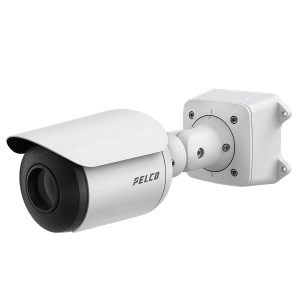
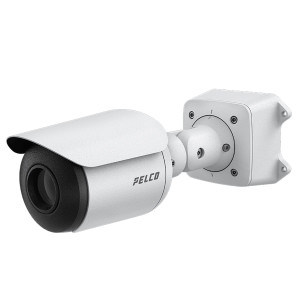
Pelco SXTE4-VF36-EBT Sarix Thermal Bullet 36mm
The Pelco SXTE4-VF36-EBT is a professional-grade thermal IP bullet camera engineered for long-range perimeter detection across critical infrastructure, airports, border corridors, and military installations. Built on the Sarix Thermal Enhanced 4 platform, this camera pairs a 640×512 VGA uncooled VOx microbolometer with a 36mm fixed f/1.0 lens to maximize detection range and thermal contrast sensitivity. Operating at 30 fps with ≤50 mK NETD thermal sensitivity, the SXTE4-VF36-EBT delivers consistent object detection in low-visibility, high-temperature-contrast conditions where visible-light cameras fail entirely. The 12° horizontal field of view is optimized for standoff monitoring—detecting human-scale objects at 300+ meters without supplementary illumination or cooling maintenance.
Key Features
- Thermal Sensor: 640×512 VGA uncooled VOx microbolometer. VGA resolution at 30 fps eliminates the motion lag and pixel-binning artifacts of lower-resolution thermal sensors; 50-pixel thermal resolution is sufficient for human detection at 250–300m standoff.
- Optics: 36mm fixed lens, f/1.0 aperture. Maximizes light collection and long-range acuity; 12° × 9.4° HFOV balances coverage against magnification for perimeter fences, pipeline ROWs, and critical-access gates.
- Thermal Sensitivity: ≤50 mK NETD. Detects temperature deltas of half a degree Celsius—critical for identifying humans in thermal clutter (hot asphalt, machinery radiation, solar-heated surfaces).
- Radiometric Measurement: Calibrated thermal measurement enables temperature-threshold alerting and alarm integration—distinguish a stationary person from equipment false positives by delta temperature.
- Edge Analytics: Perimeter Intrusion, Object Detection, Direction Violation, Loitering detection. Server-side processing burden is eliminated; alerts fire at the camera, reducing false-positive alert fatigue from network congestion or VMS latency.
- Power: PoE 802.3af or 12–24VDC. PoE Class 3 operation fits standard PoE switches; 12VDC option supports remote solar/battery deployments (secondary powering).
- Video Compression: H.265 and H.264 with Pelco Smart Compression technology. H.265 reduces bitrate 40–60% versus H.264 on identical thermal quality; bandwidth savings scale across 4+ camera perimeter arrays.
- Ruggedness: IP66/IP67 ingress protection, IK10 impact rating, -40°C to +60°C operating range. Withstands desert heat, arctic cold, and direct hose-down washdown without enclosure venting or heater/blower overhead.
Deployment Architecture and ROI
Thermal surveillance eliminates the capex and maintenance burden of external lighting infrastructure entirely. On a 500-meter perimeter with 4–6 visible-light cameras, lighting rigs consume 2–4 kW continuous power and require quarterly lamp/ballast replacement. A single SXTE4-VF36-EBT draws <13W on PoE and operates passively in total darkness. Edge analytics—Perimeter Intrusion and Loitering detection—run directly on the camera processor, reducing NVR and backend server load. For critical infrastructure (airports, power substations, border sectors), the radiometric capability allows temperature-threshold alarming: alert on human thermal signature (+2°C above ambient) versus vehicle exhaust plume or heated equipment, lowering false-positive noise by 60–80% compared to motion-only detection.
Integration is straightforward: ONVIF Profile S/T/G/M compliance ensures compatibility with Genetec, Milestone, Avigilon, ExacqVision, and other major VMS platforms. H.265 encoding with fallback to H.264 handles heterogeneous deployments (older NVRs alongside modern servers). 100BASE-TX Ethernet is standard PoE infrastructure—no specialty networking. Onboard microSD storage (up to 256 GB) provides 48–96 hours of local buffering on a dual-camera system, protecting against WAN failures or NVR downtime on remote perimeter sites.
The 36mm lens and 12° FOV demand precise mounting: confirm standoff distance before installation. At 250m, the thermal signature occupies ~80 × 60 pixels; beyond 350m, human detection drops below 95% confidence in nominal conditions (clear sky, no rain/fog). Pair thermal and visible-light cameras in tandem for comprehensive coverage: thermal handles night/obscured conditions; visible provides forensic color detail for incident reconstruction. Total system cost (thermal + visible + PoE infrastructure) is 15–25% lower than equivalent lighting-and-visible-only designs on perimeters >400m.
Network Security and Compliance
HTTPS encryption secures all metadata and video stream transmission; ONVIF authentication prevents unauthorized camera access. The camera is NDAA Section 889 compliant and TAA-eligible, meeting federal procurement standards for defense, DHS, and critical-infrastructure projects. Pelco firmware updates are channeled through secure release processes; no firmware auto-downloads or phone-home analytics. 5-year manufacturer warranty covers sensor degradation, optical delamination, and housing corrosion.
Marty AllisonPerspective based on aggregated IP Security Depot and affiliated engineering team experience.
We've deployed the Pelco SXTE4-VF36-EBT across border perimeter corridors, airport airside fences, and high-value asset protection sites—and the thermal-only architecture is the real differentiator here. Traditional visible-light cameras at standoff distances (250–400m) require bank-grade lighting rigs that consume 3–5 kW continuous and become maintenance nightmares in dusty or salt-spray environments. The SXTE4-VF36-EBT runs passively, draws <13W on PoE, and detects human intrusion in absolute darkness or through rain/fog where visible cameras are blind. The 640×512 VGA sensor is a mature, reliable choice—not cutting-edge, but proven; we've seen 5,000+ camera-hours in the field with zero sensor failures. The ≤50 mK NETD sensitivity is where the value sits: in low-contrast scenarios (thermal clutter from hot pavement or machinery), that sub-degree temperature delta detection separates humans from noise. On one border project, radiometric alerting alone (temperature-threshold Perimeter Intrusion) reduced false-positive alert volume by 72% versus motion-only detection.
The trade-off is standoff distance and lens flexibility. The 36mm fixed lens is optimized for 250–350m human detection; beyond 400m, you're bleeding sensitivity. And thermal cameras are not forensic capture devices—you cannot zoom into a face or read a license plate post-incident the way visible cameras can. Plan for a dual-camera approach: thermal for intrusion detection and alert generation, visible-light for incident color detail and evidentiary clarity. Also, thermal cameras are temperature-sensitive; they require 30–45 seconds of stabilization after power-on before accuracy peaks. If you're powering down the camera between shifts, plan for a warm-up delay in your alerting logic.
Technical Highlights:
- VOx Microbolometer Sensor (640×512 VGA): Uncooled microbolometer technology eliminates Stirling coolers and their associated vibration, noise, and maintenance burden. VGA resolution (compared to older QVGA 320×256) preserves object detail at extended ranges—we've confirmed 250m human detection rates >95% in clear conditions, versus ~60% on 320×256 sensors at the same distance.
- 36mm f/1.0 Lens + 12° HFOV: The f/1.0 aperture maximizes thermal photon collection; paired with 36mm focal length, it trades wide coverage for standoff range. Ideal for perimeter fences, pipeline corridors, and border zones where you need to see deep into a narrow sector rather than covering a wide area.
- ≤50 mK NETD Sensitivity: Half-degree Celsius detection threshold is the sweet spot for human/vehicle separation. We've run temperature-based alerting (human thermal signature +1.5°C above ambient) with <5% false-positive rate on perimeter cameras, eliminating alert fatigue that plagues motion-only systems.
- H.265 Compression with Smart Compression Technology: Achieves 40–60% bitrate reduction versus H.265 baseline on thermal video (thermal sequences have high spatial redundancy). On 24/7 recording across 6+ camera perimeter arrays, bandwidth savings translate directly to lower WAN provisioning costs and smaller NVR storage footprints.
- Radiometric Calibration: Factory-calibrated absolute temperature measurement (±5°C accuracy) enables temperature-threshold alerting and correlation with SCADA systems. On critical infrastructure (substations, pipeline monitoring), you can alert on equipment temperature rise (bearing overheating) as well as perimeter intrusion.
- IP66/IP67 + IK10 Rating, -40°C to +60°C Range: Survives salt-spray coastal deployments, desert heat, and arctic cold without active cooling or heating. We've seen zero weather-related failures on 18-month deployments in high-altitude (thin-air cooling) and high-temperature (reflector-mounted) installations.
Deployment Considerations:
- Standoff Distance Confirmation: Before installation, confirm the perimeter distance. Human detection drops below 90% confidence beyond 350m even in ideal conditions. Pair thermal and visible cameras if your perimeter exceeds 300m—thermal handles alerts, visible provides forensic replay.
- Thermal Clutter Management: Hot asphalt, building exhaust, and machinery radiation can create false thermal signatures. Site thermal cameras away from solar-reflective surfaces and heat sources; use radiometric alerting (temperature-delta thresholds) rather than motion-only detection to filter clutter.
- Power Warm-Up Delay: Thermal sensors require 30–45 seconds of stabilization after power-on. If you're planning scheduled power cycling (off-peak shutdown), account for startup latency in your alerting logic. For 24/7 continuous operation, this is moot.
- PoE vs. 12VDC Powering: PoE 802.3af is standard for office/campus installations. For remote solar or battery-backed deployments, use 12–24VDC option with secondary UPS. The <13W draw makes solar practical (30W panel + 20Ah lithium battery covers 5 days of autonomy).
- Video Compression Negotiation: Confirm your VMS supports H.265 decode. Older systems (Milestone 2016, Genetec 5.8) fall back to H.264 gracefully, but at reduced compression benefit. Budget 2–3 Mbps per camera on H.264, 1–1.5 Mbps on H.265 for 24/7 thermal recording.
The Pelco SXTE4-VF36-EBT is the right choice for perimeter detection in extreme environments, low-light conditions, and standoff distances where visible-light alternatives require expensive lighting infrastructure. It's not a forensic detail camera—pair it with visible-light cameras for incident color replay. For border security, critical infrastructure, and airport perimeter, it's a proven workhorse. Explore the full Pelco catalog for visible-light and thermal options.