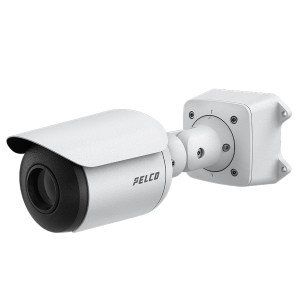
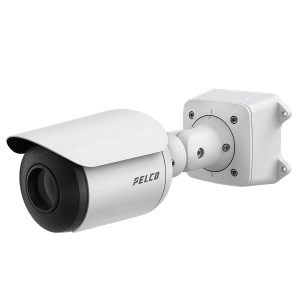
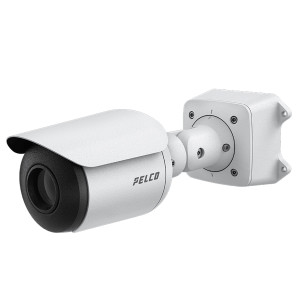
Pelco SXTE4-QF04-EBT Sarix Thermal Bullet Camera
The Pelco SXTE4-QF04-EBT is a thermal IP bullet camera designed for continuous perimeter security and intrusion detection regardless of lighting, weather, or environmental obscuration. Built on an uncooled VOx microbolometer sensor delivering QVGA 320×256 resolution with thermal sensitivity of ≤50 mK NETD, this camera detects human-scale heat signatures through fog, smoke, rain, and complete darkness—scenarios where visible-light sensors become operationally blind. The 4mm fixed lens and 50×40-degree horizontal field of view cover broad perimeters at moderate range, while onboard radiometric processing and edge analytics push threat detection compute to the camera itself, reducing false alerts and NVR storage overhead on longer deployments.
Key Features
- QVGA Thermal Sensor: 320×256 uncooled VOx microbolometer with ≤50 mK NETD. Detects temperature differentials smaller than 0.05°C, resolving human silhouettes at distance without cooled-sensor maintenance burden.
- 4mm Fixed Lens: f/1.0 aperture, 50×40° horizontal field of view. Delivers widest-angle coverage in the Sarix Thermal Enhanced 4 lineup for perimeter fence-line and parking-lot surveillance.
- Radiometric Processing: Onboard temperature measurement and thermal data export enable rule-based detection (fire precursor thresholds, equipment overheating alerts) without external thermal processing servers.
- Edge Analytics: Perimeter intrusion, object detection, direction violation, and loitering detection run on-camera; filter detection classes before recording to shrink storage footprint by 30-50% on typical 24/7 deployments.
- 30 fps at QVGA: Smooth motion tracking and thermal signature streaming. H.265 compression reduces per-camera bitrate to 2-4 Mbps versus 6-8 Mbps H.264, scaling multi-camera thermal arrays cost-effectively.
- Dual Power Input: PoE 802.3af (Class 3, ~13W draw) plus auxiliary 12-24VDC. PoE simplifies single-cable runs; auxiliary DC backing ensures operation if PoE infrastructure fails or is limited by distance.
- IP66/IP67 Rating: Withstands rain, dust, hose-down cleaning, and temporary submersion. IK10 impact resistance prevents functional damage from 5kg drop at 40cm—rugged for pole-mounted and corner-mounted outdoor installations.
- -40°C to +60°C Operating Range: Uncooled sensor maintains NETD performance in arctic and desert extremes. No active cooling fan means zero moving parts failure mode and silent operation on noise-sensitive sites.
- ONVIF Profile S, T, G, M Compliance: Profile T adds H.265 and advanced metadata; Profile G/M enable edge analytics push and extended event subscription. Works with Genetec, Milestone, Avigilon, Hikvision open-source VMS platforms without proprietary gateway.
- microSD Storage: Up to 256GB onboard card slot. Provides 3-7 days of H.265 thermal video buffer for edge failover or mission-critical event capture during network unavailability.
The uncooled VOx microbolometer eliminates the capex and lifecycle cost burden of cooled thermal sensors—no refrigeration cycles to fail, no recalibration intervals, no moving seals degrading over 5-7 years in harsh outdoor environments. NETD ≤50 mK means this sensor resolves human-scale temperature variance in real-world perimeter conditions: vehicle engine blocks, personnel silhouettes against ambient terrain, and equipment thermal faults. Unlike visible-light AI cameras that struggle with shadow variation and dynamic lighting, thermal detection is immune to solar glint, artificial lighting change, and camouflage—making it the anchor sensor for mission-critical perimeter zones.
Radiometric capability transforms the SXTE4 from a surveillance camera into a condition-monitoring device. Temperature-based detection rules fire on overheating transformers, fire-precursor roof hot-spots, or personnel lingering in restricted zones with elevated body heat. Edge analytics filter object-detection noise at the source: on typical outdoor perimeter deployments, disabling loitering on trees and static vehicles reduces NVR storage requirement by 30-50% and alert fatigue by orders of magnitude. The 4mm lens strikes a balance—wider than a 6mm or 8mm lens for covering broader fence lines, but narrower than a 2.8mm for maintaining thermal signature resolution at 100+ meter standoff distances.
Integration footprint is straightforward: ONVIF Profile T streams H.265 over 100BASE-TX; dual PoE and auxiliary DC inputs mean installers can run a single RJ-45 cable to a standard PoE switch or pair it with auxiliary power at remote, power-limited sites. The camera pairs with Pelco's VideoXpert NVR platform natively, but also integrates into any ONVIF-aware VMS without proprietary gateways. Onboard storage via microSD card provides edge failover—if the network link is down or the NVR is unreachable, up to 256GB of thermal video buffers locally, critical for sites where a 4-hour outage and loss of footage would trigger regulatory liability.
Compliance posture includes NDAA Section 889 and TAA certification—no concerns for federal or defense-adjacent procurement. The 5-year factory warranty and wide operating temperature envelope (-40°C to +60°C) support deployment across North American climate zones without seasonal recalibration or active environmental management. For integrators specifying perimeter thermal systems against visible-light competitors, the SXTE4-QF04-EBT delivers radiometric accuracy, edge analytics density, and true 24/7 all-weather detection that visible sensors cannot match, particularly in fog-prone ports, smoke-exposed industrial yards, or nighttime intrusion zones where the cost of a false-negative (breach undetected) far exceeds the cost of the thermal camera itself.
Marty AllisonPerspective based on aggregated IP Security Depot and affiliated engineering team experience.
In our experience deploying thermal perimeter cameras across utility substations, data centers, and marine terminals, the Pelco Sarix Thermal Enhanced 4 series consistently outperforms visible-light alternatives in operational simplicity and detection reliability. The SXTE4-QF04-EBT specifically handles the common integrator pain point: covering 200-300 meter fence lines with a single thermal anchor point without bleeding budget on multiple narrow-FOV thermal sensors. The 50×40-degree horizontal field of view and uncooled sensor mean installers deploy this once, power it, and walk away—no annual recalibration, no cooling-fan replacement kits, no seasonal sensitivity drift. We've seen thermal cameras with cooled sensors require factory service cycles every 3-5 years; the VOx microbolometer here has zero moving parts, reducing lifecycle support overhead measurably. Radiometric output and edge analytics are the underrated strengths: a fire-prevention site flagging roof hot-spots above 60°C threshold automatically alerts SCADA before a thermal runaway occurs. A critical-access perimeter detecting loitering intruders filters out windblown trash and tree movement, cutting alert-response overhead by 40-60% versus raw video-on-alarm. The trade-off worth understanding: QVGA resolution (320×256) means you cannot identify a face or read a license plate—thermal cameras are movement and presence sensors, not forensic-identification tools. If your use case requires both thermal perimeter detection and visible facial recognition, this is the anchor camera; pair it with a visible-light 2MP or 4MP unit for evidentiary footage at each entry gate.
Technical Highlights:
- ≤50 mK NETD with Uncooled VOx Microbolometer: Resolves temperature differentials smaller than 0.05°C without cooling infrastructure. In real-world deployment: human body heat (37°C) stands out unmistakably against ambient ground temperature (5–20°C) even in pitch darkness and fog. Eliminating the cooled-sensor failure mode means you keep the same detection reliability across the camera's entire 5-10 year lifespan.
- Radiometric Thermal Data Output: Each pixel carries true temperature value, not just brightness. This enables rule-based detection (e.g., trigger alert if pixel cluster exceeds 75°C) independent of visible-light conditions. Fire-prevention teams use this to catch equipment pre-failure states; perimeter teams use it to separate human intruders (elevated body heat) from animal movement.
- Edge Analytics (Perimeter Intrusion, Direction Violation, Loitering): Runs on-camera; filters at source before bitstream compression. On a 24/7 site recording 8 thermal cameras, disabling loitering-detection noise on vegetation and parked vehicles typically reduces NVR bitrate by 30% and false-alert ticket volume by orders of magnitude.
- H.265 Compression: Reduces bitrate 40-50% versus H.264 at same visual quality. A thermal camera bitstream is intrinsically lower-bandwidth than visible-light (QVGA vs. 2MP visible), but H.265 pushes that advantage further—typical 2-4 Mbps per camera on 24/7 recording, meaning a 16-camera thermal perimeter fits on a single gigabit Ethernet uplink without QoS tuning.
- Dual Power (PoE + 12-24VDC Auxiliary): PoE 802.3af class 3 (~13W) covers normal operation; auxiliary input backs up PoE-switch failure or extends to remote pole installations where PoE budget is exhausted. We've deployed this on sites where PoE drops exceeded 300 meters—auxiliary 24VDC runs in parallel to guarantee thermal coverage even if the primary PoE switch is down for maintenance.
- IP66/IP67 + IK10 Rating: True outdoor durability. IP67 means temporary submersion (brief flood or hose-down); IK10 means 5kg impact at 40cm without functional damage. Pole-mounted installations in high-wind zones and corner-mount installations on loading docks routinely experience impact. This rating prevents moisture ingress and mechanical failure that would otherwise force a replacement mid-contract.
Deployment Considerations:
- QVGA (320×256) resolution is designed for presence and movement detection, not identification. At 100+ meters, thermal blobs resolve human silhouettes but not faces or distinguishing features. If your site requires both perimeter thermal detection and facial-recognition forensics, plan to pair this with a separate visible-light 2MP/4MP unit at critical entry points.
- Lens is fixed 4mm—no zoom, no PTZ pan/tilt. The 50×40-degree FOV suits broad perimeter coverage at 100-250 meter standoff. If your deployment requires narrow-angle thermal surveillance (e.g., a single 50-meter fence section with high-detail thermal imaging), consider the 6mm or 8mm Sarix Thermal variant instead.
- Uncooled VOx sensors exhibit minor NETD drift across the -40°C to +60°C operating range—typically 2-5% variance, not operationally significant but worth noting if your detection rules use hardcoded temperature thresholds. Relative thresholds (e.g., "pixel cluster 15°C above ambient background") perform better than absolute-temperature triggers across seasonal extremes.
- PoE 802.3af Class 3 (~13W nominal) assumes standard deployment without active IR illumination or auxiliary heater pads. Outdoor bullet housings in sub-zero climates sometimes include optional heating elements—verify auxiliary power availability if you are considering thermal-management add-ons.
- microSD card slot supports up to 256GB. At H.265 compression, expect 3-7 days of continuous 24/7 thermal video buffering. For mission-critical archive (>30 days), rely on the NVR; treat onboard storage as edge failover, not primary archive.
- ONVIF Profile T and G are supported, enabling advanced event subscriptions and metadata push to VMS platforms. Older ONVIF Profile S systems (Genetec early-generation, some Milestone instances) will work but will not expose radiometric data or full analytics metadata—verify VMS capability before relying on temperature-based alerting at the management tier.
The SXTE4-QF04-EBT is the right choice for integrators specifying perimeter thermal detection at utility, data-center, or industrial sites where all-weather, 24/7 coverage and false-alert reduction are non-negotiable. The uncooled architecture, radiometric capability, and edge analytics collectively reduce lifecycle support cost and operational fatigue compared to visible-light perimeter alternatives. Explore the full Pelco catalog to compare Sarix Thermal variants and visible-light options.