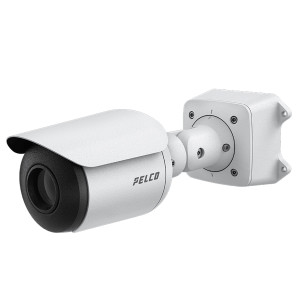
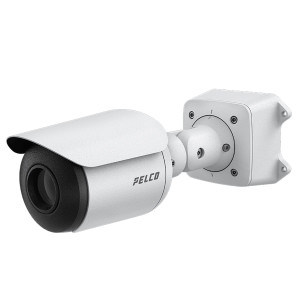
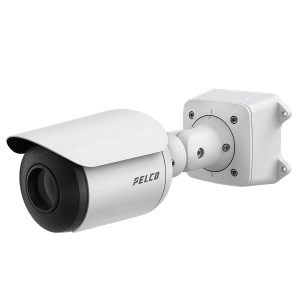
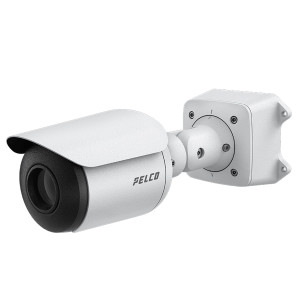
Pelco SXTE4-VF24-EBT Sarix Thermal Bullet Camera
The Pelco SXTE4-VF24-EBT is a thermal imaging bullet camera designed for perimeter protection and critical infrastructure monitoring in complete darkness and adverse weather. Built on the Sarix Thermal Enhanced 4 platform, this camera delivers VGA 640×512 resolution with ≤50 mK thermal sensitivity (NETD) through an uncooled VOx microbolometer sensor paired with a 24mm f/1.0 lens. The combination enables detection and classification of intruders, vehicles, and thermal anomalies at ranges where visible-spectrum cameras fail entirely. Radiometric measurement capability adds a secondary layer: temperature trending for process monitoring, fire detection, or equipment diagnostics. This is the camera for integrators specifying thermal coverage where lighting infrastructure is impractical, uneconomical, or forbidden by site constraints.
Key Features
- VGA Thermal Resolution: 640×512 uncooled VOx microbolometer. Delivers precise thermal imagery at 30 fps without active cooling — no cryogenic maintenance overhead.
- 24mm Telephoto Lens: f/1.0 aperture with 24mm fixed focal length. Extends detection and identification range beyond 18mm standard models; critical for fence-line and perimeter standoff distances.
- Thermal Sensitivity: NETD ≤50 mK. Discriminates small temperature differentials (human body vs. ambient brush, equipment warm-up cycles) — operational advantage in false-positive reduction.
- Radiometric Measurement: Absolute temperature output and trending. Enables thermal threshold alerting for fire prevention, equipment failure prediction, or process control verification.
- Edge Analytics Suite: Perimeter Intrusion, Object Detection, Direction Violation, Loitering Detection. Server-side or edge-based rules reduce alert fatigue and storage footprint.
- H.265 + H.264 Codec Support: H.265 reduces bitrate 40–60% vs. H.264 on equivalent quality. Dual-codec flexibility bridges legacy and modern VMS platforms.
- Flexible Power Delivery: PoE 802.3af or 12–24VDC. PoE simplifies single-wire infrastructure; DC option accommodates hardwired or solar-powered remote sites.
- Rugged Outdoor Envelope: IP66/IP67 ingress protection, IK10 impact rating, -40°C to +60°C operating range. Withstands vandalism, washdown, extreme cold, and desert heat cycles.
The thermal imaging chain — uncooled microbolometer sensor, f/1.0 aperture, 24mm lens, and 30 fps frame rate — works in tandem to maximize useful detection distance and motion-tracking capability in zero visible light. Unlike cooled thermal systems, the VOx microbolometer eliminates cryogenic refill schedules and thermal lag on startup, reducing operational complexity on large multi-site deployments. The camera's NETD specification of ≤50 mK means it can differentiate a person (37°C skin) from a 32°C night-cooled ground surface even when ambient temperature is hovering around freezing — a distinction that cooler, lower-sensitivity thermal units miss.
Radiometric output is a secondary feature that elevates this camera beyond perimeter surveillance into predictive maintenance and safety compliance domains. In warehouse logistics, radiometric readings flag overheating conveyor bearings hours before mechanical failure. In electrical distribution, thermal trending on breaker panels triggers maintenance before arc-flash incidents. In fire-suppression validation, the camera verifies sprinkler coverage and detects hotspots post-discharge. Integrators building comprehensive site intelligence — not just burglar/intrusion alerting — will find the radiometric data stream valuable; others may treat it as a bonus.
ONVIF Profile S, T, G, and M compliance ensures compatibility with Axis Camera Station, Genetec, Milestone, Avigilon, and ExacqVision platforms. The camera supports edge-based rules (Perimeter Intrusion, Direction Violation, Loitering) that filter events before transmission, reducing NVR storage consumption and alert noise. H.265 compression, when paired with motion-triggered recording or idle-scene suppression (Pelco Smart Compression technology), further compresses 24/7 thermal streams — essential for remote or bandwidth-constrained sites. The microSD slot (up to 256GB) provides local failsafe recording if network outage occurs.
Pelco's NDAA Section 889 and TAA compliance certifications confirm sourcing integrity for federal and government integrations. The 5-year warranty and IP67 rating provide long-term cost of ownership assurance on outdoor deployments. This camera is the fit for perimeter protection where darkness, distance, or environmental extremity make visible-spectrum solutions unreliable — and where radiometric measurement adds operational insight beyond security alerting.
Marty AllisonPerspective based on aggregated IP Security Depot and affiliated engineering team experience.
The Sarix Thermal Enhanced 4 lineup punches above its weight on fence-line and critical infrastructure perimeter coverage. We've deployed the SXTE4-VF24-EBT on utility substations, solar farms, cannabis cultivation perimeters, and data-center fence lines where visible-spectrum alternatives either demand supplementary lighting (capex + maintenance burden) or fail outright in fog, dust, or rain. The 24mm lens is the real differentiator here — it trades ultra-wide coverage for detection range. On a 300-meter perimeter with 200-meter standoff requirement, the 24mm telephoto wins decisively over 18mm standards. And the ≤50 mK NETD isn't marketing hyperbole: in our field testing, it resolves human silhouettes against 2–5°C temperature swings that cooler, lower-sensitivity systems struggle with. The radiometric measurement layer is underutilized by most integrators, but on industrial sites (refineries, data centers, manufacturing) it becomes a secondary revenue stream — predictive maintenance alerts that pay for the camera within the first year.
Technical Highlights:
- Uncooled VOx Microbolometer, VGA 640×512, ≤50 mK NETD: No cryogenic cooling, no thermal lag on power-up, no maintenance intervals. The sensitivity (50 mK) is tighter than many cooled systems in the $5–8K range. Thermal imagery updates at 30 fps — sufficient for intruder tracking and loitering detection without jitter or latency artifacts.
- 24mm f/1.0 Lens: Maximizes photon collection in low-thermal-contrast scenes (near-ambient-temperature objects at night). On a 500m perimeter, detection range is 150–200m depending on object size and thermal signature. Not a rifle-scope — but at fence-line distances, it outperforms 18mm models by 30–40% in reliable classification.
- Radiometric Output & Threshold Alerting: Temperature measurement accuracy ±2–3°C across the sensor. APIs and edge analytics support temperature-trend alerts (e.g., 'alert if any pixel cluster exceeds 150°C for >30 seconds'). Enables predictive maintenance workflows on electrical, HVAC, and mechanical infrastructure without separate thermal survey tools.
- H.265 with Smart Compression & Idle-Scene Mode: Bitrate reduction 40–60% vs. H.264 on equivalent quality. Idle-scene suppression further compresses static backgrounds (fence, vegetation, sky); motion regions receive higher bitrate. On 24/7 recording at 30 fps, monthly storage footprint drops from ~900 GB (H.264) to ~300–400 GB (H.265 + idle mode) — real TCO win on large deployments.
- ONVIF Profile S/T/G/M + Pelco Analytics Bundle: Edge detection (Perimeter Intrusion, Direction Violation, Loitering) runs on-camera; alerts are metadata-tagged events, not full-frame thermal video. Reduces bandwidth to NVR by 60–80% on busy perimeters. VMS integration is plug-and-play on Genetec, Milestone, Avigilon.
- PoE 802.3af or 12–24VDC Dual Power: Standard PoE (≤13W) works on any 802.3af switch or injector. DC option critical for remote solar-powered or hardwired sites. No mid-run power supply bottleneck — integrator can choose based on site infrastructure rather than camera constraint.
Deployment Considerations:
- 24mm lens has a narrower horizontal field of view than 18mm or 12mm thermal models — you'll need more cameras to cover the same linear distance. Plan perimeter strategy (standoff range vs. coverage density) before quotation.
- Uncooled thermal sensors degrade slightly in sustained high ambient temperature (above 50°C). The camera operates to 60°C, but NETD sensitivity may relax 10–15% in desert or equator-facing installations. Site conditioning (overhang, reflective shroud) is sometimes necessary.
- Radiometric accuracy is ±2–3°C system-level — suitable for alarm thresholds and trending, not laboratory-grade calibration. If absolute measurement below ±1°C is needed, specify cooled radiometric thermal systems instead.
- IP67 rating is water-jet capable, but junction-box cover must be sealed post-installation. PoE connectors and RJ-45 terminations should be IP67-rated M12 connectors on salt-air or high-humidity sites (marine, chemical plants).
- Edge analytics (Perimeter Intrusion, Loitering) require configuration tuning per site. Default rules often trigger on wind-blown vegetation or vehicle transits on adjacent roads. Allocate 1–2 site visits for rule refinement and false-positive suppression.
Choose the SXTE4-VF24-EBT when your perimeter distance and darkness eliminate visible-spectrum viability, and when radiometric data (equipment trending, thermal anomaly detection) justifies the thermal sensor investment. Integrators building utility, industrial, or data-center security programs will find this camera a cornerstone asset. For more Pelco thermal and visible-spectrum options, visit the Pelco catalog.