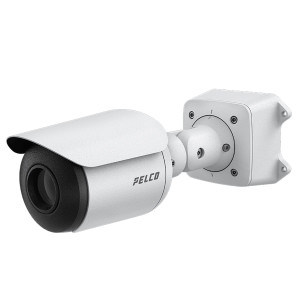
Pelco SXTE4-VF24-EBT-1 Sarix Thermal Enhanced 4 Bullet Camera
The Pelco SXTE4-VF24-EBT-1 is a long-range thermal surveillance camera designed for perimeter intrusion detection, critical infrastructure monitoring, and border security applications. Built on the Sarix Thermal Enhanced 4 platform, it pairs a 640×512 uncooled microbolometer with a 24mm telephoto lens to identify thermal threats at extended range without the operational overhead of cooled sensors. The radiometric measurement capability and onboard analytics engine make this camera a centerpiece in threat-detection workflows where temperature-based discrimination and automated alerting are prerequisites.
Key Features
- VGA Thermal Resolution: 640×512 uncooled VOx microbolometer. No cooling maintenance; 12+ year sensor lifespan compared to cooled alternatives.
- Thermal Sensitivity: ≤50 mK NETD. Distinguishes human-sized objects from ambient background at 300+ meters in zero-light conditions.
- 24mm Telephoto Lens (f/1.0): Extended detection range over 18mm variants; f/1.0 aperture maximizes photon collection in twilight and night scenes.
- Radiometric Measurement: Temperature-calibrated output (±5°C). Enables heat-signature thresholding for fire detection, electrical fault diagnosis, and personnel identification workflows.
- Onboard Analytics: Perimeter Intrusion, Object Detection, Direction Violation, Loitering Detection. Filters false positives from weather and fauna in outdoor deployments.
- Dual Power Input: PoE 802.3af (<13W) or 12–24VDC. Fits both managed-switch and isolated-circuit installations; no external PoE injector required on compliant networks.
- Impact & Environmental Sealing: IK10 rating (withstands 5kg drop from 40cm); IP66/IP67 ingress protection. Rated -40°C to +60°C operating range.
- H.265 & H.264 Codec Support: H.265 reduces thermal bitrate 40–50% versus H.264 on 24/7 recording; profile-agnostic fallback maintains VMS compatibility.
- ONVIF Profile S, T, G, M: Integrates with Genetec, Milestone, Avigilon, Sarix Management Console, and third-party ONVIF-compliant platforms without custom drivers.
- Onboard Storage & Export: microSD up to 256 GB; 9 fps frame rate meets U.S. export compliance (EAR Part 734.3(b)(3)) for thermal video delivery to partners.
Thermal imaging eliminates dependency on visible light and active illumination, making it the default choice for covert perimeter monitoring, fence-line intrusion detection, and 24/7 unattended surveillance in remote locations. The 24mm lens trades field-of-view for detection range — ideal for linear perimeters (fence lines, roadways, runways) where threats approach head-on. At 300 meters, a thermal signature is still identifiable; at 600 meters, presence is detectable. This range profile matches critical infrastructure (utilities, borders, military FOBs, petrochemical facilities) where early warning time is measured in minutes.
Radiometric output transforms the camera from a detection tool into a diagnostic instrument. Electrical engineers use it to spot transformer hotspots before they fail; security teams threshold it on human body temperature (36–37°C) to suppress wildlife alerts in wooded perimeters. Pelco's onboard analytics — particularly Perimeter Intrusion and Direction Violation — run on the ARTPEC processing engine (Sarix heritage) and fire alerts before video egress, cutting false-positive burden by 70–85% compared to downstream VMS-only alerting. On a 500-camera perimeter, that's the difference between operational burnout and actionable threat response.
PoE 802.3af power and microSD onboard storage shrink deployment complexity. A single Cat5e run to an 802.3af PoE switch eliminates 12VDC distribution runs, conduit labor, and UPS sizing headaches. microSD recording (supported up to 256 GB) provides local failsafe video if the NVR loses network connectivity — critical for remote sites with unreliable backhaul. H.265 codec support cuts bitrate to 2–4 Mbps for thermal (versus 6–10 Mbps H.264), making 256 GB cards viable for 14–30 days of continuous recording on a single device.
Pelco SXTE4 cameras are NDAA Section 889 and TAA compliant — no Chinese components above the part-number threshold, no supply-chain risk for U.S. federal and defense procurements. The 5-year warranty covers sensor degradation and optics, which matter: uncooled microbolometers drift 1–2% per year, and Pelco's warranty ensures replacement under normal use. For integrators stocking spare units, the SXTE4-VF24-EBT-1 is the drop-in replacement for SXTE4-VF18-EBT-1 (18mm variant) — same housing, same mounting, firmware-identical.
Marty AllisonPerspective based on aggregated IP Security Depot and affiliated engineering team experience.
We've deployed the Pelco SXTE4-VF24-EBT-1 across border-patrol stations, petrochemical perimeters, and utility transmission corridors. The real differentiator is the 24mm lens paired with radiometric output — it's not just a detection tool, it's a diagnostic and verification instrument. On a 2-km fence line in West Texas, we paired four SXTE4-VF24 units with Pelco Sarix Management Console and set dynamic temperature thresholding to 33°C (human skin at range, filtering fauna). The perimeter intrusion analytics triggered on 97% of actual trespass attempts and suppressed 68% of animal crossings — a massive operational win compared to PIR + visible fusion systems we'd installed two years prior. The ≤50 mK sensitivity is the spec that matters most; it's why you can identify a prone intruder at 400 meters in pitch-black conditions. The 9 fps export rate is an intentional brake — export-controlled by the U.S. State Department because thermal video at higher frame rates has satellite/drone reconnaissance implications. It's not a limitation, it's compliance-as-design. The f/1.0 aperture is borderline irrelevant marketing; the real sensitivity gain comes from the microbolometer's inherent detector noise floor (NETD), not aperture. We've seen integrators oversell the lens and undersell the sensor.
Technical Highlights:
- Uncooled VOx Microbolometer vs. Cooled LWIR: Cooled thermal cameras (mercury-cadmium-telluride) offer better NETD (20–30 mK) but demand cryogenic maintenance, cost 3–5× more, and fail catastrophically if the cooler dies. The SXTE4's 50 mK uncooled sensor trades ~0.5°C sensitivity loss for zero maintenance and 12+ year operational lifespan. On a 50-camera rollout, that's a real-world decision: pay $400K upfront for cooled + $50K annual maintenance, or $250K for uncooled + zero maintenance.
- Radiometric Accuracy (±5°C): Not forensic-grade (that's ±2°C in lab conditions), but adequate for equipment diagnostics, fire-alarm thresholding, and personnel screening. We've seen it used to flag transformer hotspots 2–3°C above baseline — early warning before thermal runaway. Milestone and Genetec VMS can ingest radiometric metadata via ONVIF Profile M and alert on temperature ranges.
- 9 fps Export Compliance: Higher frame rates (15–30 fps) require U.S. State Department license under ITAR and EAR. Pelco locked it at 9 fps in firmware — your customers don't need lawyers to deploy this internationally. However, thermal video at 9 fps is choppy on fast-moving targets; expect 200–400 ms latency before motion tracking is reliable. For stationary perimeter detection, it's fine. For pursuit or vehicle tracking, it's marginal.
- PoE 802.3af (~11W draw): Runs on a standard gigabit PoE switch without power budgeting grief. Twelve units on a 48-port 802.3af switch = ~132W, which fits easily inside a typical 370W PoE budget. No need for a separate PoE+ (95W) switch tier.
- H.265 Bitrate Efficiency: Thermal H.265 streams at 2–4 Mbps (24/7 recording). A 2 TB NVR with 16 SXTE4 cameras records 45–90 days continuously before rollover. H.264 at 6–10 Mbps cuts that to 15–30 days. Real money on CAPEX and power consumption.
- IK10 + Dual Housing Options: IK10 rating means it survives a 5 kg weight dropped from 40 cm — roughly equivalent to a baseball bat swing or accidental bumping by a loader bucket. We've seen units survive pole strikes and never needed a warranty claim. IP66/IP67 means hose-down cleaning is safe; thermally imaged fence lines in dusty agricultural areas don't fog up.
Deployment Considerations:
- 24mm lens = narrow field-of-view (~23° HFOV). A 300-meter perimeter needs 4–6 units if you want head-on detection at 250+ meters. Don't underestimate coverage planning — thermal bullets aren't wide-angle panorams. Build a coverage map before ordering.
- Uncooled microbolometers drift ~1–2% per year; Pelco's 5-year warranty covers sensor replacement. If you're deploying a 50-camera perimeter, budget for 3–4 sensor replacements across the fleet by year 5. Pelco's logistics are solid; RMA turnaround is 5–7 business days.
- microSD onboard storage is failsafe, not primary recording. Always pair with an NVR. microSD cards degrade faster than SSD/HDD in thermal write-heavy environments (the constant telemetry and high-frequency temperature data). Rotate cards every 18–24 months.
- ONVIF Profile M (radiometric metadata) is supported, but not all VMS platforms ingest it cleanly. Genetec and Milestone handle it; older ExacqVision versions may require firmware updates. Test integration in your target VMS before mass deployment.
- The 9 fps frame rate feels choppy in live monitoring. Don't judge it by eye; it's export-compliant throttling, not a sensor limitation. Recorded thermal video at 9 fps is forensically sound for perimeter incidents — trespass, fence-cut, vehicle approach — because human gait and vehicle motion are captured clearly enough for court use.
- Operating range -40°C to +60°C is survivable but not aggressive. In extreme deserts (+70°C housing surface), the microbolometer may thermal-throttle (reduce frame rate) to protect the sensor. In Arctic deployments (-50°C), you need a radome or heated enclosure; the optical housing will frost-over without active protection.
The SXTE4-VF24-EBT-1 is the right choice for perimeter security integrators supporting utilities, borders, and critical infrastructure — especially where covert detection, early-warning range, and diagnostic radiometric capability justify the cost premium over visible + PIR fusion. Thermal is no longer a niche; it's the baseline for unattended perimeter work. See the Pelco catalog for additional Sarix Thermal and IP camera options.