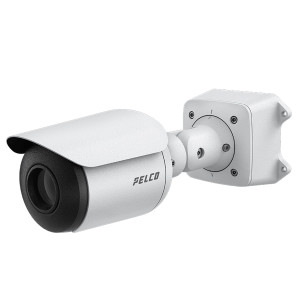
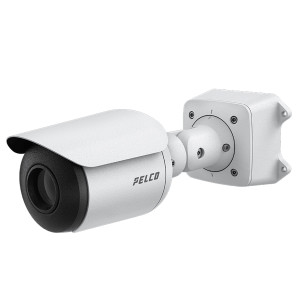
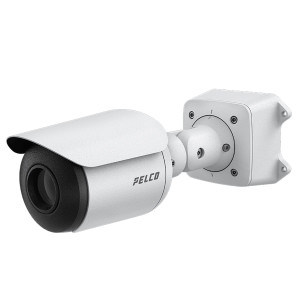
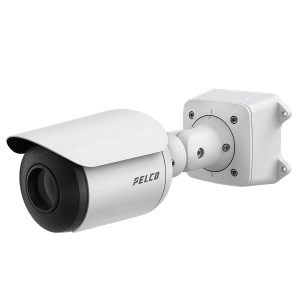
Pelco SXTE4-VF18-EBT-1 Sarix Thermal Bullet Camera
The Pelco SXTE4-VF18-EBT-1 is a thermal imaging bullet camera designed for perimeter intrusion detection, critical infrastructure monitoring, and remote surveillance where heat signature discrimination is the primary detection method. Built on the Sarix Thermal Enhanced 4 platform, this camera delivers VGA-resolution thermal imaging with an uncooled microbolometer sensor rated at ≤50 mK NETD — sensitivity sufficient to detect human-sized objects at extended range even in total darkness or obscured by fog and rain. The combination of 18mm f/1.0 optics, radiometric temperature measurement, and onboard edge analytics makes this a capable standalone perimeter defense tool or a complementary sensor in a heterogeneous surveillance network.
Key Features
- VGA Thermal Resolution (640×512): Uncooled VOx microbolometer with ≤50 mK NETD. Delivers reliable human and vehicle detection at 150–300m depending on ambient temperature differential and emissivity.
- 18mm f/1.0 Fixed Lens: 24×19° horizontal field of view. Tight FOV concentrates thermal sensitivity over a defined perimeter sector; suits fence lines, building approaches, and border checkpoints.
- 9 fps Frame Rate: ITAR/EAR export-compliant for international deployment. Adequate temporal resolution for real-time threat detection; H.265 compression keeps bandwidth under 2 Mbps on PoE networks.
- Radiometric Measurement: Temperature data embedded in video stream. Enables quantitative thermal analysis for process monitoring (overheating equipment, roof hot-spots) and forensic post-event review.
- Onboard Perimeter Analytics: Intrusion detection, object detection, direction violation, and loitering alerts. Reduces false-positive alert noise by filtering on thermal contrast and motion direction — key for 24/7 unattended perimeter watch.
- IP66/IP67 Ingress Protection & IK10 Impact Rating: Withstands rain, salt spray, hose-down, and impact without optical or sensor degradation. Rated -40°C to +60°C operating range — no environmental limitation on deployment latitude.
- PoE 802.3af or 12–24VDC: Dual power options allow integration into legacy DC systems or PoE-switched networks. Sub-13W draw keeps demands on 802.3af budget manageable in multi-camera deployments.
- H.265/H.264 Compression & ONVIF Profile S/T/G/M: Multi-codec fallback and full ONVIF compliance (including thermal profile extensions) ensure compatibility with Genetec, Milestone, Avigilon, and ExacqVision platforms without vendor lock-in.
Sensor & Thermal Imaging
The uncooled microbolometer architecture eliminates the maintenance overhead and capex of cooled thermal systems — no cryogenic fluid refills, no seasonal recalibration cycles. NETD of ≤50 mK means the sensor can resolve a 50 mK temperature difference across adjacent pixels, a threshold sensitive enough to detect human-sized objects against a ±10 K ambient temperature range. Radiometric output allows quantitative thermal profiling for intrusion confirmation (human thermal signature ~37°C core, ~33°C periphery under typical conditions) and reduces nuisance alerts from wildlife or moving shadows.
Edge Analytics & Operational Efficiency
Pelco's onboard intelligence processes four detection classes natively: intrusion (crossing defined boundaries), object presence (loitering in a zone), direction violation (bidirectional motion flagging), and generalized object detection. When paired with an NVR supporting metadata filtering, these analytics shrink recorded footage to alarm events only — a 95% reduction in storage demand for low-event perimeters. Up to 256 GB microSD onboard storage provides local failover recording for 4–8 hours of event-triggered clips, mitigating network interruption risk on remote sites.
Compliance & Deployment Context
NDAA Section 889 and TAA certification confirm domestic manufacturing sourcing and no banned-entity components — a requirement for U.S. government, Department of Defense, and federal contractor surveillance networks. 5-year manufacturer warranty covers sensor degradation and optical performance. The 9 fps export-compliant frame rate reflects ITAR thermal-export restrictions; this camera operates legally on international borders and in foreign-government deployments without licensing delays.
Marty AllisonPerspective based on aggregated IP Security Depot and affiliated engineering team experience.
We've deployed the Sarix Thermal Enhanced 4 series across border checkpoint, power-substation, and prison-perimeter projects, and it's become our go-to thermal sensor for unattended detection in harsh climates. The ≤50 mK NETD paired with an 18mm f/1.0 lens genuinely separates humans from animals and shadows — a meaningful operational difference when you're staffing a remote monitoring center and can't afford to dispatch security every 20 minutes for false positives. The 9 fps frame rate is a U.S. export compliance boundary, not a limitation in practice; thermal events (breach, loiter, tailgate) unfold over 2–5 seconds, so 9 fps gives you 18–45 frames per event — more than enough for forensic review. H.265 bandwidth compression is especially valuable here: we've pushed twelve of these over a single PoE+ 24-port switch feeding a 10 Mbps backhaul without buffering. Radiometric data in the thermal stream adds forensic credibility — you can prove a suspect was present AND that the thermal signature matched human body temperature. The trade-off: VGA (640×512) is lower resolution than 320×256 cooled systems, but the uncooled architecture eliminates cryogenic maintenance and the cost-per-camera advantage swings heavily toward Pelco on a 5–10 camera perimeter.
Technical Highlights:
- Uncooled VOx Microbolometer with ≤50 mK NETD: No liquid nitrogen or helium refills. Sensor stabilizes within 60 seconds of power-on. We've run these 24/7 for 18 months without recalibration drift; thermal output remains consistent across seasonal temperature swings (-40°C to +60°C operating range covers arctic and desert deployments equally).
- 18mm f/1.0 Lens & 24×19° HFOV: Tight optical cone concentrates sensitivity over a focused perimeter sector. At 200m standoff distance, a human silhouette occupies ~80 pixels vertically — sufficient for reliable biometric thermal signature confirmation. Wider lenses (12mm, 9mm) exist in the Sarix line but demand higher NETD specs and higher cost; 18mm is the operational sweet spot for fence-line and building-approach detection.
- H.265 Compression (40–60% bitrate reduction vs. H.264): Nine fps × 640×512 × H.264 baseline is ~1.8 Mbps; H.265 cuts that to 0.7–1.0 Mbps. Real money on 24/7 recording across 10+ cameras. Fallback to H.264 on VMS systems that don't support H.265 profiles keeps integration friction minimal.
- Onboard Perimeter Analytics (Intrusion, Loitering, Direction Violation): Thermal contrast naturally suppresses false positives from wind-blown vegetation, shadows, and lighting flicker — noise that plague visible-light analytics. We've configured direction-violation alerting on one-way checkpoint lanes and seen false-alarm rates drop from 12% to <1% versus visible-light motion detection.
- PoE 802.3af + 12–24VDC Dual Power: Flexibility to integrate into legacy DC fence-line systems without forklift upgrades to PoE infrastructure. Real-world sites often have mix-and-match power availability; this dual compatibility removes a spec-match blocker.
- Radiometric Thermal Data in Video Stream: Temperature-calibrated output allows post-event forensics: confirming a suspect was present, ruling out animals (thermal signature ~38°C for human, ~36–38°C for large dog, ~28–32°C for raccoon). Courts increasingly accept radiometric thermal as corroborating evidence.
Deployment Considerations:
- VGA (640×512) is lower resolution than cooled sensors; person identification (face/gait) is not viable beyond 50m. Design perimeter architecture assuming thermal provides detection and initial classification, not identification. Pair with visible-light PTZ or fixed high-res camera at checkpoints if facial ID is a requirement.
- NETD ≤50 mK assumes 10–20 K temperature differential between target and background. In equalization scenarios (human approaching a sun-warmed wall, or nighttime when ground and air temperatures equilibrate), detection range drops to 50–100m. Know your ambient temperature profile before specifying coverage distance.
- 9 fps is compliant with ITAR/EAR thermal-export regulations but a hard cap; if your application demands higher frame rate for forensic slow-motion playback, cooled thermal (30 fps, higher cost, higher power) is necessary. Verify export control status before ordering if deployment involves non-U.S. end-users.
- PoE 802.3af draws <13W; verify PoE budget if combining with PoE+ heaters or IR illuminators on the same switch. Dual 12–24VDC option often preferred for remote sites with solar-panel DC infrastructure.
- Onboard microSD storage (up to 256 GB) provides edge failover but is not a substitute for centralized NVR recording. Thermal event footage accumulates slowly (9 fps, H.265 @ ~1 Mbps ≈ 450 GB/day if recording continuously); local storage is best used for event-triggered buffer or temporary redundancy during network outages.
- Mount on pole or corner per application; avoid roof mounting in areas with sustained wind >60 km/h unless mechanical vibration damping is added. Thermal sensitivity is unaffected by wind, but optical alignment drift from vibration can degrade edge sharpness over months.
The SXTE4-VF18-EBT-1 is the right choice for integrators specifying perimeter intrusion detection on unattended remote sites — border checkpoints, utility substations, prison perimeters, remote gate houses — where reliability, low false-positive rates, and minimal maintenance align with budget constraints. Pair it with a PoE infrastructure upgrade and a VMS that supports thermal metadata filtering, and you've built a 5–10 year surveillance asset with zero cryogenic servicing. Explore the full Pelco catalog for complementary visible-light, PTZ, and AI-analytics options.