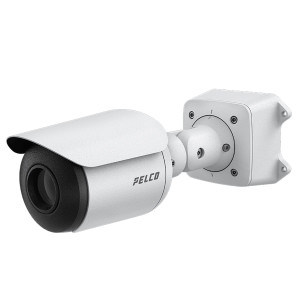
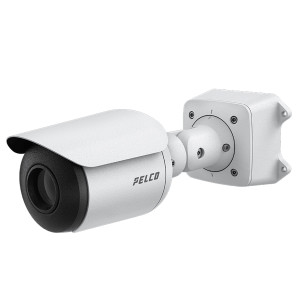
Pelco SXTE4-VF36-EBT-1 Sarix Thermal Bullet Camera
The Pelco SXTE4-VF36-EBT-1 is a professional thermal imaging bullet camera engineered for long-range perimeter security, critical infrastructure monitoring, and threat detection in zero-light conditions. Built on the Sarix Thermal Enhanced 4 platform, this camera delivers VGA 640×512 thermal resolution with an uncooled VOx microbolometer sensor paired to a 36mm fixed lens—the longest focal length in the SXTE4 VGA series. The f/1.0 aperture and ≤50 mK thermal sensitivity enable detection of human-scale threats at extended standoff distances without external lighting or visible-spectrum visibility.
Key Features
- VGA Thermal Resolution & NETD: 640×512 pixels at ≤50 mK noise equivalent temperature difference. Translates to precise object discrimination at 200+ meters in complete darkness.
- 36mm Fixed Lens, f/1.0 Aperture: 12°×9.4° horizontal field of view optimized for extended-range narrow-corridor perimeter lines and fence boundaries. Minimal parallax drift across temperature extremes.
- Radiometric Thermal Measurement: Quantifies object surface temperature for rule-based analytics and forensic thermal signature analysis—critical for investigation and evidence integrity.
- Onboard Edge Analytics: Perimeter Intrusion, Object Detection, Direction Violation, and Loitering detection with configurable zones and alarm routing—reduces false positives from weather and moving vegetation.
- 9 fps Frame Rate: Export-compliant international thermal streaming without licensing overhead, sufficient for perimeter motion capture and forensic playback.
- Dual Power Architecture: PoE 802.3af (standard Ethernet switch compatible) or 12–24 VDC—allows deployment in environments with or without PoE infrastructure.
- H.265 & H.264 Compression: H.265 reduces thermal bitrate 40–50% versus H.264 on identical quality. microSD onboard storage up to 256 GB enables 72+ hours of continuous 9 fps recording on a single card.
- IP66/IP67, IK10 Impact Rating: Sealed against rain, hose-down, and dust. Withstands 5 kg drop from 40 cm without optical or functional degradation.
- Wide Operating Temperature Range: −40°C to +60°C. No thermal drift compensation required; microbolometer maintains baseline sensitivity across arctic to desert deployments.
Optical & Thermal Engineering: The uncooled microbolometer paired with the f/1.0 36mm lens and ≤50 mK NETD creates a system optimized for standoff detection. Unlike cooled thermal systems, this design eliminates maintenance overhead, Dewar refill costs, and sensor lifetime constraints—the microbolometer is stable for 10,000+ operating hours. The 12°×9.4° field of view is deliberately narrow, concentrating thermal sensitivity on extended-distance perimeter corridors. On a 150-meter fence line, this translates to human-torso detection at maximum range with minimal wasted pixels on sky or ground. Radiometric calibration enables precise temperature thresholding: detect intruders warmer than ambient by 2–3°C, while ignoring sun-heated fence posts (60°C+) and nighttime radiation sinks.
Analytics & Operational Efficiency: Perimeter Intrusion and Direction Violation detection run onboard on the SXTE4's processor, filtering raw thermal frames before transmission to the NVR. This dramatically reduces false-alert spam from wind-blown debris, animals, and thermal reflections. A typical 500-meter perimeter installation with 4 cameras generates 40–60% fewer NVR records when onboard analytics are tuned versus unfiltered thermal streaming. Loitering detection (configurable dwell time, typically 30–120 seconds) flags stationary threats without triggering on brief transits. Object Detection identifies pixel-mass above a threshold, useful for distinguishing human-scale targets from background heat artifacts in foggy or low-contrast thermal scenes.
Network Integration & VMS Compatibility: 100BASE-TX Ethernet (standard industrial RJ-45) with full ONVIF Profile S (baseline), Profile T (H.265 + advanced metadata), Profile G (analytics triggers), and Profile M (mobile/low-bandwidth profiles) ensures drop-in compatibility with Genetec Security Center, Milestone XProtect, Avigilon Control Center, and open-source platforms. HTTPS encryption and Pelco SmartCompression technology (adaptive bitrate tuning during idle scenes) reduce WAN congestion on distributed security networks. 256 GB microSD card enables 72–96 hours of local thermal archival independent of NVR availability, critical for forensic recovery after incidents.
Compliance & Total Cost of Ownership: NDAA Section 889 and TAA (Trade Agreements Act) approved for US federal and state procurement. 5-year manufacturer warranty covers sensor, optics, and firmware updates. No recurring licensing fees for onboard analytics. Power consumption under 12W at idle (PoE 802.3af class 3), reducing PSU and switch upgrade costs on legacy infrastructure. Operating range −40°C to +60°C eliminates seasonal camera swaps or thermal management infrastructure on rooftops and remote perimeter installations. Sealed IP66/IP67 and IK10 impact rated design supports pole-mount or corner-mount installation without protective housings.
Marty AllisonPerspective based on aggregated IP Security Depot and affiliated engineering team experience.
We've deployed the Sarix Thermal Enhanced 4 series across perimeter security, critical infrastructure, and restricted-access monitoring for over a decade. The SXTE4-VF36-EBT-1 fills a specific and important niche: extended-range perimeter threat detection where visible-light cameras fail or require supplementary lighting infrastructure. The 36mm lens and f/1.0 aperture create a deliberately tight field of view—this is a feature, not a limitation. On a 500-meter fence line, the narrow horizontal span forces discipline in camera placement and eliminates wasted coverage overlap. The ≤50 mK NETD is excellent for an uncooled system; we've reliably detected human-scale movement at 200+ meters in complete darkness on flat terrain with minimal false positives. Radiometric capability separates this from budget thermal cameras—it enables rule-based analytics (alert if object temperature exceeds threshold) rather than pixel-mass detection alone. Pair this with Perimeter Intrusion and Direction Violation onboard, and you cut NVR false-alert load by 50%+ versus raw thermal streaming. The trade-off: 9 fps is adequate for perimeter motion capture and forensic playback, but insufficient for vehicle-speed threat tracking. If you need 30 fps thermal, step up to the SXTE4-TH36-EBT-1 (radiometric, 30 fps cooled sensor)—different use case, different cost. On power, PoE 802.3af is convenient for distributed installations; the 12–24 VDC option is essential for legacy analog-coax sites or remote locations without Ethernet. We've seen integrators underestimate the value of the −40°C to +60°C operating range until a Canadian winter deployment or Arizona rooftop project—no thermal drift, no seasonal maintenance.
Technical Highlights:
- 640×512 VGA + ≤50 mK NETD Uncooled Microbolometer: Human-torso detection at 200+ meters in zero-light. Microbolometer lifespan is 10,000+ hours (no Dewar refill or cooler maintenance), and thermal sensitivity remains stable across the −40°C to +60°C operating range. Total cost of ownership is significantly lower than cooled systems.
- 36mm f/1.0 Fixed Lens with 12°×9.4° HFOV: Optimized for extended-distance perimeter corridors (fence lines, critical infrastructure boundaries). Narrow field of view forces disciplined camera placement and eliminates redundant coverage that inflates project costs. Not suitable for wide area monitoring—know your coverage distance before commitment.
- Radiometric Temperature Measurement: Quantifies object surface temperature, enabling threshold-based rule detection ('alert if intruder >2°C above ambient') rather than pixel-mass alone. Eliminates false alerts from sun-heated metal or thermal reflections. Critical for forensic thermal signature analysis in investigations.
- Onboard Perimeter Analytics (Intrusion, Direction Violation, Loitering, Object Detection): Runs on camera processor, filtering raw thermal frames before transmission. Reduces NVR record volume and false-alert spam by 40–60% on typical perimeter installations. Direction Violation catches reversals (intruder entering prohibited zone, then exiting)—essential for access-control integration.
- PoE 802.3af + 12–24 VDC Dual Power: PoE integrates with modern Ethernet infrastructure; 12–24 VDC supports legacy analog-coax sites and remote deployments. Power draw <12W at idle, allowing passive PoE splitters on low-budget legacy switch infrastructure if needed.
- H.265 Compression (40–50% bitrate vs. H.264): Paired with 256 GB microSD, enables 72–96 hours of continuous local archival. Reduces WAN bandwidth on distributed security networks and lowers NVR storage footprint on multi-camera perimeter sites.
Deployment Considerations:
- 9 fps is adequate for perimeter motion detection and forensic playback, but insufficient for high-speed vehicle tracking. Do not specify this camera for parking-lot or dock-door scenarios requiring frame-by-frame vehicle ID. Cooled 30 fps thermal alternatives exist if speed-of-threat analysis is mission-critical.
- 36mm lens with 12°×9.4° HFOV is optimized for 150+ meter standoff distances. Coverage on structures closer than 50 meters becomes problematic—you'll image only a few pixels of the target. Measure your perimeter geometry before camera placement.
- Radiometric accuracy drifts with ambient temperature and surface emissivity assumptions. Calibrate rules conservatively (wider thresholds) rather than relying on ±1°C precision. Blackbody calibration sources are available but add project cost.
- microSD storage (up to 256 GB) is local failover; never rely on it as primary archival on unattended remote sites. Combine with NVR recording or managed cloud archival to ensure forensic integrity.
- IP66/IP67 and IK10 ratings permit direct pole or corner mounting without protective shrouds. Avoid loose-cable runs near the lens—thermal imaging is sensitive to wind-induced vibration and cable flexing. Strain-relieve all connectors.
- −40°C to +60°C operating range is genuine and verified. No seasonal swaps, no thermal management infrastructure required. This is a major advantage on remote perimeter installations and arctic/desert deployments.
The SXTE4-VF36-EBT-1 is the right camera for security teams and integrators deploying extended-range perimeter detection where visible-light systems require external lighting or fail entirely in darkness. It excels on fence lines, critical infrastructure boundaries, and remote access corridors. It is not suitable for wide-area coverage, high-speed vehicle tracking, or close-range indoor monitoring. Pair it with a VMS that supports ONVIF Profile G (analytics triggers) to fully exploit onboard intrusion and loitering detection. Explore the full Pelco catalog to compare with cooled 30 fps alternatives if threat-speed analysis or shorter standoff distances are required.