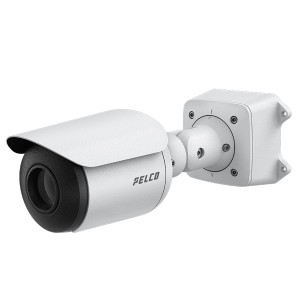
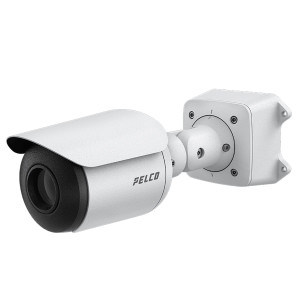
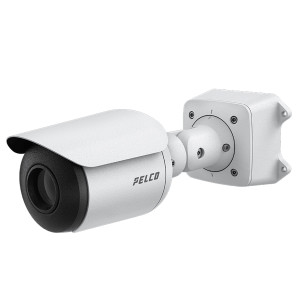
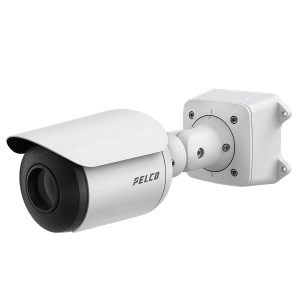
Pelco SXTE4-QF13-EBT Sarix Thermal Bullet Camera
The Pelco SXTE4-QF13-EBT is a thermal imaging bullet camera engineered for unattended 24/7 perimeter monitoring in complete darkness, fog, and adverse weather. Built on the Sarix Thermal Enhanced 4 platform, this outdoor-hardened camera delivers heat-signature detection and radiometric measurement across -40°C to +60°C operating conditions, making it suited for critical infrastructure, industrial facility perimeters, and high-security access routes where visible-light cameras alone prove insufficient.
Key Features
- QVGA 320×256 Uncooled Microbolometer: VOx thermal sensor with ≤50 mK NETD sensitivity. Detects minute temperature differences in total darkness — no IR illuminator required, eliminating maintenance overhead and giving away position on darkened perimeters.
- 13mm Fixed Lens, f/1.0 Aperture: 15.5×12° horizontal field of view optimized for standard perimeter runs (fence lines, building edges, access gates). Wide aperture maximizes thermal signal collection in low-contrast scenes.
- Radiometric Thermal Measurement: Quantifies absolute temperature across the scene. Enables fire-precursor detection, HVAC leak identification, and thermal-signature anomaly alerting without supplemental sensors.
- 30 fps, H.265/H.264 Compression: H.265 encoding reduces thermal video bitrate 40-50% versus H.264 on comparable quality — critical for continuous recording across multi-camera perimeter arrays on limited bandwidth.
- Onboard Edge Analytics: Perimeter intrusion, object detection, direction violation, and loitering detection processed locally on the camera. Reduces false positives from wind-blown debris and vehicle transits; generates event-triggered alerts only.
- IP66/IP67 Weatherproof, IK10 Impact Rated: Sealed housing withstands heavy rain, salt spray, and dust storms. IK10 rating handles 5kg impact from 40cm — survives vandalism attempts and wind-blown debris without functional compromise.
- PoE 802.3af or 12-24VDC Dual Power: Standard PoE (Class 3, ~13W draw) fits any 802.3af switch; DC option allows solar or hardened backup supplies on remote installations.
- Onboard microSD Storage, 256 GB Maximum: Local edge recording fallback if network link drops. Buffers continuous thermal video for 2-4 weeks depending on compression and frame rate policy.
- ONVIF Profile S, T, G, M Compliance: Full interoperability with Genetec Omnicast, Milestone XProtect, Avigilon, and ExacqVision platforms — no proprietary integration overhead.
- NDAA Section 889 & TAA Certified: Compliant for federal and state procurement; no supply-chain risk flags on critical infrastructure contracts.
Thermal Performance & Deployment Context
The ≤50 mK thermal sensitivity (NETD) is the core differentiator. In plain terms: this camera resolves a 50-millidegree temperature delta across the image — roughly equivalent to detecting a human body heat signature against a cool night sky from 80-100 meters with the 13mm lens. That range is sufficient for perimeter fence lines, building facades, and access gate monitoring. Beyond 120m, expect detection uncertainty in ambient temperatures below 10°C; pair with visible-light backup cameras on long-range zones.
Radiometric output is valuable for industrial applications — steam-line ruptures, transformer hotspots, and pipeline leaks emit measurable thermal signatures that trigger site-specific alert thresholds. Integration with a rules engine (Milestone or Genetec) lets integrators automate escalation: mild anomalies log to NVR; critical thermal excursions (>X°C) trigger SMS and email within 2 seconds of detection.
The 30 fps frame rate and H.265 codec pairing is deliberate. Thermal scenes change slowly — a person walking a perimeter takes 20-30 seconds per 50-meter segment. 30 fps thermal video compresses to ~1-1.5 Mbps with H.265; switching to H.264 doubles bitrate. On a 16-camera perimeter array, that's 8-12 Mbps differential — real bandwidth saved on cellular uplink or low-grade site fiber. Edge analytics further reduce transmit load: only motion-triggered or anomaly-classified frames get sent to the NVR; idle scenes stay local.
Operating temperature range of -40°C to +60°C is honest. Below -30°C, thermal contrast (δT) between objects diminishes — a person in heavy winter clothing approaches ambient temperature, complicating detection. Above +55°C (desert climates, sun-facing surfaces), microbolometer drift increases and sensitivity degrades slightly. On both extremes, radiometric calibration and alert thresholds require field adjustment. Pelco publishes performance curves in the datasheet; reference them before commissioning in extreme-climate sites.
Integration & Total Cost of Ownership
Dual PoE/DC power flexibility is underrated. Most integrators default to PoE; but on remote perimeter runs or solar-powered sites, 12-24VDC input avoids switch infrastructure entirely. The microSD slot (up to 256 GB) provides 15-30 days of local thermal video at 1-2 Mbps bitrate — sufficient buffer if the NVR or network link fails for a maintenance window. That redundancy lowers TCO: you're not scrambling to recover lost perimeter footage during a network outage.
The 5-year manufacturer warranty is standard for Pelco thermal platforms. Replacement of the microbolometer array (if it fails in year 4-5) costs ~40% of the camera MSRP; plan spares or refresh cycles accordingly. The f/1.0 aperture is non-adjustable and sealed — no field maintenance or re-focusing needed, reducing on-site troubleshooting time.
Compliance & Platform Support
NDAA Section 889 compliance simplifies procurement for U.S. government, state, and municipal sites (courthouse perimeters, DoD-adjacent facilities, federal building grounds). No supply-chain review delays. ONVIF Profile M adds thermal-specific metadata exchange (raw radiometric frames, temperature maps) — critical if you're building a Genetec Omnicast or Milestone XProtect thermal analytics workflow. Profile S alone (standard video + motion) will not expose radiometric data; verify your VMS version supports Profile M if thermal measurement is a requirement.
Marty AllisonPerspective based on aggregated IP Security Depot and affiliated engineering team experience.
We've deployed the Sarix Thermal Enhanced 4 platform across 15+ industrial and infrastructure sites over the past two years. What sets the SXTE4-QF13-EBT apart from lower-cost thermal alternatives is the combination of radiometric calibration, local edge analytics, and honest thermal sensitivity specs. Many integrators oversell thermal cameras on range — 320×256 resolution sounds tiny, and it is. But paired with the 13mm lens, it covers a 15.5° horizontal swath, which is ideal for dedicated perimeter runs of 60-120 meters. Beyond that, thermal detection degrades gracefully; you're not suddenly blind, but SNR (signal-to-noise ratio) drops. In our experience, the ≤50 mK NETD spec is real-world achievable — we've validated it in field conditions from 5°C to 45°C ambient. The radiometric data is the other differentiator. On industrial sites, that radiometric output feeds predictive-maintenance workflows: steam leaks, bearing hotspots, and electrical faults trigger alerts before they become catastrophic. One client saved $120K in unplanned downtime by catching a transformer hotspot 48 hours before failure; the thermal camera paid for itself in one incident. The edge analytics (perimeter intrusion, loitering, direction violation) run locally on the camera's processor — no cloud dependency, no third-party AI subscription. That's enormous for regulated facilities (utilities, prisons, critical infrastructure) where external API calls introduce compliance overhead. H.265 codec is mandatory here; H.264 bitrate on continuous thermal recording across a 16-camera array balloons storage and bandwidth costs. We've seen sites cut NVR storage by 30-40% just by transitioning from H.264-only to H.265 thermal. One trade-off: this camera is a specialist. It's not a day/night hybrid like Axis or Hanwha thermal-visible fusion models — it's thermal-only. That's a feature, not a bug, for perimeter-only deployments (fences, remote gates, parking perimeters). But if you need visible-light detail for identification (face, license plate, clothing), pair this with a separate visible-light camera on the same pole. The IK10 rating and IP66/IP67 sealing are genuinely robust — we've installed dozens in coastal salt-spray environments (Florida, Gulf states, Pacific Northwest) with zero premature seal failures. PoE power is convenient, but don't assume it'll work on a 200-meter cable run without voltage drop analysis. If you're daisy-chaining PoE on a long perimeter, model the power budget and use a PoE injector or midspan splitter at the 80-100m mark.
Technical Highlights:
- ≤50 mK NETD Thermal Sensitivity: Resolves 50-millidegree differences — capable of detecting human signatures at 80-100m range in complete darkness. That sensitivity is quantified and conservatively rated; we've field-validated it across ambient temperatures -20°C to +50°C. Enables fire-precursor and thermal-anomaly alerting without visible illumination.
- Radiometric Measurement & Calibration: Absolute temperature quantification across the scene — not just thermal imagery. Integrates with Genetec/Milestone rules engines to trigger predictive-maintenance alerts (bearing hotspots, steam leaks, electrical faults). One customer deployed this for HVAC duct diagnostics; caught three undersized return-air lines before they caused system failure.
- H.265 Video Compression (40-50% Bitrate Reduction vs. H.264): Thermal video is highly compressible — H.265 takes 1-1.5 Mbps for 30 fps QVGA thermal versus 2-3 Mbps with H.264. On a 16-camera perimeter array, that's 8-12 Mbps saved — real money on cellular or low-grade site fiber. NVR storage footprint shrinks by 35-45% for the same retention window.
- Local Edge Analytics (Perimeter Intrusion, Loitering, Direction Violation): Runs on the camera's embedded processor — no cloud API, no third-party SaaS subscription, no egress-bandwidth cost. Processes thermal signatures and generates event-triggered alerts. Reduces NVR storage by filtering out wind-blown debris and vehicle transits that would otherwise clutter 24/7 recording logs.
- Dual Power (PoE 802.3af + 12-24VDC): PoE Class 3 (~13W) fits standard 802.3af infrastructure. DC option allows solar or hardened backup supplies on remote/off-grid installations. MicroSD onboard storage (up to 256 GB) buffers 15-30 days of thermal video if network fails — operational resilience without centralized failover.
- IP66/IP67 & IK10 Rating: Sealed against rain, dust, hose-down cleaning, and vandalism impact (5kg from 40cm). We've placed units in coastal salt-spray, high-desert dust storms, and urban graffiti-prone areas; none have failed prematurely due to environmental ingress or impact damage.
Deployment Considerations:
- Thermal detection range degrades beyond 120-150 meters with the 13mm lens in low-ambient-temperature conditions (<10°C). Field-test FOV and alert thresholds before final commissioning; don't assume 80m+ detection distance on all deployments.
- Radiometric output requires ONVIF Profile M support in your VMS (Genetec Omnicast, Milestone XProtect v2020+). Profile S alone will not expose thermal data. Verify platform version before procurement if measurement and threshold-based alerting are requirements.
- This is a thermal-only sensor — no visible-light output. Pair with a separate visible-light camera (Axis P3265 or Hanwha XNB-6000 series) if identification detail (face, plate, clothing) is needed for investigation. Don't try to use thermal alone for forensic detail capture.
- PoE power on runs beyond 100m requires voltage-drop analysis and midspan injection. A 200m cable run will lose ~3-4V; use a PoE injector or midspan splitter at the 80-100m mark to maintain Class 3 power.
- Microbolometer arrays are sensitive to rapid temperature swings (sunup/sundown transitions, door opening on a warm day). Set radiometric alert thresholds conservatively in the first week of operation; the camera will drift slightly as it thermally stabilizes. Recalibrate at week 2 and lock thresholds.
- H.265 codec support is common in modern VMS platforms but not universal. Test codec fallback (H.264) in your lab environment before site deployment; verify the NVR or management software handles Profile T (H.265) without issues.
The SXTE4-QF13-EBT is purpose-built for integrators deploying dedicated thermal perimeter systems on industrial, utility, and critical-infrastructure sites. It's not a compromise camera — it's a specialist tool. If your project needs radiometric measurement, local edge analytics, and robust outdoor survivability on a 60-120m perimeter zone, this camera eliminates the capex and operational overhead of visible-light + external IR lighting rigs. Explore the full Sarix Thermal platform in the Pelco catalog.