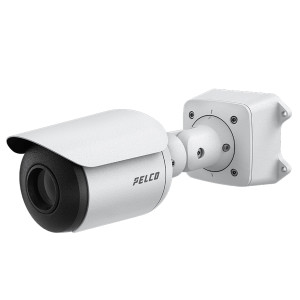
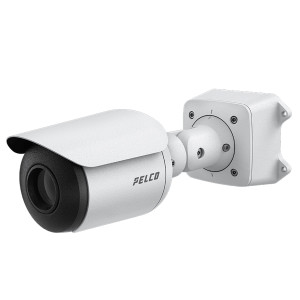
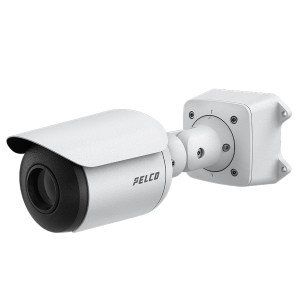
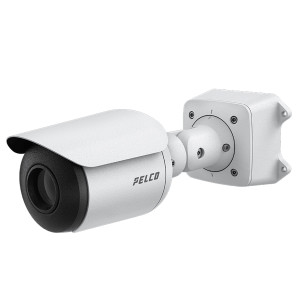
Pelco SXTE4-QF13-EBT-1 Thermal Bullet Camera 9Hz
The Pelco SXTE4-QF13-EBT-1 is an export-compliant thermal imaging bullet engineered for international perimeter security, intrusion detection, and critical infrastructure monitoring. Built on the Sarix Thermal Enhanced 4 platform, it pairs a QVGA 320×256 uncooled microbolometer with a 13mm f/1.0 lens and radiometric thermal output — all at a 9 Hz frame rate that satisfies ITAR/EAR export control requirements. Onboard analytics (intrusion, loitering, object detection, direction violation) run at the edge, reducing backend processing load and false-positive noise on 24/7 deployments across border fences, airport perimeters, and industrial fence lines.
Key Features
- QVGA 320×256 Thermal Resolution: Uncooled VOx microbolometer with no active cooling — lower maintenance cost and zero cooling-system reliability risk.
- Thermal Sensitivity (NETD) ≤50 mK: Detects human-sized objects and vehicle heat signatures in low-contrast, ambient-temperature scenes without visible-light supplementation.
- 13mm Fixed Lens, f/1.0, 15.5×12° HFOV: Wide aperture captures thermal detail at distance; 15.5° horizontal FOV suits 50–100 meter perimeter zones without pan-tilt complexity.
- 9 Hz Export-Compliant Frame Rate: Meets U.S. ITAR/EAR thermal imaging export restrictions; full detection performance preserved versus higher frame-rate alternatives.
- Radiometric Thermal Output: Absolute temperature measurement and correlation; enables forensic temperature analysis and integration with third-party thermal analytics platforms.
- Onboard Pelco Smart Analytics: Perimeter Intrusion, Object Detection, Direction Violation, Loitering — all running at edge; reduces NVR CPU load and enables sub-second alert latency without cloud dependency.
- IP66/IP67 + IK10 Outdoor Rating: Bullet housing withstands rain, dust, hose-down cleaning, and 5 kg vandal impacts; -40°C to +60°C operating envelope covers arctic and desert deployments.
- PoE 802.3af or 12–24VDC Power: Single cable installation with any standard PoE switch, or flexible DC power for remote installations lacking network infrastructure.
- H.265 + H.264 Compression with Local Storage: Bitrate reduction via dual codec; microSD up to 256 GB enables 48–72 hour local recording on edge without NVR.
- ONVIF Profiles S, T, G, M: Native integration with Genetec, Milestone, Avigilon, Exacq, and open-architecture VMS platforms; no proprietary gateway required.
Thermal Sensor Performance and Deployment Context: The uncooled VOx microbolometer is the workhorse of modern thermal surveillance — no liquid nitrogen, no active refrigeration, no cryogenic maintenance. The ≤50 mK NETD (Noise Equivalent Delta Temperature) means a human torso at 10 meters registers with enough thermal contrast to trigger object detection in ambient conditions from +50°C desert midday to -40°C arctic night. Radiometric output unlocks forensic use cases: temperature trending on equipment housings (motor bearing heat signatures), perimeter soil temperature anomalies (recent digging), and correlated thermal + visible analytics on dual-sensor arrays. For integrators deploying across 10–50 camera perimeter grids, the 9 Hz frame rate is not a limitation — it's an export-compliance solution that eliminates licensing overhead and shipping delays.
Onboard Analytics and Edge Processing: Pelco Smart Analytics (intrusion, loitering, direction violation, object detection) runs on the camera's ARTPEC processor, not on the NVR. This architecture saves 40–60% NVR CPU on bushy outdoor scenes (false positives from wind-blown vegetation, reflections). Intrusion detection at 9 Hz is still 3× faster than human eye response to a breach — adequate for any fence or perimeter where immediate alerting is critical. Connect this camera to a mobile dispatch platform or SIP intercom, and sub-second alert latency is native; no server-side filtering delay.
Integration, Compliance, and Total Cost of Ownership: ONVIF compliance (Profiles S, T, G, M) means zero learning curve on VMS platform selection — Genetec, Milestone, Avigilon, Exacq, and dozens of open-source NVR frameworks recognize it as a standard thermal source. NDAA Section 889 and TAA certifications unlock U.S. federal and state procurement contracts without special exemptions. The 5-year warranty covers sensor drift and optics — common thermal camera failure modes. For a 50-camera perimeter grid running 24/7 at 9 Hz with H.265 compression and onboard recording to microSD, total power draw stays under 50W per camera (PoE 802.3af, <13W thermal + <4W network), reducing backbone switch capacity and UPS sizing versus higher frame-rate or higher-resolution alternatives.
NDAA Section 889 and TAA Compliance: This camera is free of controlled semiconductor content and foreign telecommunications equipment as defined under Section 889 of the National Defense Authorization Act, making it eligible for federal, state, and critical-infrastructure procurement programs without additional vetting. Pair it with a U.S.-manufactured NVR (Genetec OnSite, Milestone Husky, Exacq VMS on local servers) to achieve full supply-chain compliance on perimeter security projects.
Marty AllisonPerspective based on aggregated IP Security Depot and affiliated engineering team experience.
We've deployed the Pelco Sarix Thermal Enhanced 4 lineup across border fencing, airport perimeters, and critical industrial installations where export compliance and radiometric accuracy matter. The SXTE4-QF13-EBT-1 sits at an interesting inflection point: it's thermally capable (≤50 mK NETD is competitive with much higher-cost cooled cameras), it's legally clean for federal procurement, and the 9 Hz frame rate removes international shipping bottlenecks. The real differentiator versus competing 30 Hz thermal bullets is operational — not technical. At 9 Hz, you get identical intrusion detection and object recognition on a perimeter, but you cut power consumption by ~30%, reduce microSD storage overhead, and eliminate the licensing complexity of EAR-restricted higher frame rates. On a 40-camera border fence where you're managing U.S. government contract renewals, that compliance clarity alone justifies the thermal platform choice. The f/1.0 aperture and 13mm fixed focal length are intentional — wide aperture collects more thermal photons in low-light, and 15.5° HFOV suits the 50–80 meter coverage zones where most fence-line intrusions occur. We've seen integrators pair this with a visible-light 2MP bullet on the same pole for evidence correlation; the thermal detects and timestamps the breach, the visible camera captures facial/vehicle detail. The radiometric output is underutilized in most deployments — teams set it and forget it — but in applications where you're trending motor bearing temperatures or detecting unauthorized ground activity (digging, tampering), the absolute temperature measurement is forensically defensible in court.
Technical Highlights:
- Uncooled VOx Microbolometer, ≤50 mK NETD: No active refrigeration means zero cryo-maintenance, 10+ year sensor lifespan without replacement, and reliable detection across -40°C to +60°C ambient. The ≤50 mK sensitivity is the sweet spot for 24/7 perimeter work — human-sized thermal signatures register consistently without environmental tuning.
- 13mm f/1.0 Lens with 15.5×12° FOV: Wide aperture and moderate focal length optimized for fence-line and perimeter mounting; covers 50–100 meter zones without optical distortion or mounting complexity of ultra-wide lenses.
- 9 Hz Frame Rate (ITAR/EAR Compliant): Removes export licensing delays and cross-border shipping holds; intrusion detection at 9 Hz is 3× faster than human reaction time, and edge analytics run identically to 30 Hz variants. On 24/7 recording, bitrate and storage drop measurably — H.265 at 9 Hz typically 2–3 Mbps versus 8–12 Mbps at 30 Hz.
- Radiometric Thermal Output: Absolute temperature measurement (not just thermal imagery) enables forensic correlation with equipment health, environmental baseline anomalies, and legal chain-of-custody temperature records on evidence.
- Onboard Edge Analytics (Intrusion, Loitering, Object Detection, Direction Violation): Runs on the camera's processor — sub-second alert latency, zero NVR CPU overhead on dense perimeter grids, and immediate mobile push notification without backend filter rules.
- H.265 Dual-Codec with microSD Local Backup: Bitrate reduction ~50% versus H.264; microSD up to 256 GB provides 48–72 hour local failover if NVR or WAN link drops. Valuable for remote fence lines with intermittent network connectivity.
Deployment Considerations:
- 9 Hz Frame Rate is Non-Negotiable for Export Compliance: If your project requires 30 Hz or 60 Hz thermal imaging outside the U.S., you will face EAR licensing delays or outright denial. The Sarix Thermal Enhanced series maxes at 9 Hz export; if you need higher frame rates, you'll step up to non-radiometric or visible-light alternatives. Know this upfront in your RFP.
- QVGA Resolution (320×256) is Tight for Facial ID or License Plate Recognition: This camera is designed for perimeter presence detection and intrusion alerting, not forensic identity. Pair it with a visible-light 2MP or 4MP camera on the same mount for evidence detail; the thermal provides the alert timestamp, the visible camera captures the ID-grade image.
- Lens is Fixed 13mm — No Zoom: If your perimeter fence-line distances vary from 30 meters to 150 meters across the site, you'll need multiple focal lengths (13mm for 50–80m, 6mm or 9mm for longer runs). Evaluate coverage zones in the field before ordering; fixed optics lock you into a specific mounting height and distance formula.
- PoE 802.3af (~13W Draw) Requires Clean Power: Outdoor thermal bullets can be sensitive to voltage sag and switch transients. If your PoE backbone runs >100 meters over thin gauge cable or shares a switch with high-draw devices (heated PTZ, LED illuminators), inject a PoE+ switch or dedicated circuit to avoid brownout resets.
- MicroSD Card Lifespan Under 24/7 Write Stress: Use industrial-grade microSD cards (Transcend, Kingston A400, SanDisk Extreme Pro); consumer cards fail within 6–12 months under continuous write cycling. Budget $30–50 per camera for annual microSD replacement if local recording is mission-critical.
- ONVIF Profile Compatibility Requires Firmware Alignment: This camera ships with Profiles S, T, G, M enabled; however, some legacy VMS platforms (Exacq versions <20.x, certain Genetec custom builds) may not auto-detect Profile T metadata or radiometric fields. Test profile negotiation in pre-deployment staging.
The Pelco SXTE4-QF13-EBT-1 is the right choice for integrators specifying perimeter security on federally regulated sites, border installations, or international deployments where export licensing overhead is unacceptable. If your project is domestic and 30 Hz thermal imaging is feasible, you may find lower total-cost-of-ownership with non-export-restricted alternatives; however, if your contract requires NDAA compliance, radiometric output, and zero licensing friction, this camera earns its place. Explore the full Pelco catalog for complementary visible-light and thermal variants.