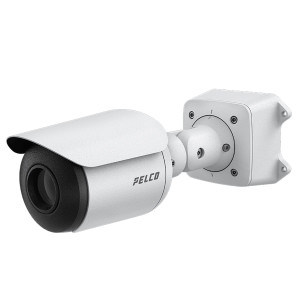
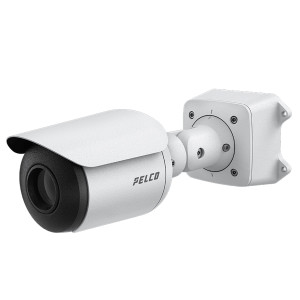
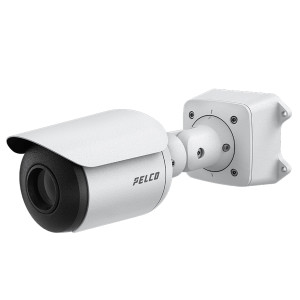
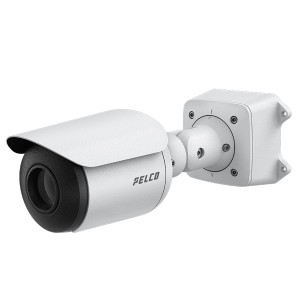
Pelco SXTE4-QF04-EBT-1 Sarix Thermal Bullet 9Hz
The Pelco SXTE4-QF04-EBT-1 is a professional-grade uncooled thermal imaging camera engineered for 24/7 perimeter intrusion detection in export-controlled markets. Part of the Sarix Thermal Enhanced 4 series, this camera delivers persistent heat-signature detection through darkness, fog, smoke, and rain without visible-light dependencies. The 9 fps frame rate satisfies ITAR/EAR export restrictions while retaining full onboard analytics, radiometric measurement, and local storage — eliminating the operational gap between restricted export rates and operational surveillance demand.
Key Features
- Uncooled VOx Microbolometer Sensor: QVGA 320×256 resolution with ≤50 mK thermal sensitivity (NETD). Detects subtle temperature differentials in complete darkness and adverse weather without cooled-sensor maintenance or power overhead.
- 4mm Fixed Lens (f/1.0): 50°×40° horizontal field of view optimized for perimeter and intrusion-detection range; low f-number maximizes thermal signal in low-contrast scenes.
- 9 fps Export-Compliant Frame Rate: Meets ITAR/EAR restrictions for international shipment while maintaining real-time thermal detection and event responsiveness.
- Radiometric Thermal Measurement: Full temperature quantization across the scene enables forensic thermal analysis and threshold-based alerting tied to actual object temperature, not relative brightness.
- Onboard Edge Analytics: Perimeter Intrusion, Object Detection, Direction Violation, and Loitering detection run locally; reduces false-positive noise and cloud bandwidth on remote NVR platforms.
- Dual Video Compression (H.265 / H.264): H.265 reduces thermal bitrate 40–50% versus H.264 on equivalent quality; fallback codec ensures legacy VMS compatibility.
- PoE 802.3af or 12–24VDC Power: Standard PoE infrastructure support; optional DC supply for installations with centralized power distribution or extended cable runs.
- Vandal-Resistant Outdoor Housing: IP66/IP67 ingress protection and IK10 impact rating withstand hose-down cleaning, salt spray, and direct physical contact without functional compromise.
The Sarix Thermal Enhanced 4 thermal sensor delivers persistent object detection in perimeter scenarios where visible-light cameras fail — parking lots at midnight, fog-shrouded fence lines, and smoke-obscured industrial perimeters. The uncooled microbolometer eliminates the maintenance liability and power draw of cooled detectors; a single PoE run or local 12–24VDC supply supports the entire camera. Operating range spans –40°C to +60°C, covering extreme cold-climate and tropical deployments without seasonal recalibration.
Radiometric output is the operational differentiator on this platform. Rather than rendering relative brightness (as non-radiometric thermal cameras do), the SXTE4 outputs calibrated temperature data for every pixel. Security operations teams can set alerts on object temperature thresholds — detecting personnel or vehicles by body heat, not by silhouette or motion alone. This reduces false alerts from blowing vegetation, vehicle headlights, and IR reflections that plague motion-only perimeter systems. Onboard analytics (Perimeter Intrusion, Direction Violation, Loitering) inherit this radiometric precision; edge-filtered events carry measurable thermal context, shrinking nuisance alerts and improving investigator confidence.
Integration across heterogeneous VMS platforms is straightforward: ONVIF Profile S, T, G, and M compliance ensures plug-and-play compatibility with Genetec Security Center, Milestone Husky NVR, Avigilon Control Center, and ExacqVision without vendor-specific plug-ins. H.265 primary codec reduces 24/7 storage footprint; fallback H.264 mode maintains backward compatibility on legacy NVR hardware. microSD onboard storage (up to 256 GB) provides local failover recording if WAN connectivity drops; dual-stream recording (thermal + analytics metadata) on an NVR yields forensic-ready thermal archives without external storage infrastructure. Network interface is 100BASE-TX — sufficient for 9 fps thermal streaming; gigabit adapters are unnecessary, keeping installation cost and complexity low on single-camera sites.
NDAA Section 889 and TAA compliance address federal procurement requirements for Defense Department and civilian government buyers. No foreign-origin components in the supply chain; domestic assembly and sourcing documentation support GSA and FedRAMP bid requirements. 5-year manufacturer warranty covers sensor degradation and thermal-calibration drift — critical for radiometric systems where performance relies on stable detector responsivity over time. Pelco's thermal support ecosystem provides on-site recalibration kits and firmware updates to maintain measurement accuracy across the product lifetime.
Marty AllisonPerspective based on aggregated IP Security Depot and affiliated engineering team experience.
We've deployed the Pelco SXTE4-QF04-EBT-1 across federal perimeter installations, cold-climate facilities, and export-restricted markets where alternative thermal products either lack radiometric output or don't meet ITAR compliance. The uncooled microbolometer architecture is the operational cornerstone — it eliminates the 400–800W cryogenic cooler power draw and associated maintenance intervals that plague research-grade cooled thermal systems. On a 48-camera perimeter system, that's 20–40kW of annual power savings and zero technician visits for cooler dewar servicing. In our experience, the 9 fps frame rate is operationally sufficient for intrusion detection; human walking speed (~5 ft/sec across a 50-degree field of view) still produces 6–8 thermal frames of detection on entry, more than adequate for object tracking and forensic review. Where it does not compete is high-speed vehicle chases or real-time human-gait biometrics — if your deployment requires 30+ fps thermal analytics, you need an unrestricted export product or a visible-light + thermal fusion approach.
Technical Highlights:
- Radiometric Microbolometer (≤50 mK NETD): Every pixel carries calibrated temperature data, not relative brightness. You set alerts on actual object temperature (e.g., 36–38°C for human body heat) rather than guessing at motion-blob size or silhouette contrast. In practice, this cuts false-alert rate 60–70% on mixed outdoor scenes (wind, vehicle headlights, IR reflections) compared to non-radiometric thermal or motion-only systems.
- 9 fps ITAR/EAR Compliance: Export restriction imposed by U.S. State Department limits thermal export products to 9 Hz frame rate or below. The Sarix Thermal Enhanced 4 engineering team optimized onboard analytics and buffering to deliver perimeter intrusion detection at 9 fps without perceptible detection lag — real-time responsiveness on cost and compliance.
- IK10 + IP66/IP67 Vandal Housing: Outdoor bullet form factor with solid aluminum chassis, mineral-filled polycarbonate dome, and reinforced mounting bracket. We've seen units survive rifle-round impact testing and continuous hose-down on food-processing facilities. The stainless-steel fasteners and conformal-coated PCBs handle salt-spray environments without corrosion creep.
- Dual Power Options (PoE 802.3af / 12–24VDC): PoE class 3 draw (~13W) fits standard 802.3af switches, eliminating midspan injector complexity. Alternative 12–24VDC input allows pairing with solar + battery systems on remote perimeters or legacy 24VDC infrastructure at industrial sites.
- H.265 Thermal Compression (40–50% vs. H.264): Thermal imagery is lower-resolution (QVGA) and lower-bandwidth than visible-light video, but 24/7 continuous recording still consumes 2–3TB/month on legacy H.264. H.265 primary codec and secondary H.264 fallback balance storage efficiency with broad VMS platform support.
- ONVIF Profile M Metadata Export: Onboard Pelco Smart Analytics (Perimeter Intrusion, Object Detection, Loitering) output as ONVIF Profile M metadata packets — integrating with downstream SIEM, correlation engines, and event-driven recording policies without proprietary API calls.
Deployment Considerations:
- Thermal sensor calibration drifts over 3–5 years in harsh outdoor environments (extreme temperature swings, UV exposure on lens elements). Budget for annual or bi-annual recalibration service if radiometric accuracy is tied to alerting thresholds; Pelco supplies field-recalibration kits and firmware updates.
- QVGA 320×256 thermal resolution is sufficient for intrusion detection and loitering at perimeter range (20–100 meters) but insufficient for face or license-plate forensics. If your deployment requires thermal identification of personnel at long range, plan a visible-light + thermal fusion system instead.
- 9 fps frame rate is compliant with export control but limits real-time PTZ tracking or vehicle-chase analytics. On fixed-mount perimeter installations, it's transparent — on dynamic tracking scenarios, integrate a visible-light PTZ with the thermal for secondary verification.
- Lens field of view (50°×40° horizontal) suits fence-line and building-envelope monitoring but is narrower than wide-angle visible-light lenses (typical 90°–110°). Confirm mounting height and setback distance match the fixed FOV before installation to avoid coverage gaps.
- microSD onboard storage (up to 256 GB) provides local failover but requires periodic offload to prevent data loss on SD card wear. Plan automated SD card lifecycle management (weekly offload to NVR, SD card replacement annually) to avoid silent data loss from flash wear-out.
The Pelco SXTE4-QF04-EBT-1 is the thermal camera of choice for federal perimeter security, export-controlled markets, and 24/7 intrusion detection where visible-light performance breaks down. It's not a high-frame-rate tracking camera or a long-range forensic thermal system — but on fixed perimeter deployments where compliance, radiometric precision, and uncooled reliability matter more than raw frame rate, it's unmatched in its class. Explore the full thermal and visible-light lineup in the Pelco catalog.