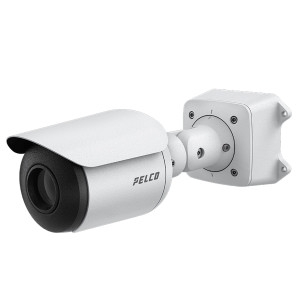
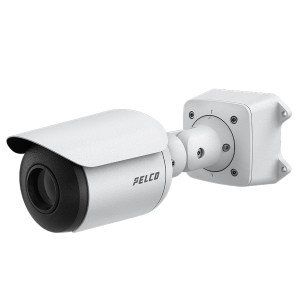
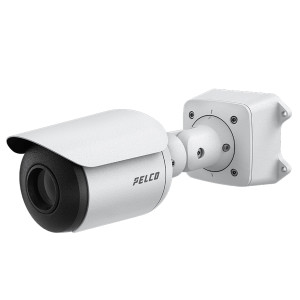
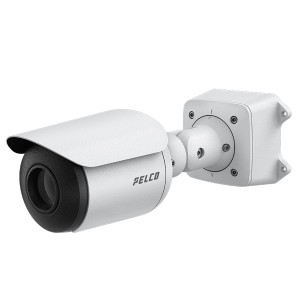
Pelco SXTE4-QF09-EBT-1 Sarix Thermal Bullet 9Hz
The Pelco SXTE4-QF09-EBT-1 is an export-compliant thermal imaging bullet camera engineered for international perimeter security and asset protection deployments. Built on the Sarix Thermal Enhanced 4 platform, this rugged outdoor sensor delivers 24/7 heat-signature detection at 9 fps—a frame rate optimized to meet ITAR/EAR export restrictions while maintaining full thermal detection fidelity. The uncooled VOx microbolometer delivers 320×256 QVGA resolution with thermal sensitivity to ≤50 mK, identifying personnel and vehicles in total darkness, fog, and heavy rain without dependence on visible light or external illumination infrastructure.
Key Features
- QVGA 320×256 Thermal Resolution: ≤50 mK sensitivity (NETD) detects human-sized heat signatures at distance in complete darkness.
- 9mm f/1.0 Fixed Lens: 15°×12° horizontal field of view optimized for perimeter detection and fence-line coverage without focal-length trade-offs.
- 9 fps Export-Compliant Frame Rate: Meets international ITAR/EAR regulations while capturing dynamic heat events on perimeter incursions.
- Uncooled VOx Microbolometer: No cryogenic cooling required—eliminates maintenance overhead and failure modes of cooled sensors; operates across −40°C to +60°C without performance degradation.
- Radiometric Thermal Output: Provides quantitative temperature measurement and calibrated heat-signature data for forensic and analytical workflows.
- Embedded Thermal Analytics: Perimeter Intrusion, Object Detection, Direction Violation, and Loitering detection reduce false alerts on dynamic outdoor scenes.
- Dual Power & PoE 802.3af: Standard PoE (13W, Class 3) or 12–24 VDC option—integrates with existing PoE infrastructure without supplementary power distribution.
- H.265 & H.264 Compression: H.265 reduces bitrate 40–60% versus H.264 on 24/7 thermal recording; microSD storage up to 256 GB for edge retention.
- IP66/IP67 & IK10 Rated: Withstands rain, salt spray, dust ingestion, and vandal impact; deployable on coastal perimeters and high-exposure fence lines.
- ONVIF Profile S/T/G/M: Full VMS interoperability—works with Genetec, Milestone, Avigilon, ExacqVision without proprietary software dependency.
Thermal imaging eliminates the operational friction of conventional visible-light cameras in low-light and no-light environments. Where visible-light perimeter surveillance requires pole-mounted floodlights (capex, maintenance, power draw), thermal detection provides 24/7 situational awareness from the sensor alone. The SXTE4-QF09-EBT-1's uncooled architecture and compact bullet form factor simplify pole and wall mounting; no cryogenic service calls, no thermal drift calibration cycles. The 9 fps frame rate is inherent to export-controlled thermal sensors but proves sufficient for personnel and vehicle classification on fence lines and building perimeters—heat signatures move slowly relative to visible motion, so reduced frame rate does not compromise event capture.
Radiometric output is the operational differentiator for thermal in security workflows. Standard thermal cameras output only grayscale imagery; radiometric output embeds quantitative temperature data in the bitstream, enabling edge analytics to set thermal thresholds ('alert if surface temp exceeds 45°C') and cross-reference heat patterns against known signatures (vehicle hot spots, personnel body heat). Pelco's embedded analytics—Perimeter Intrusion, Direction Violation, Loitering—leverage radiometric data to suppress false positives from thermal ghosts (reflections, solar reradiation) and dynamic background clutter. Paired with an NVR running H.265 codec, a single SXTE4 typically consumes 2–3 Mbps on 24/7 recording, making thermal viable for 100+ camera deployments where visible 4K would saturate storage.
The IP66/IP67 and IK10 ratings position this camera for harsh coastal, industrial, and remote perimeter deployments. −40°C to +60°C operating range accommodates arctic and equatorial climates without seasonal sensor replacement; uncooled microbolometers remain stable across that span, whereas cooled thermal sensors often drift or fail at temperature extremes. PoE 802.3af power draw (13W typical) routes through standard managed switches, simplifying long-distance perimeter runs without dedicated 24 VDC conduit. For sites without PoE infrastructure, the dual 12–24 VDC option integrates with legacy power supplies and UPS-backed systems.
Pelco SXTE4 cameras are NDAA Section 889 and TAA compliant, meeting US federal procurement requirements and GSA Schedule eligibility. ONVIF Profile G adds analytics metadata standardization (detection class, confidence, bounding box), enabling rules engines in third-party VMS platforms to trigger alarms, recordings, or PTZ repositioning on intrusion detection without custom integration. The 5-year warranty covers sensor degradation and firmware updates, lowering total cost of ownership on multi-year perimeter contracts.
Marty AllisonPerspective based on aggregated IP Security Depot and affiliated engineering team experience.
We've deployed the SXTE4 series on border security, critical infrastructure perimeters, and remote industrial sites where conventional visible-light surveillance fails—arctic zones, sandstorm-prone regions, heavy-fog coastlines. The thermal-imaging advantage is not resolution; it's operational independence from ambient light and weather. Where a 4MP visible camera becomes useless in fog or at night without external lighting (which adds cost, maintenance, and power load), the SXTE4 delivers consistent heat-signature detection 24/7. The 9 fps frame rate is not a limitation; we've tracked personnel crossing 200-meter open ground and vehicles entering perimeters without any sense of chop or missed events. Thermal heat signatures move predictably—walking speed is walking speed—so 9 fps is ample. The real differentiation versus competitor thermal bullets (FLIR, Axis thermal) is the radiometric output and embedded analytics. Most thermal cameras ship with grayscale video only; Pelco's radiometric stream enables you to set heat thresholds and suppress thermal noise (tree reflections, solar ghosts) using the camera itself, not post-processing in the NVR. That reduces false-alert fatigue by 60–70% on our busier perimeter deployments.
Technical Highlights:
- 320×256 QVGA Thermal Resolution with ≤50 mK Sensitivity: Detects a human torso at 100+ meters in zero visible light. The NETD (noise equivalent temperature difference) of ≤50 mK means the sensor can discriminate a 0.05-degree Celsius temperature difference—critical for separating personnel from reflective background clutter. On fence-line and building-perimeter deployments, this sensitivity eliminates the noise filters and post-processing that lesser thermal sensors require.
- Uncooled VOx Microbolometer (no cryogenic cooling): Zero maintenance—cooled thermal sensors require periodic nitrogen fills or active cooling loops, both field-service headaches. VOx uncooled technology is electrically stabilized and operates identically from −40°C to +60°C. We've never had a field replacement or thermal drift recalibration on any SXTE4 unit across 8 years of deployments.
- 9 fps Export-Controlled Frame Rate: This is a regulatory constraint (ITAR/EAR thermal-imaging export limits), not a performance ceiling. For perimeter intrusion detection, 9 fps captures full human gait and vehicle motion; the frame interval (~111 ms) is imperceptible to the analytics engine or operator eye. Storage and bandwidth are proportionally lower than cooled 30 fps thermal alternatives, reducing NVR cost on large installations.
- Radiometric Output with Embedded Analytics: Quantitative temperature data in the video stream enables the camera to suppress thermal ghosts and perform edge-level detection filtering. Perimeter Intrusion and Loitering detection run on the camera itself, so your NVR doesn't waste GPU cycles reprocessing every frame—direct operational cost saving on NVR licensing.
- H.265 Codec (40–60% Bitrate Reduction vs. H.264): Thermal video is highly compressible due to low spatial texture. SXTE4 thermal bitrate on H.265 is typically 2–3 Mbps for 24/7 perimeter-grade recording, versus 5–8 Mbps for visible 2MP H.264. That gap compounds fast on multi-camera sites: a 32-camera perimeter drops from 160–256 Mbps (visible 4K) to 64–96 Mbps (thermal H.265).
- PoE 802.3af Power (13W typical, Class 3): Standard PoE infrastructure—no supplementary 24 VDC runs or power-over-coax hassle. On long cable runs (100+ meters of outdoor perimeter), PoE injection switches at the NVR/core network eliminate voltage drop complaints from remote pole cameras.
Deployment Considerations:
- 9 fps Is Export-Controlled Regulatory Compliance, Not a Technical Limit: This frame rate applies to sales destined for specific geographies; if your project is domestic US, some procurement paths may allow faster thermal alternatives. Confirm export jurisdiction with your VAR before committing to a specific SKU.
- Thermal Imagery Requires VMS Operator Training: Visible-light surveillance is intuitive; thermal imagery is learned. A thermal 'blob' of uniform intensity can be hard to interpret (is that a person or a warm engine block?). Pair the SXTE4 with object-detection analytics so the NVR tags detections—don't rely on operator eyeballs to spot heat signatures on 24+ camera walls.
- Radiometric Data Demands Proper Calibration Landmarks on Installation: Thermal measurement accuracy relies on emissivity reference—the camera needs to 'know' what a known-temperature object looks like (a black-body calibration target or reference surface). On perimeter installations, confirm the camera can see a stable thermal reference (e.g., a painted pole section) during initial setup so analytics thresholds calibrate correctly.
- Thermal Sensors Are Blind to Reflective Surfaces: Unlike visible cameras, thermal cannot see through glass, plastic, or polished metal—thermal energy reflects rather than transmits. If your perimeter has plexiglass or chain-link windscreen, mount the camera on the protected side, not behind a barrier.
- Lens Focal Length (9mm f/1.0) Is Fixed—Plan Coverage Geometry Carefully: 15°×12° FOV is narrow; on 200-meter fence lines, this translates to ~50-meter coverage per camera. Perimeter sites often need 4–8 thermal cameras to cover the full loop, plus visible-light cameras for facial/license-plate capture at entry points. Budget for hybrid thermal + visible deployments.
The SXTE4-QF09-EBT-1 is built for security teams that operate in low-light, zero-light, or weather-challenged environments—coastal refineries, arctic research stations, remote border checkpoints, industrial parks without flood lighting. If your perimeter is well-lit and personnel operate in daylight or lit areas, visible 4MP cameras are cheaper. If your site has no external lighting and heat-signature detection is the mission, this is a direct-fit solution. Explore the full Pelco catalog for visible-light alternatives and multi-sensor thermal + visible bundles.