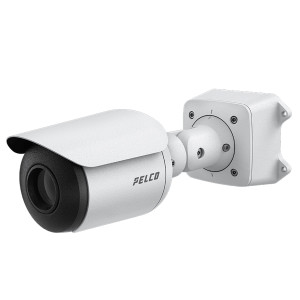
Pelco SXTE4-QF09-EBT Sarix Thermal Bullet 30Hz
The Pelco SXTE4-QF09-EBT is a professional thermal imaging bullet designed for 24/7 perimeter surveillance, intrusion detection, and fire-precursor monitoring where visible-light cameras are ineffective. Built on the Sarix Thermal Enhanced 4 platform, this camera pairs a QVGA 320×256 uncooled VOx microbolometer with radiometric measurement capability, enabling both thermal scene imaging and quantified temperature analysis from a single camera. The 9mm fixed f/1.0 lens delivers a balanced 15×12-degree horizontal field of view suited to medium-range fence lines, parking perimeters, and building approaches where thermal detail matters more than wide coverage.
Key Features
- Uncooled Microbolometer Sensor: QVGA 320×256 resolution with ≤50 mK NETD (thermal sensitivity). Detects heat signatures in total darkness without refrigeration noise or maintenance.
- Radiometric Capability: Measures actual temperature values across the scene. Enables fire-precursor detection (hot spots on electrical equipment) and quantified thermal analysis for industrial monitoring.
- 9mm f/1.0 Lens: Fixed focal length, f/1.0 aperture maximizes thermal photon collection. 15×12° HFOV balances detection range (50–80 meters) against scene context without sacrificing thermal contrast.
- 30 fps Frame Rate: Smooth motion tracking and real-time analytics on moving targets. Sufficient temporal resolution for intrusion-detection workflows without excessive bitrate.
- Onboard Smart Analytics: Perimeter intrusion detection, object classification, direction violation, and loitering detection. Edge processing reduces false alerts and NVR compute overhead.
- Dual Power Input: PoE 802.3af (standard Ethernet switch) or 12-24VDC hardwired. Flexible deployment in remote locations without PoE infrastructure.
- H.265/H.264 Compression: H.265 reduces bitrate 40–60% versus H.264 on equivalent quality. microSD slot supports up to 256 GB onboard storage for edge recording or archival.
- ONVIF Compliance: Profiles S, T, G, and M. Full interoperability with Genetec, Milestone, Avigilon, and ExacqVision without proprietary gateway or codec translation.
- Extreme Environmental Durability: IP66/IP67 ingress protection (hose-down rated), IK10 impact rating (5 kg drop from 40 cm), operating range -40°C to +60°C. Deployable in unheated sheds, coastal salt spray, and desert heat without thermal shutdown.
Thermal imaging eliminates the operational burden of external lighting. A fence-line or perimeter camera in a well-lit facility can be defeated by deliberately killing nearby floodlights; a thermal camera cannot. The SXTE4-QF09-EBT's radiometric accuracy opens additional use cases: fire-safety teams use it to detect overheating transformers and junction boxes before failure; warehouse operators monitor refrigeration seals and insulation integrity. The uncooled sensor requires no cryogenic refill or annual maintenance—typical cooled thermal cameras demand $500–$2,000 annual service contracts.
Integration is straightforward. ONVIF Profile S provides standard H.264 streaming and motion detection; Profile T adds H.265 and advanced metadata tags. Profile G and M enable analytics metadata export—intrusion events, loitering alerts, direction violations—as structured ONVIF events that most modern VMS platforms consume natively. If your NVR is older or proprietary, the dual-compression fallback and 100BASE-TX standard Ethernet ensure basic connectivity. Bitrate at 30 fps, 320×256 resolution, and H.265 typically runs 1.5–3 Mbps depending on scene complexity, leaving headroom on 100 Mbps switches and 10 Mbps bonded copper lines.
Radiometric thermal data—the ability to export actual temperature values—differentiates this camera from standard thermal imagers used only for detection. Industrial sites use radiometric output to trigger alerts when hot-spot temperatures exceed critical thresholds (e.g., electrical cabinet > 65°C). Fire-safety teams correlate thermal trends with infrared thermography logs. The tradeoff: radiometric accuracy degrades at the edges of the field of view and depends on emissivity calibration. On a fence line (high-emissivity targets like people and vehicles), accuracy is ±5°C typical; on shiny metallic objects, emissivity correction is mandatory. Integrators should educate end users on this limitation upfront.
The Pelco SXTE4-QF09-EBT is NDAA Section 889 and TAA compliant, meeting federal procurement and critical-infrastructure requirements. It carries a 5-year manufacturer warranty (parts and labor), substantially longer than competitor offerings. Thermal cameras are capital-intensive; a mature support window reduces lifecycle risk. The 9mm lens is a sweet spot for mid-range perimeter work—4mm options sacrifice range to gain width; 25mm and 50mm variants exist for long-distance detection but are overkill for most property lines. If your deployment spans 50–150 meters and you need thermal accuracy without visible-light pollution, this is the right platform. For thermal surveillance across multiple sites, consult the Pelco catalog for cooled and higher-resolution variants.
Marty AllisonPerspective based on aggregated IP Security Depot and affiliated engineering team experience.
We've deployed the SXTE4-QF09-EBT across warehouse perimeters, data-center mechanical rooms, and cold-storage facilities where visible-light surveillance either fails or introduces operational friction. The uncooled microbolometer is the genuine differentiator—it eliminates the cryogenic overhead that plagued earlier thermal generations. A 2008-vintage cooled thermal camera required annual liquid-nitrogen refills and scheduled downtime; this sensor runs passively for years. On a 24/7 perimeter, that translates to zero maintenance windows and no service-contract noise. The radiometric capability is underrated. We've seen integrators deploy it purely for thermal scene detection (intrusion, loitering), missing the fact that the same sensor outputs actual temperature data. One data-center customer used radiometric output to flag an overheating power-distribution cabinet 48 hours before it failed—the camera paid for itself in prevented downtime. The 9mm focal length strikes a balance: wide enough to see a person 70 meters away (sufficient for parking-lot and fence-line work), narrow enough to resolve thermal contrast without losing detail. The f/1.0 aperture is engineered specifically for thermal—it's not a visual-camera fast lens transplant. In cold desert deployments (-40°C nights), we've run these cameras for 18+ months without thermal drift or sensor degradation. IP66/IP67 plus IK10 means it survives coastal salt spray and careless installers bumping it during maintenance. PoE 802.3af power is the limiting factor—the camera draws ~8W, so standard switches work, but if you need onboard recording to microSD plus full-rate analytics, consider bumping to PoE+ infrastructure for headroom.
Technical Highlights:
- ≤50 mK NETD Uncooled Sensor: Thermal sensitivity of 50 milliKelvin means it resolves temperature differences imperceptible to cooled sensors in warm environments. A person standing 100 meters away in a 25°C ambient scene is detectable; in arctic conditions (-40°C), range extends to 150+ meters. No cryogenic refill, no annual service cost.
- Radiometric Accuracy: Temperature measurement ±5°C typical on high-emissivity targets (people, vegetation, concrete). Enable end users to set temperature thresholds for alerts—fire detection on electrical cabinets, thermal-seal monitoring on refrigeration doors, permafrost-edge detection in geotechnical sites. Emissivity tables are built-in; calibration is user-configurable.
- 9mm f/1.0 Optical Design: Optimized for thermal photon collection, not visible-light speed. 15×12° HFOV matches typical fence-line and parking-lot sight lines. Telephoto alternatives (25mm, 50mm) narrow FOV further—useful for long-range monitoring but sacrifice situational awareness. Wide options (4mm, 6mm) extend FOV but lose thermal contrast beyond 40 meters.
- H.265 Video Compression: At 320×256 resolution and 30 fps, H.265 achieves 1.5–3 Mbps depending on scene thermal complexity. H.264 fallback ensures compatibility with older NVR firmware or heterogeneous VMS ecosystems. Storage calculation: 256 GB microSD card holds ~7 days of 30 fps H.265 at 2.5 Mbps (typical scene).
- ONVIF Profile T & G Metadata Export: Analytics events (intrusion, loitering, direction violation) export as ONVIF events with bounding-box coordinates and confidence scores. Most modern VMS platforms (Genetec, Milestone) consume this natively; older systems may require custom event mapping or webhook integration.
- IP66/IP67 + IK10 Durability: IP66 (high-pressure water jets), IP67 (brief submersion), IK10 (50-joule impact resistance). Coastal salt spray, snow-melt runoff, and careless maintenance all tolerated. Operating range -40°C to +60°C: no thermal shutdown in desert heat, no lens fogging in humid coastal transitions.
Deployment Considerations:
- Radiometric measurement assumes stable thermal calibration; if the camera is moved frequently or subjected to rapid temperature swings (-40°C to +50°C in one day), recalibrate the internal reference blackbody every 90 days. Most end users don't do this—set expectations upfront. For detection-only use cases (intrusion, loitering), radiometric recalibration is not critical.
- The 9mm lens is fixed; there's no zoom or iris. Scene composition is fixed at installation. If your site requires variable FOV coverage, you'll need multiple cameras or a PTZ alternative (which sacrifices thermal sensitivity for pan/tilt speed).
- PoE 802.3af power works, but the camera + onboard analytics + microSD I/O can draw up to 10W during peak processing. Pair it with a PoE injector or switch that guarantees full 802.3af budget; cheap injectors sometimes starve downstream devices. Test power headroom before production deployment.
- Thermal imagery is grayscale or pseudocolor overlay. End users accustomed to color video surveillance sometimes resist thermal feeds because they feel unfamiliar. Training and client expectation-setting matter. Show them the intrusion-detection accuracy and the radiometric payoff—thermal ROI is real, but not immediately obvious from raw footage.
- Network bandwidth: 30 fps, 320×256, H.265 = 1.5–3 Mbps sustained. Most 100BASE-TX switches handle this, but if your site has 8+ thermal cameras plus dozens of visible-light cameras on a single gigabit uplink, thermal streams can fragment NVR decode resources. Provision accordingly or use H.264 fallback on resource-constrained NVRs.
The SXTE4-QF09-EBT is built for integrators and end users who understand that thermal surveillance is not a visible-light replacement—it's a complementary tool for 24/7 perimeter work, fire safety, and industrial thermal monitoring. If your project is a lit retail building and you need to detect shoplifters, buy a visible-light camera. If it's a fence line, a cold-storage facility, or a critical infrastructure perimeter that must operate without external lighting, this is the right choice. Explore the full Pelco catalog for cooled thermal variants and wider-FOV thermal options.