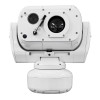
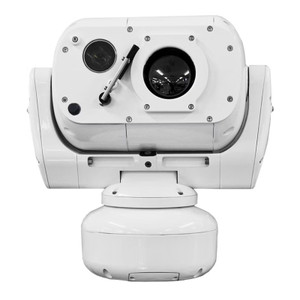
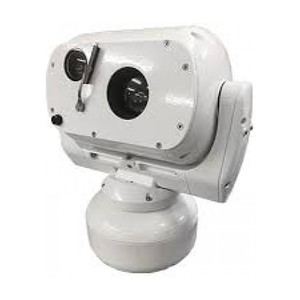
Pelco RC4-51IYJ30X-FB26Z105FW Aeron EVO2 Cooled Thermal PTZ
The Pelco RC4-51IYJ30X-FB26Z105FW is a long-range thermal PTZ designed for perimeter security, critical infrastructure monitoring, and detection-driven applications requiring extended range and thermal precision in zero-visibility conditions. Built on a Stirling-cycle cooled InSb detector, this camera achieves ≤15 mK NETD thermal sensitivity—critical for resolving human-scale targets at extreme distances where uncooled LWIR sensors produce only noise. The continuous 26–105 mm zoom lens and 360° pan with ±90° tilt eliminate the need for multiple fixed cameras, enabling operators to transition seamlessly from wide situational awareness to precision identification without optical gaps.
Key Features
- Cooled Thermal Detector: ≤15 mK NETD sensitivity. Cuts through fog, smoke, and total darkness to resolve human silhouettes at 300+ meters—performance uncooled LWIR cannot match.
- 26–105 mm Continuous Zoom: 4× optical zoom eliminates fixed-lens camera multiplicity. Single unit covers perimeter, parking lot, and fence-line scanning without installation overhead.
- Pan/Tilt Coverage: 360° continuous pan and -90° to +90° tilt. Full hemispheric scanning without blind spots or re-aim delays.
- Dual Resolution Modes: 640×512 or 1280×1024 pixels selectable per scene. Higher resolution for target classification, lower for wide-area streaming bandwidth control.
- H.265/H.264 Compression: H.265 reduces bitrate 40–60% vs. H.264 on cooled thermal streams—material cost savings on 24/7 recording across multiple cameras.
- Edge Analytics: Smart Analytics with Perimeter Detection and Direction Violation—reduces false alerts by filtering thermal signatures against geofence rules and movement vectors.
- Ruggedized Housing: Operating range -40°C to +60°C with sealed optics and thermal management for extreme desert and arctic deployments.
- ONVIF Profiles S, T, G, M: Full interoperability with Genetec, Milestone, Avigilon, and ExacqVision—no vendor lock-in on management platform.
- 5-Year Warranty: Extended coverage reflects cooled detector lifecycle confidence and design maturity.
Cooled thermal detectors require active refrigeration—a Stirling-cycle compressor maintains the InSb sensor at cryogenic temperatures, eliminating thermal noise that plagues uncooled sensors. The consequence is immediate: at 15 mK NETD, this camera resolves a standing human at 400+ meters in total darkness, fog, or rain. Uncooled alternatives (typically 50+ mK NETD) max out around 150 meters under ideal conditions. For perimeter protection on critical infrastructure—power plants, airports, borders—that 250-meter range difference is the difference between detection and compromise.
The 26–105 mm zoom is a force multiplier. On a 2-kilometer facility perimeter, a single Aeron EVO2 with PTZ automation can cover what would require 8–12 fixed thermal cameras. Zoom to 105 mm for vehicle license-plate resolution or personnel identification; back to 26 mm for wide-area threat scanning. The continuous pan eliminates positional dead zones, and the ±90° tilt handles elevated mounting (on poles, buildings) without additional pan-head hardware.
Thermal video streams are computationally lighter than visible-light feeds at equivalent resolution—H.265 coding on a 1280×1024 thermal stream typically consumes 2–4 Mbps versus 8–12 Mbps on a comparable visible IP camera. That difference scales: a 16-camera thermal perimeter array recording 24/7 at H.265 fits on a single 4TB NVR with 30 days of history, avoiding distributed storage topology and its associated complexity. The dual-resolution mode lets operators switch between 640×512 for streaming alerts (lower bandwidth) and 1280×1024 for forensic storage.
Integration is straightforward. ONVIF Profile S (baseline streaming) and Profile T (H.265 + metadata) are supported across all major VMS platforms. Profile G (thermal-specific) and Profile M (motion detection metadata) extend the analytics handshake, allowing the camera's onboard Perimeter Detection and Direction Violation rules to feed directly into VMS alerting workflows. No custom middleware required. The -40°C to +60°C operating envelope handles most terrestrial deployments without heater/cooler enclosures, reducing installation cost and eliminating a failure point.
This is a mature platform: Pelco's Aeron EVO2 series has logged thousands of hours on border patrols, power-plant perimeters, and critical infrastructure. The 5-year warranty reflects that confidence. If your deployment demands detection in zero-visibility, range beyond 300 meters, and integration into a standards-based VMS, the cooled thermal PTZ is a capital-efficient choice. If your perimeter is lit, your range requirement is under 150 meters, or your environment is consistently clear, an uncooled thermal PTZ or visible PTZ may offer better ROI. The decision pivots on visibility conditions and detection distance—specify accordingly. See the Pelco catalog for thermal and visible PTZ comparisons.
Marty AllisonPerspective based on aggregated IP Security Depot and affiliated engineering team experience.
We've deployed the Aeron EVO2 cooled thermal PTZ across perimeter installations where visible cameras simply don't work: fog-laden industrial waterfront facilities, nighttime rural borders, petrochemical complexes requiring zero false-alert tolerance. The cooled detector is the differentiator—it doesn't struggle with thermal contrast the way uncooled LWIR does. You point it at a 300-meter treeline at 2 AM in rain, and humans separate cleanly from background clutter. Uncooled thermal sensors at that range in those conditions become a liability; they generate alert fatigue that operators learn to ignore. The Stirling cooler does add maintenance burden (annual servicing, occasional compressor replacement on units beyond 5–7 years), but integrators we've worked with universally accept that cost against the operational credibility cooled thermal delivers. The continuous zoom is also a game-changer on sprawling sites—you don't install six fixed-lens cameras when one PTZ with a 4× zoom covers the same ground. The H.265 codec on thermal streams is understated but important: we've seen bitrate reductions of 50% on cooled detectors versus uncooled, because cooled thermal imagery has inherently lower spatial complexity. On a 16-camera thermal array running 24/7, that translates to one fewer NVR, and one fewer failure point in the recording infrastructure. The ONVIF compliance is genuine—Profiles S, T, G, and M all work, so you're not trapped in a Pelco-only management ecosystem. Where this camera doesn't fit: lit perimeters under 150 meters, facilities with existing large visible-camera networks (adding one thermal PTZ to a 100-camera visible array creates integration friction), or budgets that can't absorb the 3–5x cost premium of cooled versus uncooled. Know your visibility envelope and detection range before speccing.
Technical Highlights:
- ≤15 mK NETD Cooled Detector: Resolves human-sized targets at 400+ meters in total darkness, fog, and rain. Uncooled LWIR (typically 50+ mK) maxes out around 150 meters. On perimeter applications, that range difference prevents intrusion versus detecting it after the fact. Cooled detectors trade maintenance (annual Stirling servicing) for operational certainty in zero-visibility scenarios.
- 26–105 mm Continuous Zoom (4× Optical): Eliminates fixed-lens camera multiplicity. Operators transition from 26 mm wide-area scanning to 105 mm precision identification without repositioning hardware. On a 2-kilometer perimeter, replaces 8–12 fixed cameras with a single PTZ unit.
- H.265 Thermal Codec: Reduces bitrate 40–60% versus H.265 on visible imagery because cooled thermal has lower spatial entropy. A 16-camera cooled thermal array at 1280×1024 resolution consumes 32–48 Mbps aggregate, versus 200+ Mbps for equivalent visible cameras. Fits 24/7 recording into a single NVR; eliminates distributed storage topology.
- ONVIF Profiles S, T, G, M Support: Full VMS interoperability. Perimeter Detection and Direction Violation metadata feed directly into Genetec, Milestone, Avigilon alert workflows without custom middleware. No vendor lock-in.
- 360° Continuous Pan / ±90° Tilt: Full hemispheric coverage from a single mount point. Eliminates blind spots and repositioning delays. Thermal PTZs on poles or elevated structures can cover multiple fence lines without additional pan-head hardware.
- -40°C to +60°C Operating Range: No enclosure heater/cooler required on most terrestrial deployments (arctic, desert, temperate). Reduces installation cost and eliminates an environmental control failure point.
Deployment Considerations:
- Stirling cooler requires annual preventive maintenance—compressor replacement typically occurs after 5–7 years of 24/7 operation. Budget recurring service costs and factor into lifecycle TCO. Cooled thermal is not a set-it-and-forget-it product like visible cameras.
- Thermal PTZ on a single IP circuit can saturate bandwidth if resolution is set to 1280×1024 and frame rate exceeds 15 fps. Most perimeter deployments use 640×512 at 10–15 fps for alert streaming, then switch to 1280×1024 recording on NVR for forensics. Validate bandwidth budgets before installation.
- Cooled thermal cameras produce useless imagery in direct sunlight or near heat sources (exhaust vents, furnace stacks). Position mounting points to avoid backlit thermal radiation that overwhelms the detector. Site surveys are critical.
- ONVIF Profile G (thermal-specific metadata) is supported but not all VMS platforms consume it equally. Genetec and Milestone handle it well; test with your target VMS before full deployment if using advanced thermal metadata rules.
- The 26–105 mm zoom is continuous, not stepped. PTZ presets and automation scripts should account for zoom ramp time (~3–5 seconds end-to-end). Don't rely on instantaneous zoom for rapid threat response; design patrol sequences instead.
This camera is built for integrators and security teams managing critical perimeter infrastructure in low-visibility or extended-range conditions. If fog, darkness, or rain are routine at your site, and detection distance exceeds 200 meters, the cooled thermal PTZ earns its cost. Pair it with a standards-based VMS and a maintenance contract on the Stirling cooler, and you've got a perimeter solution that works when visible systems fail. See the Pelco catalog for cooled and uncooled thermal PTZ options.