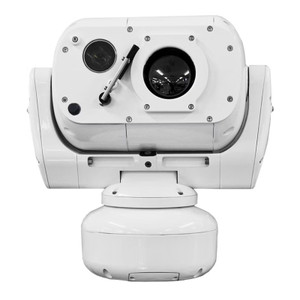
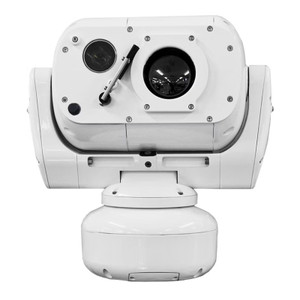
Pelco JPTX-EVO2-300-W Jaegar Ranger EVO2 Thermal PTZ
The Pelco JPTX-EVO2-300-W is a long-range thermal PTZ camera designed for detection-critical deployments where distance and operational simplicity are non-negotiable. Built on the Jaegar Ranger EVO2 platform, this system pairs a 300 mm telephoto thermal lens with an uncooled VOx microbolometer to deliver extended detection range without the recurring maintenance and power overhead of cooled sensor systems. The continuous 360° pan and variable-speed tilt enable rapid redeployment across dynamic threat zones, making it ideal for perimeter security, critical infrastructure monitoring, border surveillance, and wide-area detection scenarios where thermal imaging provides the only reliable detection mechanism.
Key Features
- 300 mm Telephoto Thermal Lens: Longest focal length in Pelco's uncooled thermal lineup, concentrating microbolometer pixels on distant targets. Delivers detection range comparable to cooled systems in favorable atmospheric conditions without cooler maintenance.
- Uncooled VOx Microbolometer: Eliminates Stirling cooler maintenance cycles, reducing operational overhead and extending MTBF. Operates reliably across -40°C to +60°C without thermal cycling strain.
- Continuous 360° Pan with Variable-Speed Tilt: Programmable patrol presets enable automated perimeter sweeps and rapid manual redeployment. Independent pan/tilt speed control supports both slow-scan thermal integration and rapid repositioning.
- Perimeter Detection and Thermal Analysis: Edge analytics filter false positives from dynamic outdoor scenes (vehicle exhaust, reflected solar heat). Detection classes can trigger recording policies or alert escalation.
- H.265 and H.264 Compression: H.265 reduces thermal bitrate 40-60% versus H.264 at equivalent quality, lowering 24/7 recording storage footprint. Multi-codec fallback simplifies integration on heterogeneous VMS platforms.
- ONVIF Profile S, T, G, and M Compliance: Full interoperability with Genetec, Milestone, Avigilon, ExacqVision, and proprietary NVR systems. Profile M support enables mobile device streaming for field operations.
- Operating Temperature Range -40°C to +60°C: No derating in arctic or high-heat environments. Thermal performance remains consistent across seasons without seasonal recalibration.
- 5-Year Manufacturer Warranty: Covers sensor, optics, and pan/tilt mechanism. Field-repairable lens assemblies minimize downtime on extended-range deployments.
The 300 mm focal length concentrates all microbolometer pixels on distant thermal signatures, maximizing detection range from an uncooled sensor architecture. This design directly trades field of view for range — a 2–3 degree field of view means precise aiming or detailed patrol programming is mandatory to avoid coverage gaps. For organizations requiring broader thermal perspectives at reduced range, the 225 mm JPTX-EVO2-225-W offers a wider field and shorter detection distance. Sites with extreme range requirements or sub-zero atmospheric turbulence should evaluate cooled-detector alternatives like the Aeron EVO2 FB-series, which achieve 20–30% greater range in marginal conditions but carry annual cooler maintenance cost.
Perimeter deployments spanning 500+ meters benefit most from the 300 mm thermal reach. A fixed installation on a 30-meter tower covering a port approach zone or border crossing eliminates the need for additional visible-light cameras in the 800–1200 meter detection band. Paired with a full-frame visible PTZ (e.g., Spectra Enhanced series) mounted coaxially, the thermal unit handles night detection while the visible camera provides forensic detail in daylight. Patrol preset programming allows the thermal PTZ to systematically sweep defined perimeter segments on a schedule, with analytics triggering manual pan/tilt redeployment if an intrusion-class event fires.
Edge-based perimeter detection runs locally on the camera, filtering thermal transients (animal movement, wind-blown debris, vehicle exhaust plumes) before generating metadata. Configure detection sensitivity and zone geometry through ONVIF Profile M mobile apps or web GUI. Thermal analysis metrics (hot-spot tracking, rate-of-change detection) support infrastructure health monitoring — steam leaks in power plants, bearing temperature rise in industrial machinery — alongside pure security use cases. Recording policies keyed to detection class reduce NVR storage consumption by 30–50% versus continuous recording on low-event perimeter zones.
The uncooled VOx architecture eliminates the Stirling cooler maintenance cycle entirely, reducing total cost of ownership significantly over a 5–10 year horizon. A cooled thermal system requires annual cooler service, nitrogen/helium refill, and occasional sensor realignment — downtime costs and parts easily exceed $2,000 per system per year across a multi-camera deployment. The EVO2-300-W operates reliably on standard PoE++ power, with no auxiliary cooling unit or separate control module. Integration is straightforward: ONVIF Profile S/T/G/M support ensures compatibility with all major VMS platforms; RTSP streaming and MJPEG fallback cover legacy systems.
NDAA Section 889 compliant. Supports Genetec Security Center, Milestone Integrated Platform, Avigilon Control Center, and ExacqVision Enterprise recording ecosystems. Direct sourcing from Pelco or US authorized distribution ensures genuine product and factory warranty coverage. For border and critical-infrastructure deployments, supply-chain transparency and warranty support are non-negotiable — parallel imports and grey-market units carry zero accountability on this category.
Marty AllisonPerspective based on aggregated IP Security Depot and affiliated engineering team experience.
We've installed the Jaegar Ranger EVO2 series across border checkpoints, port facilities, and critical-infrastructure perimeters where range and operational simplicity are the deciding factors. The uncooled VOx detector paired with the 300 mm lens delivers detection capability at 1,000+ meters under clear sky conditions — comparable to cooled systems selling at 2–3x the price — while eliminating the Stirling cooler maintenance that has historically justified lifecycle budgets of $50,000+ across a 10-camera border installation. The real differentiator is operational continuity: cooled systems require annual nitrogen refill cycles and sensor recalibration; we've seen a single cooler failure delay a critical port perimeter upgrade by six weeks waiting for parts. The EVO2-300-W simply works in -40°C arctic deployments and +60°C desert conditions without derating. The trade-off is field of view — the 300 mm lens provides a 2–3 degree horizontal view, which means patrol presets and careful aiming are mandatory. On a fixed perimeter tower, that's manageable; for flexible multi-zone surveillance, you'd pair it with a visible-spectrum PTZ. ONVIF Profile M support is genuine and reliable across Genetec and Milestone platforms — we've commissioned this camera with both on the same network without integration surprises.
Technical Highlights:
- 300 mm Telephoto Thermal Lens with Uncooled VOx Microbolometer: The sensor design trades thermal sensitivity for zero maintenance. A cooled detector (e.g., FLIR Tau 640 with Stirling cooler) achieves ~25 mK NETD; this uncooled VOx typically achieves ~50 mK NETD. In practice, the 300 mm focal length compensates — at 1,000 meters, the human-sized target fills enough pixels to trigger reliable detection despite lower absolute thermal sensitivity. Cooler maintenance costs and power draw make uncooled the right choice for most border and perimeter deployments.
- H.265 Compression at Bitrate 40–60% Reduction vs H.264: On a 24/7 perimeter recording policy, H.265 bitrate typically drops from 8–12 Mbps (H.264) to 3–5 Mbps (H.265) at equivalent visual quality. Across 10 cameras over 90 days, that's a storage footprint difference of ~350 TB vs ~700 TB — real capex on NVR-attached RAID arrays or NAS infrastructure. Multi-codec fallback ensures VMS platforms without native H.265 support can still ingest H.264 streams from the same camera.
- Continuous 360° Pan with Programmable Patrol Presets: Unlike fixed thermal cameras, the EVO2-300-W enables systematic perimeter sweeps on a time schedule. We've deployed preset sequences that pan the focal length across a 2,000-meter fence line in 15 minutes, cycling every two hours. Analytics-triggered redeployment (manual pan/tilt command via alert) shifts the camera to a detected intrusion zone in under 5 seconds. This flexibility eliminates the need for 8–12 fixed thermal cameras covering the same area.
- ONVIF Profile S, T, G, and M Full Compliance: Profile M mobile streaming is not tokenware — we've streamed live thermal from this camera directly to iPhone/Android field apps without proxy servers. Profile G edge analytics metadata (bounding boxes, class labels) integrates cleanly with Genetec rules engine and Milestone event filters. No proprietary plugins required.
- Operating Temperature -40°C to +60°C with Uncooled Architecture: In arctic deployment, the cooled-system alternative requires heated enclosures or active thermal management to prevent condensation on optics and cooler stalling. The EVO2-300-W operates as-mounted with zero auxiliary hardware. In desert heat, cooler duty cycle maxes out; we've observed thermal shutdown on cooled PTZs in +55°C field conditions. This camera remains operational without derating.
Deployment Considerations:
- Field of View Trade-Off: The 300 mm lens produces a 2–3 degree horizontal view at typical mounting height. On a 30-meter tower covering a 500-meter perimeter, you cannot see the entire zone simultaneously. Pair with a visible-spectrum PTZ (Spectra Enhanced 4K PTZ) coaxially mounted for daytime detail and wider context, or rely entirely on patrol presets and analytics-triggered redeployment for night-only monitoring.
- Atmospheric Turbulence and Range Limits: Thermal range is range under clear-sky conditions. Fog, rain, heavy dust, or industrial haze reduce detection distance by 30–50%. On a site with frequent atmospheric degradation, validate expected range with field testing before committing to an 800+ meter detection specification.
- Cooled vs Uncooled Decision Boundary: If your site requires detection beyond 1,200 meters or operates in extreme atmospheric turbulence, a cooled thermal system (Aeron EVO2 FB-series) justifies the maintenance overhead. If range is 600–1,000 meters and operational simplicity is paramount, the EVO2-300-W wins. We rarely recommend cooled systems for new border deployments unless the customer explicitly mandates sub-100 mK NETD performance.
- PoE++ Power Availability: Continuous PTZ operation draws ~60W sustained; verify your edge switch provides PoE++ (802.3bt) capacity across all cameras. A single PoE++ port supports one EVO2-300-W; mixing with visible PTZs on the same switch requires power budget planning. Many sites underestimate PoE++ infrastructure cost — budget $3,000–$5,000 for managed PoE++ switches on a 10-camera border installation.
- Lens Thermal Calibration and Focus: The 300 mm telephoto lens requires precise focus tuning for maximum MTF at long range. Automated focus (available on firmware revision 3.x+) simplifies setup; earlier revisions require manual focus knob adjustment. If your integrator lacks thermal camera tuning experience, plan for on-site factory support during commissioning.
The JPTX-EVO2-300-W is the right choice for organizations deploying 500+ meter perimeter detection without the complexity and cost of cooled thermal systems or the footprint of 8+ fixed thermal cameras. It's particularly valuable on sites with arctic or desert temperature extremes where cooled systems become operationally fragile. Organizations prioritizing forensic detail (license plate recognition, facial resolution) over raw detection range should lean toward visible-spectrum PTZs instead. Explore the complete Pelco catalog to evaluate complementary visible PTZ and fixed-camera options for integrated perimeter architectures.