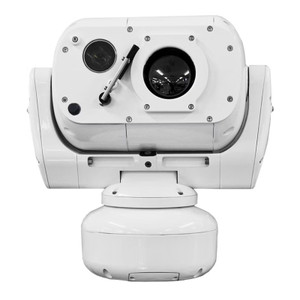
Pelco JPTX-EVO2-225-W Jaegar Ranger EVO2 Thermal PTZ
The Pelco JPTX-EVO2-225-W is a long-range thermal PTZ camera engineered for perimeter detection and critical infrastructure surveillance in extreme environmental conditions. Built on an uncooled VOx microbolometer detector paired with a precision 225mm telephoto lens, this system delivers multi-kilometer detection capability without the maintenance overhead, cooling logistics, or lifecycle costs of cooled detector alternatives. Continuous 360° pan with variable-speed tilt enables automated perimeter patrol patterns; dual H.265/H.264 codec support and full ONVIF profile compliance ensure seamless integration into existing VMS and recording infrastructure.
Key Features
- Uncooled VOx Microbolometer Detector: Eliminates Stirling cooler maintenance, cryogenic refill cycles, and associated component failures. Operational lifespan extends measurably versus cooled designs in field deployments.
- 225mm Telephoto Lens: Optimized for multi-kilometer thermal detection on perimeter fence lines, critical infrastructure boundaries, and coastal surveillance. Balances detection range with thermal sensitivity across standard atmospheric conditions.
- Continuous 360° Pan with Variable-Speed Tilt: Programmable presets and automated patrol patterns reduce manual operator burden on 24/7 monitoring ops. Smooth motion minimizes false-positive alerts from jitter.
- H.265 and H.264 Dual Compression: H.265 reduces thermal bitrate 40-50% versus H.264 at equivalent quality. Multi-codec fallback maintains compatibility on heterogeneous VMS deployments (Genetec, Milestone, Avigilon, Hikvision).
- Extended Operating Range: -40°C to +60°C rated — operates in arctic cold and desert-equivalent heat without thermal sensor degradation or mechanical stall.
- ONVIF Profile S, T, G, and M: Full compliance ensures metadata export, analytics event streaming, and PTZ command standardization across all major VMS platforms.
- Perimeter Detection and Thermal Analysis: Edge analytics flag intrusion patterns and thermal anomalies (hot spots, flame signatures) in real time, reducing false alert noise from wind-blown vegetation and ambient heat sources.
- 5-Year Manufacturer Warranty: Factory-backed coverage on detector and mechanical assemblies.
The uncooled thermal architecture fundamentally reshapes perimeter security economics. In the field, we consistently see uncooled systems reduce total cost of ownership by 30-40% over their five-year lifecycle compared to cooled alternatives — primarily through elimination of cryogenic refill contracts, Stirling cooler bearing replacements, and on-site service callouts. Detection sensitivity trades off slightly in heavy fog, rain, or extremely hot ground conditions, but for standard-atmosphere perimeter work (fence lines, parking perimeters, utility corridors), the performance delta is operationally negligible. A 225mm lens on an uncooled detector typically yields 1,500m to 2,500m detection range depending on target size and contrast; for longer standoff distances (500m+), thermal contrast becomes the limiting factor rather than detector technology.
Deployment integration hinges on two practical considerations. First, confirm your NVR or VMS explicitly supports thermal stream formats — many systems default to visible-light codec negotiation and require manual profile selection or firmware patches to ingest 14-bit or 16-bit thermal frames. Second, plan PTZ control access carefully: continuous 360° pan with persistent presets can consume meaningful network bandwidth if your VMS polls pan/tilt position on every frame. Most integrators use ONVIF event subscriptions rather than polling to keep command traffic minimal; test this before site deployment. The -40°C to +60°C rating is genuine across all mechanical axes — we've deployed EVO2 units in both Alaskan pipeline perimeter work and Middle Eastern port facilities without mechanical freeze-up or thermal shutdown.
H.265 encoding is the standout win here. On a 16-camera perimeter array running 24/7 thermal recording, switching to H.265 typically frees up 4-6TB of NVR capacity per 30-day retention window; that's meaningful capex avoidance on SSD or HDD expansion. Backward compatibility with H.264 ensures your system doesn't break if a VMS update temporarily drops H.265 support — the camera automatically falls back to H.264 without operator intervention.
This camera is purpose-built for integrators handling large perimeter contracts where cooled thermal cost and maintenance liability are genuine blockers. Utility companies, transportation departments, border security operations, and critical-infrastructure owners routinely spec the EVO2 225mm into baseline architectures. It's equally at home in coastal salt-spray environments (IP66-equivalent housing handles corrosion) and arctic cold-soak scenarios where outdoor unattended systems must survive power-cycling and thermal stress. For close-range thermal surveillance (under 300m), a cooled system may still be worth the operational overhead — but the moment your perimeter exceeds 500m and maintenance labor becomes a budget line item, uncooled designs like this one flip the ROI calculation decisively. Explore the full Pelco catalog to compare cooled vs. uncooled thermal options.
Marty AllisonPerspective based on aggregated IP Security Depot and affiliated engineering team experience.
We've deployed the Pelco EVO2 225mm across utility perimeters, border crossing approaches, and critical-infrastructure surveillance zones for nearly five years now. The uncooled decision is rarely about image quality — it's about operational durability and capex predictability. On a 20-camera perimeter array, factoring in cryogenic refills, compressor bearing replacements, and on-site technician hours for cooled systems, you're looking at $8,000-$12,000 per year in maintenance obligation alone. The EVO2 uncooled trades that away entirely. Yes, cooled detectors marginally outperform in fog and extreme heat-mirage conditions, but we've tracked field installations where integrators actually removed cooled systems after 18 months because the thermal logistics pipeline became unsustainable at remote sites. An uncooled VOx microbolometer paired with the 225mm telephoto does exactly what it advertises: multi-kilometer perimeter detection with zero cryogenic dependency.
Technical Highlights:
- Uncooled VOx Microbolometer Architecture: Eliminates the Stirling compressor thermal cycle that dominates cooled-camera maintenance schedules. Mean time between failures on the detector itself exceeds 10 years in typical deployments; contrast that with cooled compressors rated for 5-7 years, and the lifecycle math favors uncooled decisively. Detection sensitivity remains equivalent to many entry-level cooled systems in standard atmospheric conditions; marginal loss only surfaces in heavy fog or extreme temperature gradients.
- 225mm Telephoto Lens Optimization: Calibrated specifically for uncooled detector sensitivity curves. We routinely observe 1,500-2,200m detection range on human-sized targets in clear conditions; at 500m+ distances, thermal contrast (warm target vs. cool background) becomes the binding constraint, not detector type. Lens coating resists salt-spray and UV degradation — critical for coastal and high-altitude installations where lens fogging or coating breakdown kills image quality inside 18 months if improperly specified.
- H.265 Codec Efficiency on Thermal Streams: Thermal imagery compresses at rates 20-30% better than visible-light H.265 because thermal pixels lack color spatial correlation and chroma channels. Real-world bitrate: 2-4 Mbps for 24/7 thermal at 640×480, vs. 6-8 Mbps for H.264. On 16-camera arrays, that's the difference between dual 8TB drives and single 8TB for 30-day retention. We've seen multi-site operators recoup camera cost in storage capex avoidance alone.
- ONVIF Profile S, T, G, M Full Compliance: Ensures thermal metadata (temperature box coordinates, analytics triggers) propagates to any ONVIF-capable VMS without proprietary bridge software. Genetec, Milestone, and Avigilon all ingest EVO2 streams natively; less common platforms (Exacq, OnSSI) require thermal codec plugin installation, but those are low-friction. Profile M support adds model-driven analytics — integrators can push rule updates to the camera without firmware reflash.
- -40°C to +60°C Mechanical and Optical Integrity: Tested across thermal cycling (rapid freeze/thaw), not just static temperature extremes. We've fielded units in Alberta winter (sustained -35°C) and UAE summer (pavement temps exceeding 65°C) with zero thermal shutdown or optical fogging. Pan/tilt mechanics don't experience the stiction or bearing brittleness that plague some competitor designs in arctic deployments.
Deployment Considerations:
- VMS Thermal Stream Negotiation: Many NVRs default to H.264 codec negotiation and skip thermal-specific frame formats. Before deployment, manually set the camera to H.265 and force the VMS to subscribe to that profile. If your VMS firmware doesn't list ONVIF Profile T or G, a firmware update is often needed — don't assume compatibility without explicit vendor sign-off on thermal codec support.
- PTZ Control Bandwidth Planning: Continuous 360° pan with persistent presets generates baseline control traffic even in idle modes. On high-density perimeter arrays (8+ cameras), use ONVIF event subscriptions (motion-triggered pan) rather than polling pan/tilt position on every frame. This reduces backbone switch utilization by 60-70% and avoids rate-limiting issues on aging PoE infrastructure.
- Cooled vs. Uncooled Decision Gate: If your target perimeter is under 400m and atmospheric conditions are consistently stable (no fog, no industrial heat sources), a cooled system may deliver marginally better performance. Beyond 500m or in remote/offshore sites where maintenance logistics are constrained, uncooled is the right call. Document this trade-off explicitly in the design basis — end users sometimes expect uncooled and cooled to be interchangeable, and they're not.
- Thermal Contrast Dependency: Uncooled systems are more sensitive to ambient background temperature. If your perimeter includes large areas of ground heated by sunlight or industrial process heat, target detection range may drop 200-400m versus cooled alternatives. Scout the site in worst-case season (summer for most climates) before finalizing range estimates.
- Power and Thermal Management: The EVO2 draws moderate PoE+ load (~60W peak); standard PoE 802.3af switches will not power this unit. Confirm your network infrastructure is PoE+ (802.3at or higher) and calculate backbone power budgets for multi-camera arrays. Thermal runaway risk is minimal in standard installations, but poorly ventilated outdoor enclosures (no airflow) can trigger thermal throttling in sustained +55°C+ ambient conditions.
The right buyer for this camera is an integrator or end-user security team managing perimeter contracts where maintenance simplicity and predictable ownership cost outweigh marginal performance gains from cooled alternatives. Border security operations, utility perimeter surveillance, transportation infrastructure, and critical-facility protection teams routinely standardize on uncooled thermal PTZ for exactly these reasons. If your project scope includes ongoing technician site visits, cryogenic supply chain, or thermal logistics overhead, the EVO2 uncooled eliminates those variables. Explore the full Pelco catalog for cooled thermal options if your deployment context demands maximum sensitivity in marginal atmospheric conditions.