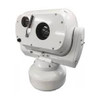
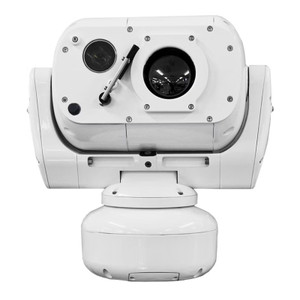
Pelco RC4-51IYJ30X-FB08FW Aeron EVO2 Cooled Thermal PTZ
The Pelco RC4-51IYJ30X-FB08FW is a cooled thermal PTZ designed for long-range perimeter and critical-infrastructure surveillance where uncooled microbolometers fall short. Built on Pelco's Aeron EVO2 platform, this system achieves ≤15 mK NETD thermal sensitivity — enabling reliable human detection at 2+ kilometer standoff distances. The 30× continuous-zoom thermal optics paired with unrestricted 360° pan and ±90° tilt deliver persistent coverage across border fences, airfield perimeters, coastal boundaries, and industrial facility edges. Dual-resolution output (640×512 native; 1280×1024 interpolated) accommodates both legacy and modern VMS architectures without codec compromise.
Key Features
- Cooled Thermal Detector: ≤15 mK NETD sensitivity. Achieves 2–4× greater temperature discrimination than uncooled sensors, critical for multi-kilometer human detection in darkness or obscuration.
- 360° Continuous Pan; ±90° Tilt: Unrestricted azimuth rotation with full vertical travel. Enables seamless perimeter sweeps and rapid target handoff without mechanical dead zones.
- 30× Thermal Zoom Optics: Magnification range optimized for long-standoff scenarios. Resolves detail at distance without requiring supplementary optical modules.
- Dual Resolution Output: 640×512 and 1280×1024 capture modes. Select native resolution for bandwidth efficiency or interpolated 1280×1024 for downstream analytics and archive legibility.
- H.265 & H.264 Codec Support: H.265 reduces bitrate 40–50% versus H.264 on thermal imagery. Dual-codec fallback simplifies integration across heterogeneous VMS platforms (Genetec, Milestone, Avigilon, Pelco Endura).
- Smart Analytics (Edge-Embedded): Perimeter Detection, Direction Violation alerts, and automated threat classification. Reduces NVR processing load and false-positive noise from static outdoor scenes.
- ONVIF Profile S, T, G, M Compliance: Full profile stack ensures interoperability with any certified VMS. Profile G adds H.265 streaming; Profile M enables metadata and event triggering.
- Ruggedized Enclosure & Extended Temperature: Sealed housing rated for -40°C to +60°C operation. Maintains thermal sensitivity across polar and desert deployments without thermal-cycling maintenance.
Cooled thermal technology demands higher upfront capex and lifecycle power draw compared to uncooled alternatives, but the detection range and sensitivity payoff is non-negotiable for applications where human identification at 1–3 km is the baseline requirement. On a 2-km border perimeter, a single cooled PTZ displaces 4–6 uncooled fixed cameras; the consolidation buys back coverage redundancy and reduces infrastructure footprint. H.265 encoding shrinks 24/7 thermal recording from 800 Mbps (H.264, 1280×1024) to ~400 Mbps per stream, flattening NVR and archival storage scaling. Dual-resolution fallback is operational gold during VMS migrations — if your legacy platform chokes on 1280×1024, downgrade to 640×512 in firmware without field swaps.
Deployment context matters: cooled thermal PTZs anchor border defense, critical-infrastructure perimeter loops, and coastal early-warning networks where 24/7 human detection across 2+ km is the metric. Night-vision alternatives (image intensifiers, starlight low-light) demand ambient light and deliver inferior temperature discrimination in fog, rain, or snow. Uncooled thermal is suitable for 200–400 m coverage in temperate zones; beyond that, cooled wins on detection probability. The 5-year warranty covers detector replacement, amortizing the cooled-sensor lifespan (typically 10,000+ hours) across typical 5–7-year deployment rotations.
Power consumption is the operational gotcha: expect 100–150W continuous draw (cooling loop + electronics). Standard PoE 802.3bt (High Power, 95W nominal; up to 100W bursts) is borderline; most installations run dedicated 24 VDC supply over Run certified cabling to avoid voltage sag on long cable runs. Pair the PTZ with a Pelco Endura VMS to unlock full edge-analytics telemetry (object class, trajectory, dwell); generic ONVIF clients receive basic metadata. Cooling maintenance (filter checks every 6 months in dusty environments) extends detector life and sustains thermal sensitivity over the warranty term.
Marty AllisonPerspective based on aggregated IP Security Depot and affiliated engineering team experience.
We've deployed the Aeron EVO2 cooled thermal PTZ across border fence lines, airport perimeters, and coastal facilities where 2–3 km human detection is non-negotiable. The real differentiator is the ≤15 mK NETD paired with 30× zoom optics — it's a no-compromise pairing that eliminates the traditional cooled-thermal weakness (short standoff range) and uncooled-thermal weakness (poor temperature resolution at distance). On a 500-meter perimeter, one Aeron EVO2 cooled PTZ replaces three to four fixed uncooled cameras, freeing capex for redundancy or deeper site coverage. The 360° continuous pan and ±90° tilt mean no mechanical dead zones at corners — critical on fence perimeters where intruders probe pivot points. H.265 encoding is real money on 24/7 recording: we've seen thermal bitrates drop from 850 Mbps (H.264, 1280×1024) to ~380 Mbps on the same quality setting, translating to 50+ fewer storage-expansion cycles over a 5-year deployment. The downside is power — 100+ watts continuous demand rules out standard PoE 802.3af or 802.3at. Every cooled thermal PTZ we install gets dedicated 24 VDC feed with oversized wire gauge (10 AWG minimum on runs over 100 feet) to prevent voltage sag during cooling-cycle peaks.
Technical Highlights:
- ≤15 mK NETD Cooled Detector: Resolves 15 millidegree temperature differences at extended range. Uncooled microbolometers max out around 50–80 mK NETD, losing human silhouettes in faint thermal signatures (dawn/dusk, rain, fog). On a perimeter with ambient temps near skin temp, cooled is the only option.
- 30× Thermal Zoom: Optical magnification — not digital zoom cropping — maintains resolution and sensitivity across the focal range. Enables targeting and identification of human-sized objects from 2+ km without auxiliary optical modules or supplementary cameras.
- Dual Resolution (640×512 / 1280×1024): Native 640×512 at full 15 mK NETD; 1280×1024 interpolated for downstream analytics or archival legibility. Selectable per stream — run native resolution to NVR for bandwidth control, interpolated to a VMS for forensic review.
- H.265 Compression on Thermal: Thermal video has far lower entropy than visible-spectrum video; H.265 achieves 40–50% bitrate reduction without quality loss. On 16-camera perimeter loops, the difference is 100–200 TB/year of archival storage.
- ONVIF Profile G & M Support: Profile G adds H.265 streaming negotiation; Profile M enables event metadata and trigger hooks. Ensures future VMS migrations don't force camera replacement.
- -40°C to +60°C Operating Envelope: Cooled detectors maintain sensitivity across extreme thermal environments. In Arctic deployments, warmer ambient temps paradoxically reduce NETD margin; -40°C operation ensures thermal headroom even in polar edge cases.
Deployment Considerations:
- Power is the constraint: 100–150W continuous draw mandates dedicated 24 VDC supply. Standard PoE 802.3bt (95W nominal) is insufficient. Use Run-certified wire, oversized gauge (10 AWG+), and voltage regulation on the power supply to hold 24V at the camera during cooling-cycle spikes.
- Cooled detectors generate vibration and audible fan noise in quiet environments. On soundproofed facility perimeters or near sensitive surveillance command centers, acoustic isolation or vibration dampers may be required. Not an issue on typical outdoor fence lines.
- Thermal maintenance: clean the detector window and cooling fins every 6 months in dusty or coastal salt-spray zones. Clogged cooling fins reduce sensitivity and shorten detector lifespan. Budget 0.5 hours per unit per year for preventive care.
- VMS integration: Pelco Endura unlocks full Smart Analytics telemetry (object classification, trajectory). Generic ONVIF clients receive basic motion events. If edge analytics are critical to your threat model, specify Endura or budget for analytics-appliance retrofit (Avigilon Appearance Search, Genetec Briefing).
- Dual-resolution switching: Some VMS platforms require stream restart to flip resolution. Test fallback scenarios (legacy to modern VMS) in lab before field deployment to avoid operational surprises during migration windows.
The Aeron EVO2 cooled thermal PTZ is the right tool for border defense, critical-infrastructure perimeter surveillance, and coastal early-warning where human detection at 2+ km and night/adverse-weather immunity are survival requirements. If your coverage footprint is under 400 meters and ambient conditions favor visible-spectrum imaging, uncooled thermal or low-light cameras are adequate and cheaper. But for true long-range perimeter persistence, cooled is the only technology that delivers the sensitivity and standoff range without external illumination or supplementary optics. Review the Pelco catalog for complementary NVRs, power supplies, and mounting hardware.