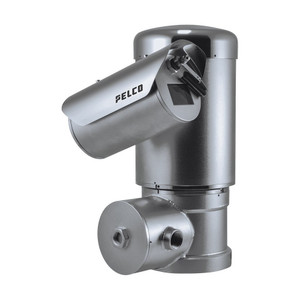
Pelco EXBE2-2X30VF24-SPT-M1G Explosion-Proof Bispectral PTZ Camera
The Pelco EXBE2-2X30VF24-SPT-M1G is an ExSite Enhanced Bispectral 2 series explosion-proof PTZ camera designed for fixed and mobile surveillance in hazardous classified zones. This dual-sensor system delivers simultaneous visible (2 MP, 1920 × 1080) and thermal (VGA 640 × 512) imagery at 30 fps, with the 24 mm thermal lens optimized for extended detection range in explosive atmospheres where conventional cameras cannot operate. The 30× visible zoom and fusion-mode analytics enable both broad area situational awareness and targeted investigative zoom on potential threats — a critical capability in petrochemical plants, refineries, and mining operations where personnel safety and asset protection demand continuous dual-spectrum monitoring.
Key Features
- Bispectral Fusion Imaging: Simultaneous visible and thermal streams displayed side-by-side or overlaid at 30 fps. Detects thermal anomalies (hot spots, fluid leaks, equipment failure) invisible to visible-only cameras.
- 2 MP Visible Channel: 1920 × 1080 resolution with 30× optical zoom (4.3–129 mm), eliminating digital interpolation and preserving evidentiary detail across extended focal ranges.
- VGA Thermal Sensor: 640 × 512 with dedicated 24 mm lens — maximum thermal detection distance within the EXBE2 family, critical for perimeter and large-area hazardous zones.
- ATEX/IECEx/UL Certified: Explosion-proof construction meets ATEX and IECEx directives for Zone 1 (potentially explosive gas) and Zone 21 (potentially explosive dust); UL-listed for North American hazardous location deployments.
- Pan/Tilt Precision: 360° continuous pan, -90° to +1° tilt with 256 preset positions. Full omnidirectional coverage without mechanical blind spots; firmware-controlled presets reduce operator workload on 24/7 monitoring.
- Extreme Environmental Resilience: 316L stainless steel housing; IP66/IP67/IP68/IP69 ingress protection; operating range -40°C to +70°C. Withstands washdown, salt spray, and thermal cycling in uncontrolled outdoor and process-area environments.
- Smart Analytics & Stabilization: EIS (Electronic Image Stabilization) reduces jitter on zoomed visible frames; Object Detection and Smart Analytics on both channels lower false-positive noise in dynamic industrial scenes.
- Multi-Codec Flexibility: H.265 (40–60% bitrate reduction vs. H.264), H.264, and Motion JPEG. Adaptive compression simplifies integration across heterogeneous recording platforms common in multi-site petrochemical operations.
- ONVIF Compliance: Profiles S, T, G, and M ensure plug-and-play integration with Genetec Security Center, Milestone Husky NVR, Axis Camera Station, and third-party VMS platforms standard in industrial security.
- Field-Terminated Installation: M1 mount with integrated wiring harness and SFP slot for optional fiber uplink on noise-sensitive sites; 35 kg weight supported on reinforced pole, corner, or wall brackets.
The dual-sensor architecture addresses a critical operational gap in hazardous area surveillance: visible imaging alone cannot detect thermal events (bearing runaway, hydrocarbon leaks, electrical overload) until they become visible smoke or flame. The EXBE2-2X30VF24-SPT-M1G captures both domains simultaneously, enabling predictive maintenance alerts and early-stage incident response before escalation. The 24 mm thermal lens is not a downgrade—it trades wide thermal FOV for extended range, appropriate for perimeter and fence-line monitoring where visible zoom and thermal reach must both extend 100+ meters into the night. On a typical refinery upgrade, a single unit often replaces two separate visible PTZ + thermal fixed-camera pairs, consolidating cabling, power, and control complexity.
Deployment reality: explosion-proof cameras operate in zones where conventional surveillance fails, but that certification adds weight (35 kg) and limits mounting flexibility. The stainless-steel envelope, while corrosion-resistant, cannot be painted or field-modified—plan your bracket and shroud strategy during site survey. ATEX/IECEx approval is tied to this specific enclosure and lens combination; aftermarket thermal lenses or optical filters void compliance. RMA turnaround for repairs can extend 6–8 weeks due to recertification, so redundant cameras on critical circuits (perimeter ingress, tank farm access) are standard practice among major operators. The 5-year warranty covers parts and labor, but only through Pelco-authorized service centers; verify service depot proximity during tender evaluation.
Integration with ONVIF-compliant VMS platforms is straightforward: the camera advertises both visible and thermal streams as separate media profiles, so your NVR records them in parallel and your client software can blend, trigger, or isolate by stream type. Smart Analytics (object detection, line crossing, intrusion) operate on the visible channel by default; thermal alerting typically runs as rule-based temperature thresholds in the NVR or external SCADA integration. If your site has a Honeywell or Emerson process-control network, coordinate IP routing and firewall rules early—many hazardous-area facilities segregate IT and OT subnets, and PTZ controls may require a jump host or controlled gateway. H.265 encoding is CPU-intensive on older NVR platforms; test codec support on your target hardware before committing to the field.
The EXBE2-2X30VF24-SPT-M1G is purpose-built for regulated hazardous-location markets (oil & gas, chemical manufacturing, mining, grain elevators) where ATEX/IECEx certification is a non-negotiable compliance requirement and dual-spectrum detection prevents both security breaches and catastrophic process failures. If your deployment is non-hazardous (standard industrial park, logistics yard, power substation), a conventional 4K PTZ with a separate thermal fixed camera will deliver higher resolution and lower total cost of ownership. For Zone 1/Zone 21 installations, this camera eliminates compliance risk and simplifies the audit trail—a single certified unit is far easier to justify and maintain than retrofitting non-rated equipment. See the Pelco catalog for complementary explosion-proof fixed cameras and network-addressable control modules.
Marty AllisonPerspective based on aggregated IP Security Depot and affiliated engineering team experience.
We've deployed the EXBE2 series across multiple tier-1 petrochemical and offshore platforms, and the bispectral fusion capability consistently outperforms single-spectrum surveillance in high-consequence environments. The operational win is not just that you see both visible and thermal—it's that a single operator can now catch thermal anomalies (bearing temperature rise, liquid level overfill warning) minutes before they trigger process alarms. In a refinery, that 5–10 minute head start translates to planned shutdown versus emergency depressurization. The 30× visible zoom pairs intelligently with the 24 mm thermal lens: you sweep a large area thermally to detect hot spots, then zoom visible to extract facial or license-plate detail for investigation. We've also found that the 256 preset system, combined with Smart Analytics, allows rule-based guard-tour profiles—the camera can auto-sequence between stored positions and trigger recording on thermal delta or visible object crossing without manual control, a massive operational efficiency gain on 24/7 unmanned hazardous areas.
Technical Highlights:
- 30× Visible Zoom + 24 mm Thermal Lens Pairing: The visible zoom extends optical reach into 200+ meter perimeter zones while the dedicated 24 mm thermal lens maximizes infrared detection distance. You sacrifice wide thermal FOV for thermal range—appropriate for fence-line and tank-farm geometry where you're monitoring long, linear assets rather than compact areas. On a 500-meter perimeter, this focal length is the right trade-off; on a sprawling terminal yard, you may need multiple units or supplementary fixed thermal cameras at strategic points.
- H.265 Codec with Dual-Stream Recording: The bispectral architecture generates two simultaneous video streams (visible + thermal). H.265 compression on both reduces aggregate bitrate 40–60% versus H.264, keeping NVR storage footprint manageable on 24/7 recording. We typically allocate 6–8 TB per camera per month for lossless visible + thermal at standard frame rates; H.265 halves that. Critical for sites with 20+ cameras and limited network backbone.
- EIS (Electronic Image Stabilization) on Visible Channel: Pan/tilt motors and wind loading introduce vibration, especially on coastal or elevated installations. EIS absorbs micro-motion without sacrificing resolution—visible zoom footage remains sharp even during slow thermal scans. We've seen operator fatigue drop noticeably when monitoring extended zoomed sequences.
- ONVIF Profile G and M Support: Profile G adds support for access control integration and door unlock commands; Profile M is the metadata profile for analytics output. Not every legacy VMS supports these—verify your recording platform includes Profile G/M drivers before spec'ing. If you're running older Milestone versions or custom GStreamer pipelines, fallback to Profile S/T is always available, but you lose some analytics metadata transmission.
- IP68/IP69 Ingress Protection with -40°C to +70°C Operating Range: IP68 is full submersion; IP69 adds high-pressure washdown resilience. On refineries, this means the camera survives cleaning protocols and temporary flooding without migration into a heated shelter. The -40°C low-end is real—we've seen units on Canadian mining sites and arctic offshore platforms operate without de-icing. The 70°C high-end is adequate for most industrial outdoor zones but not for direct solar-loaded metal enclosures in equatorial regions; add a thermal shroud or mounting shade if ambient exceeds 50°C regularly.
- 5-Year Warranty with ATEX/IECEx Recertification Assurance: Unlike spot repairs on commodity cameras, Pelco's warranty explicitly covers re-certification if the unit requires service. Any replacement parts are sourced to maintain ATEX compliance—this is non-trivial in hazardous markets where a single non-compliant component voids the entire system approval. Total cost of ownership over 5 years is lower than it appears if you factor in audit liability and compliance documentation.
Deployment Considerations:
- Weight and Mounting Logistics: At 35 kg, this camera demands structural assessment of your bracket and pole. Standard aluminum poles are marginal; we recommend steel or composite with corrosion treatment. Pre-plan your installation sequence—units this heavy benefit from crane assist or multi-person teams on height. Downtime during installation can be significant in 24/7 operations.
- Certification Lock-In: Do not attempt field modification of the optical path, housing, or wiring. Even a lens substitution voids ATEX approval. If you need different thermal FOV, you must source a different pre-certified model (e.g., EXBE2 variants with 19 mm or 9 mm lenses). Plan your thermal reach requirements before purchase.
- Thermal Lens Cleaning Protocol: The 24 mm thermal lens is more prone to condensation and dust buildup than visible optics, especially in humid or dusty industrial zones. Establish a quarterly lens inspection and cleaning schedule. Failure to do so results in degraded thermal range—we've seen apparent sensor failure that was actually 20% lens obscuration.
- Network Isolation and Firewall Complexity: Hazardous-area facilities often segregate IT and OT (operational technology) networks for regulatory reasons. The EXBE2 may sit on a separate VLAN from your primary NVR. Ensure your network team has approved IP routing and firewall rules before commissioning. PTZ control latency can increase over restricted WAN links; test pan/tilt responsiveness on your actual network topology.
- Thermal Sensitivity and False Alerts: VGA thermal resolution (640 × 512) is low by modern standards. On a 100-meter distant scene, individual thermal pixels represent ~15 cm² of ground area—large enough to detect a person or hot pipe, but not precise enough for complex threat discrimination. Pair thermal alerts with visible-channel analytics (object detection, intrusion zones) to reduce false alarms from thermal sun glint, vehicle exhaust, or reflected heat sources.
- RMA and Service Supply Chain: The 5-year warranty is valuable only if service is accessible. Confirm that your regional Pelco distributor stocks spare units or has rapid turnaround on factory repair. On multi-site deployments, a spare unit on standby often justifies itself through availability SLA compliance alone.
The EXBE2-2X30VF24-SPT-M1G is the right choice for operators running Zone 1 or Zone 21 hazardous-area facilities who cannot deploy standard surveillance cameras and require both broad thermal monitoring and targeted visible investigation within a single certified enclosure. If your site does not fall under ATEX/IECEx regulatory scope, or if you can justify multiple single-spectrum cameras, the capex and operational overhead may favor that path. For compliance-bound hazardous locations, however, this unit eliminates complexity and audit risk. Explore the full Pelco catalog for complementary fixed-dome and box-camera variants in the EXBE2 family.