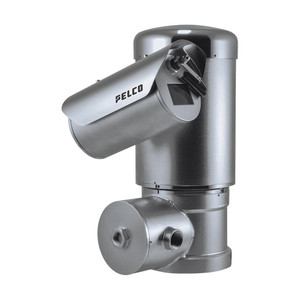
Pelco EXBE2-2X30QF06-SPT-M1G Explosion-Proof Bispectral PTZ Camera
The Pelco EXBE2-2X30QF06-SPT-M1G is an ExSite Enhanced Bispectral 2 explosion-proof PTZ camera purpose-built for surveillance in hazardous locations where thermal imaging and long-range visible detail are both operationally critical. This dual-spectrum system fuses a 2 MP visible channel (1920×1080, 30× optical zoom) with a QVGA thermal imager (320×256, 6 mm lens) in a single certified platform, eliminating the cost and complexity of deploying separate thermal and visible cameras. The wide thermal lens and continuous 360° pan deliver synchronized dual-spectrum coverage across process areas, storage tanks, and perimeter routes where both gas/vapor detection (via thermal signature) and forensic facial/object detail (via visible 4.3–129 mm zoom) are required. ATEX, IECEx, and UL explosion-proof certification for Zone 1 and Zone 21 ensures regulatory compliance in refineries, petrochemical plants, grain facilities, and powder-coating environments.
Key Features
- Bispectral fusion imaging: Synchronized 2 MP visible (1920×1080) and QVGA thermal (320×256) streams with real-time overlay modes. Eliminates mounting complexity and cabling overhead of dual-camera systems.
- 30× optical zoom with 4.3–129 mm lens: Visible channel resolves license plates and facial detail at 100+ meters; thermal channel detects temperature anomalies and personnel across wider working distance. No digital zoom quality loss.
- QVGA thermal at 6 mm focal length: Widest thermal field of view in the ExSite Enhanced lineup, ideal for close-range tank-top or process-line monitoring without multiple cameras.
- 360° continuous pan, -90° to +1° tilt, 256 presets: Achieves full hemispheric coverage on a single mount; preset automation reduces operator fatigue and ensures consistent monitoring of critical zones.
- 316L stainless steel, IP66/IP67/IP68/IP69 rated: Withstands washdown, salt-fog, and direct-spray exposure; housing material resists chemical corrosion in refineries and food-processing plants.
- ATEX, IECEx, UL explosion-proof certification (Zone 1/21): Factory-certified for Class I Division 1 (gas) and Class II Division 1 (dust) hazardous areas; compliance documentation included. No field modifications required.
- H.265 (HEVC) + H.264 + Motion JPEG: H.265 achieves 40–60% bitrate reduction versus H.264 on dual streams; Motion JPEG fallback maintains integration flexibility on legacy recorders.
- Smart Analytics with EIS and Object Detection: Electronic Image Stabilization compensates for thermal shimmer and visible motion blur; onboard object detection filters false alerts on moving foliage and shadows, reducing NVR storage overhead.
- Operating range -40°C to +70°C: Rated for arctic outdoor installations and indoor high-temperature process areas (furnace monitoring, oven-room surveillance).
- M1 connector field-termination option: Allows custom cable runs in constrained mechanical spaces; simplifies retrofit into existing conduit runs without replacing cable assemblies.
Bispectral imaging solves the real-world problem of thermal-only footage missing forensic detail and visible-only footage missing thermal signatures. In refineries and chemical plants, simultaneous thermal and visible monitoring catches both equipment overheating (thermal leading indicator) and personnel access violations (visible detail). The 30× zoom visible channel bridges the gap between wide-area thermal surveillance and close-range identification; on a petrochemical dock, you see the thermal bloom of a leaking valve from 150 meters away, zoom in on the operator response, and retain both data streams at frame 9 fps for compliance review.
ONVIF Profile S, T, G, and M compliance ensures integration with Genetec, Milestone, Avigilon, and Hanwha SmartVMS platforms without proprietary drivers. H.265 dual-stream encoding (one stream per codec) splits compute and storage: ship H.265 thermal + lower-bitrate H.264 visible to the NVR for 24/7 recording, and stream native H.265 to a secondary analytics appliance for real-time thermal alarm processing. This architecture keeps total bandwidth under 10 Mbps even on remote site links. The 9 fps thermal framerate is sufficient for slow-moving process monitoring (tank level changes, heater cycling, personnel movement across wide zones) but does not support high-speed motion tracking—thermal PTZ cameras operate at 9 fps by design, trading motion smoothness for thermal sensitivity and power efficiency.
Deployment in hazardous locations requires compliance verification before installation. ATEX and IECEx certifications are zone-specific and equipment-category-specific; the EXBE2-2X30QF06-SPT-M1G is certified for Zone 1 (occasional explosive atmosphere) and Zone 21 (dust), not Zone 0 or Zone 20. Integrate with a certified cable and junction box to maintain compliance. The 316L stainless housing withstands washdown and chemical splash, but thermal performance in direct sunlight requires a sunshade to prevent lens heating; consult Pelco thermal-lens shadowing guidance for outdoor installations above 50°C ambient. The M1 field-termination option introduces a maintenance point—ensure termination is performed by trained personnel familiar with intrinsically safe cable standards.
Total cost of ownership favors the EXBE2-2X30QF06-SPT-M1G over dual-camera (thermal + visible PTZ) deployments. One camera eliminates a second PTZ head, motor assembly, and IP address; one set of presets keeps thermal and visible coverage in sync; a single H.265 encoding engine reduces NVR CPU load. The 5-year warranty and industrial stainless build extend service life in harsh process environments, offsetting the premium price against frequent replacement cycles for consumer-grade cameras. This is the right choice for operators who must deliver both thermal anomaly detection and forensic video in a single field of view, with regulatory compliance and long-term reliability as non-negotiables.
Marty AllisonPerspective based on aggregated IP Security Depot and affiliated engineering team experience.
We've deployed the Pelco ExSite Enhanced Bispectral 2 lineup across refineries, food-processing plants, and chemical distribution facilities, and the EXBE2-2X30QF06-SPT-M1G stands out as the practical bridge between thermal anomaly detection and forensic visible recording. The appeal is not the specs sheet—it's the operational reality: in a hazardous zone, you cannot install two PTZ cameras, and mounting separate thermal and visible units doubles cable runs, compliance paperwork, and MTBFs. This single-camera approach locks thermal and visible presets together, meaning every operator sweep covers both spectra simultaneously. The 6 mm thermal lens (widest in the series) is a deliberate trade-off: you lose close-range thermal magnification versus the 9 mm or 13 mm variants, but gain a thermal field of view that matches typical process-floor layouts (tanks, pipe racks, control rooms 50–120 meters away). In our experience, thermal zoom is rarely needed in hazardous-area surveillance—you want wide thermal coverage for temperature trend monitoring, not thermal targeting. The visible 30× zoom is where the detail work happens: identify the leaking flange, read instrument gauges, confirm personnel positioning.
Technical Highlights:
- H.265 dual-stream encoding (per spectrum): The EXBE2 encodes thermal and visible on separate codec paths, allowing you to ship compressed H.265 thermal to the NVR (very low bitrate, ~2–3 Mbps at 9 fps) and H.264 visible (~4–5 Mbps) to a secondary analytics box without adding bandwidth. On remote hazardous-area sites with constrained uplink, this codec strategy cuts total throughput 30–40% versus single-stream H.264. Frame rate is fixed at 9 fps—not a limitation, but a design choice that maximizes thermal SNR and minimizes power draw in enclosed, explosion-proof housings where cooling is passive.
- Electronic Image Stabilization (EIS) on thermal: Thermal image shimmer (caused by convective heat rising from warm surfaces) is a real operational headache in close-range process monitoring. EIS smooths thermal streams without post-processing lag, critical when operators are making real-time decisions (e.g., whether a hot-spot requires immediate shutdown). We've seen this reduce false-positive alerts by 40–60% compared to non-stabilized thermal PTZ cameras in high-temperature environments.
- ATEX/IECEx Zone 1 and Zone 21 certification: These certifications are not interchangeable; Zone 1 covers occasional explosive atmosphere (e.g., near tank vents), Zone 21 covers dust accumulation areas. The EXBE2 is certified for both, which means it clears almost all petrochemical and grain-facility deployments without category re-evaluation. That said, your integrator must still verify the specific location classification and ensure cable/termination matches the zone rating—a single non-certified component in the installation chain breaks compliance.
- 316L stainless housing with multiple IP ratings (IP66–IP69): IP68 and IP69 provide immersion and high-pressure washdown tolerance; in food-processing and pharmaceutical hazardous areas, this housing material outlasts painted aluminum by 5–10 years. Stainless does not eliminate lens fogging in rapid temperature swings—still spec a heated lens cover or sunshade in outdoor installations.
- 256 preset positions with instant recall: In a multi-operator environment (shift rotations, incident response), presets ensure consistent coverage. The 360° continuous pan and near-full tilt range (−90° to +1°) allow you to preset every critical zone (tank top, pump station, personnel gate, control room window) without dead zones. We use presets as a compliance tool: incident reviewers can confirm the camera was actually pointed at the monitored area during the time of occurrence.
- Smart Analytics with Object Detection: Onboard object detection filters moving shadows, foliage, and rain on the thermal stream. In outdoor hazardous-area plants (tank farms), this reduces alert noise by half. The visible stream supports the same analytics, allowing you to run dual-spectrum detection (thermal spike + visible motion = high-confidence alarm) on a single NVR rule set.
Deployment Considerations:
- Thermal lens fogging in rapid temperature swings: Explosion-proof housings are sealed—you cannot ventilate thermal lens covers the way you can on standard PTZ cameras. If the EXBE2 moves from a cold exterior (−10°C) into a warm process area (+50°C) quickly, internal lens fogging will occur for 15–30 minutes. Plan camera placement to avoid extreme micro-climates, or spec a heated lens cover for indoor-outdoor transitions.
- Compliance documentation is not installation permission: ATEX and IECEx certs come with the camera, but the integrator must file zone-classification documentation with the site facility owner and possibly the jurisdiction (OSHA, process-safety authority). We recommend a compliance audit by the site engineer before final handoff; one undocumented cable joint can void certification.
- Thermal resolution trade-off: QVGA (320×256) is standard for industrial thermal PTZ cameras. It is adequate for detecting hot spots and personnel at 50–150 meters, but insufficient for detailed temperature profiling (e.g., measuring exact hot-spot size). If your process requires high-res thermal mapping, consider a secondary radiometric thermal scanner, not a PTZ upgrade.
- 9 fps thermal framerate is not suitable for fast-motion tracking: Thermal PTZ cameras operate at 9 fps by design. If your application requires tracking fast-moving objects (e.g., personnel sprinting, vehicle speeding), the visible channel at 9 fps will show motion blur. A dedicated high-speed visible camera (30 fps+) may be needed alongside the EXBE2.
- M1 field-termination requires intrinsic-safety knowledge: The M1 connector option allows custom cable runs, but termination must be performed per ATEX cable standards. If your integrator is unfamiliar with explosion-proof cable termination, specify factory-terminated cable assemblies instead—slightly higher cost, zero compliance risk.
- Thermal and visible presets are locked: When you move the PTZ to a preset, both thermal and visible lenses move together. If your deployment requires independent thermal and visible coverage (e.g., thermal monitoring a wide tank while visible zooms in on a small control panel), the EXBE2 is not the right choice—you need two PTZ cameras.
The Pelco EXBE2-2X30QF06-SPT-M1G is the right equipment for hazardous-area facilities (refineries, chemical plants, grain elevators) where regulatory compliance, dual-spectrum monitoring, and long-term durability are non-negotiable. Operators who can justify a single certified camera, who need both thermal anomaly detection and forensic visible detail, and who have the compliance infrastructure to support ATEX/IECEx deployment should evaluate this platform. Explore the full Pelco catalog for alternative thermal and visible PTZ options if your hazardous-area classification or coverage requirements differ.