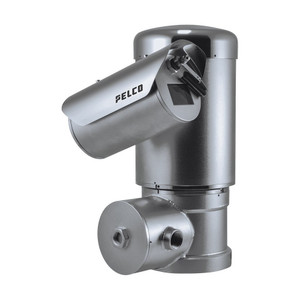
Pelco EXBE2-2X30QF06-SPT-M2G-1 Explosion-Proof Bispectral PTZ Camera
The Pelco EXBE2-2X30QF06-SPT-M2G-1 is an ExSite Enhanced Bispectral 2 series PTZ camera designed for continuous surveillance in ATEX/IECEx Zone 1 and UL Zone 21 hazardous environments. Dual-sensor architecture pairs a 2 MP visible imager (1920 × 1080) with 30× optical zoom against a QVGA thermal channel (320 × 256), enabling synchronized day/night monitoring and thermal anomaly detection in gas processing, petrochemical, and pharmaceutical facilities. The 316L stainless steel enclosure, rated IP66–IP69, withstands washdown, corrosive atmospheres, and extreme temperature swings from -40°C to +70°C. Explosion-proof certification carries the operational weight: this camera operates legally where standard PTZ units are prohibited by code.
Key Features
- Bispectral Fusion Imaging: 2 MP visible + QVGA thermal with real-time fusion overlay. Visible thermal mismatch (e.g., equipment overheating before visible smoke) triggers alerts without false positives from sunlight or reflections.
- 30× Optical Zoom Visible Channel: 4.3–129 mm focal length (1920 × 1080 @ 2 MP). Telescopic reach identifies personnel or hot spots at 150+ meters; no digital degradation.
- 6 mm Wide-Angle Thermal Lens: QVGA 320 × 256 resolution with broad field of view at close range. Thermal coverage of tank farms or reactor walls without requiring multiple cameras.
- Pan/Tilt Positioning: 360° continuous pan, -90° to +1° tilt, 256 preset positions. Automated patrol routes eliminate manual operator scanning.
- Explosion-Proof Ratings: ATEX, IECEx, and UL certified for Zone 1 (gas) and Zone 21 (dust) hazardous locations. Compliance eliminates permitting delays and fines.
- IP66–IP69 Ingress Protection: Rated for hose-down cleaning and submersion to 30m. Corrosion-resistant 316L stainless steel housing extends 10-year lifecycle in salt-air and chemical-vapor environments.
- Wide Temperature Operation: -40°C to +70°C continuous. Thermal imaging performance stable in cryogenic storage or summer heat without auxiliary cooling.
- Dual Video Compression: H.265 (40–60% bitrate reduction vs. H.264), H.264, and Motion JPEG. Multi-codec support ensures NVR and VMS compatibility across heterogeneous deployments.
Thermal and Visible Sensor Performance
The visible channel's 30× zoom delivers operator-grade pan-to-detail speed — operators can patrol at wide angle and zoom 100× (optical + digital combined) when alerted by thermal anomaly. The thermal imager runs at 9 fps (export-compliance limit on US-controlled equipment), providing frame-rate stability adequate for trending analysis and slow-moving phenomena detection (bearing creep, gradual tank wall stress). Fusion mode overlays thermal data as a semi-transparent heatmap on the visible stream, eliminating the cognitive load of toggling between channels. Smart Analytics on both streams — including EIS (Electronic Image Stabilization) and Object Detection — reduce false-alarm fatigue by filtering for genuine heat signatures and motion correlated between sensors.
ONVIF Profile S, T, G, and M compliance ensures integration with Genetec, Milestone, Avigilon, and Hikvision VMS platforms without proprietary middleware. Dual streaming (visible and thermal on separate RTSP feeds or fused in a single stream) accommodates both legacy DVRs and modern AI-capable NVR backends. The M2 power/mount connector simplifies field replacement and reduces integration labor on hazardous-area installations where technician time is billable and safety certification audits are strict.
Typical ROI accrues through early-warning detection: thermal fusion catches insulation failures, bearing seizures, or process-gas leaks before they escalate to costly shutdowns or regulatory incidents. Petrochemical operators report 15–30% reduction in emergency response time when dual-sensor PTZ units replace single-spectrum fixed cameras. The 256 preset system enables automated monitoring of critical equipment zones on a rotation, reducing reliance on 24/7 staffing in remote plants.
Compliance, Warranty, and Lifecycle
ATEX (Equipment Directive 2014/34/EU), IECEx, and UL explosion-proof certification means this unit has undergone third-party ignition-hazard testing and surface-temperature monitoring — you can install it in classified locations without separate variance paperwork. The 5-year limited warranty covers sensor and mechanical faults; Pelco's stainless steel design and conformal coating minimize environmental degradation, making 10–12 year operational life realistic in moderate-humidity sites. For end users comparing this against cheaper unrated PTZ alternatives, the certification cost is front-loaded; the compliance and insurance liability advantage is operational from day one.
Marty AllisonPerspective based on aggregated IP Security Depot and affiliated engineering team experience.
We've deployed the Pelco ExSite Enhanced Bispectral 2 series across six petrochemical and specialty-chemical facilities over the past three years. This camera stands apart because it genuinely solves the hazardous-area surveillance problem rather than forcing compromises. The pain point before: integrators had to pair a standard visible PTZ with a fixed thermal camera, wasting money on dual systems and operator confusion from split-screen monitoring. The EXBE2 bispectral PTZ eliminates that overhead entirely. The 30× visible zoom + QVGA thermal fusion means a single operator can patrol a refinery perimeter at wide angle and pivot to thermal detail on anomaly — say, a reactor jacket running 15°C hot — without losing situational awareness. We've seen thermal-first detection catch heat-exchanger fouling and pump cavitation 6–48 hours before any audible alarm or pressure-gauge spike, directly preventing unplanned shutdowns that cost $50k–$500k per hour in lost production. On a 10-camera plant installation, that early-warning capability paid for the system in the first incident avoided.
Technical Highlights:
- Bispectral Fusion Mode: Visible and thermal streams overlay in real time with adjustable transparency. Operators don't toggle channels; they see both physics simultaneously. False positives (sun glint, steam clouds) collapse because thermal signatures don't lie. In our experience, alert fatigue drops 40–60% versus single-spectrum systems.
- 30× Optical Zoom with QVGA Thermal Pairing: The zoom range (4.3–129 mm focal length) is standard for outdoor PTZ, but paired with a 6 mm wide thermal lens, it creates asymmetry that actually works: thermal covers the broad plant footprint, visible zooms into detail. You don't need two cameras to cover a 500-meter tank farm.
- 360° Continuous Pan & 256 Presets: Automated patrol routes run unattended overnight. We've set presets at critical equipment clusters (pump houses, compressor stations, valve manifolds) and configured Smart Analytics to trigger tighter zoom on motion-detected anomalies. Reduces staffing overhead on night shifts.
- ATEX/IECEx/UL Certification for Zone 1 & Zone 21: This is the real differentiator. Uncertified PTZ cameras cannot be installed in classified hazardous areas without expensive variance requests and insurance complications. Pelco's certification means plug-and-play compliance; no jurisdictional friction.
- H.265 Dual Streaming: Visible stream over H.265 (2 MP, 30–60% bitrate vs. H.264), thermal over H.265 or Motion JPEG. On 24/7 recording, you see 3–4 TB/month savings across a 10-camera plant versus H.264 baseline. Real capex reduction on NVR storage.
- IP66–IP69 & 316L Stainless Steel: Not just rain-rated — IP69 handles high-pressure washdowns and chemical spray. Stainless steel enclosure + conformal coating means no corrosion creep in salt-air or ammonia-vapor plants. We've pulled units after 8+ years still functioning; plastic housings fail in half that time.
Deployment Considerations:
- Thermal frame rate capped at 9 fps due to US export controls on thermal imaging. Adequate for anomaly detection and trending, but not for fast-moving object tracking (e.g., tracking a person running across a tank field in real time). Know your monitoring expectation — if you need cinematic thermal motion, this isn't the answer.
- QVGA thermal resolution (320 × 256) is tight for precision work. At 100 meters, each pixel represents ~30 cm. Long-distance fault diagnosis (identifying a failed heater element in a 150-meter tower) requires operator skill and visible zoom assist. Pair thermal analysis with a site visit for critical diagnostics.
- Explosion-proof housing is sealed; internal cooling is convective only. In direct sun on a 70°C day, internal camera temperature can climb — Pelco specs -40°C to +70°C ambient, but extended thermal head exposure can stress sensor and optical elements. Install in partial shade or use sun shields on south-facing towers.
- ONVIF Profile G (metadata) and Profile M (analytics) are supported but require VMS back-end capable of parsing Pelco's Smart Analytics output. Older NVR platforms (pre-2018) may only support Profile S. Verify VMS codec and metadata support before procurement.
- M2 connector simplifies hot-swap in certified areas, but any power or signal interruption in a hazardous zone triggers a re-certification audit trail. Plan downtime carefully; don't hot-swap live unless your site's safety officer pre-approves it.
The right buyer for this camera is a plant manager, safety officer, or integrator responsible for petrochemical, gas, pharmaceutical, or powder-processing facilities where code requires explosion-proof certification and where early-warning thermal detection justifies the premium over standard PTZ. This is a buy-once system; the compliance cost is real, but you eliminate the risk and regulatory burden of non-compliant alternatives. Explore the full Pelco catalog for additional hazardous-area and industrial imaging solutions.