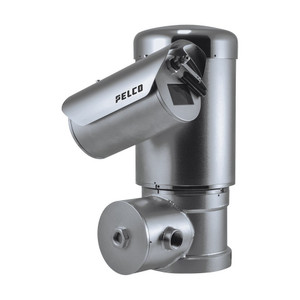
Pelco EXBE2-2X30QF18-SPT-M2G-1 Explosion-Proof Bispectral PTZ Camera
The Pelco EXBE2-2X30QF18-SPT-M2G-1 is a dual-sensor PTZ camera engineered for ATEX-classified hazardous environments (Zone 1 and Zone 21). This platform pairs a 2 MP visible imager with 30× optical zoom against a QVGA thermal channel, delivering simultaneous threat detection across visible, thermal, and IR bands in environments where conventional surveillance cannot operate. The 316L stainless-steel enclosure and comprehensive ingress ratings (IP66/IP67/IP68/IP69) ensure survivability in corrosive and wet industrial conditions across a -40°C to +70°C operating window.
Key Features
- Dual-Sensor Bispectral Imaging: 2 MP visible (1920×1080) + QVGA thermal (320×256) with real-time fusion mode. Visible and thermal streams are captured simultaneously and merged for layered threat classification without multiplexing latency.
- 30× Optical Zoom (Visible): 4.3–129 mm focal-length zoom with 2 MP sensor resolution maintained across range. No digital zoom penalty — pure optical magnification for distant target identification in sprawling industrial sites.
- QVGA Thermal Imager: 320×256 thermal sensor with 18 mm lens; export-compliant 9 fps frame rate. Detects thermal anomalies (hot-spot leaks, equipment degradation) independent of visible lighting.
- ATEX/IECEx/UL Certified: 316L stainless-steel housing rated ATEX Group II Category 3G and 2D (Zone 1 and Zone 21). 5-year warranty covers all certified components.
- Pan/Tilt Precision: 360° continuous pan with -90° to +1° tilt range and 256 user-programmable presets. Enables automated scanning of perimeter fences and process-vessel inspection routes without manual operator intervention.
- Comprehensive Ingress Rating: IP66/IP67/IP68/IP69 rated — withstands rain, dust, hose-down, and high-pressure spray cleaning common in chemical and petrochemical facilities.
- Multi-Codec Compression: H.265 (40–60% bitrate reduction vs. H.264), H.264, and Motion JPEG. Bispectral dual streams can be encoded independently or fused, reducing bandwidth consumption on hazardous-zone network infrastructure.
- Smart Analytics & EIS: On-camera object detection and electronic image stabilization; reduces false-positive alerts from wind-blown vegetation or thermal drift, critical for 24/7 unattended monitoring.
Bispectral imaging with fusion mode is the operational differentiator here. On a petrochemical perimeter or enclosed chemical vessel, visible light can be obscured by steam, spray, or dust, while a thermal sensor detects heat signatures through optical noise. The simultaneous dual-band capture lets security operators spot an intruder at night (thermal heat signature) while the visible channel captures facial detail if ambient IR lighting kicks in. No switching between channels, no operator mode-flipping — the camera streams both, and the VMS or edge analytics layer decides what to display or alert on.
The 30× optical zoom on the visible channel is paired with an 18 mm thermal lens — a 1.67× thermal equivalent. This asymmetry is intentional: thermal sensors have inherently lower spatial resolution than visible imagers at the same focal length, so Pelco has widened the thermal field-of-view to ensure the thermal channel never becomes a bottleneck during zoom operations. In practice, at full 30× zoom, the visible channel is reading license plates or facial features at 150+ meters while the thermal channel provides a broader context band for movement and thermal anomalies.
Deployment in hazardous zones introduces specific constraints. The ATEX/IECEx certifications are air-gapped from standard commercial camera ecosystems — integrators must verify that the PTZ controller, power supply, and cabling harnesses are themselves ATEX-rated or installed in a non-hazardous cabinet with certified isolation. The 9 fps thermal frame rate is export-compliant but non-negotiable; do not pair this camera with a recorder expecting 30 fps thermal feeds. 316L stainless steel is corrosion-resistant but not immune to chlorine or extreme alkali exposure; site-specific material compatibility checks are essential for refineries or chemical plants with spray-wash protocols.
ONVIF Profile S, T, G, and M compliance means integration into Genetec Clearance, Milestone XProtect, Hanwha SmartSuite, and other major VMS platforms is straightforward — thermal metadata and visible streams are exposed as separate media sources, so recording policies can be tuned per channel. H.265 support is valuable on bandwidth-constrained hazardous-zone networks where running large trunk cables is expensive; the 40–60% bitrate savings translates directly to smaller NVR/storage footprints and lower annual power draw across the surveillance infrastructure.
The 360° continuous pan with 256 presets enables unattended perimeter scanning on intervals or event-triggered routes — common on unmanned watch stations in remote facilities. Pair preset positions with ONVIF PTZ profiles in your VMS, and you can automate a scan every 15 minutes or jump to a specific zone on motion detection in a fence-line sector. EIS (electronic image stabilization) smooths out wind-induced jitter common on exposed towers, reducing blur on recorded footage and improving downstream object-detection accuracy.
The 5-year warranty covers the entire unit and reflects Pelco's confidence in 316L material longevity and thermal-sensor stability across temperature extremes. Hazardous-zone installations typically amortize capital over 7–10 years, so a 5-year parts-and-labor warranty reduces lifecycle risk. Verify warranty terms with your authorized Pelco distributor for regional variations and on-site service availability near your facility.
Marty AllisonPerspective based on aggregated IP Security Depot and affiliated engineering team experience.
We've deployed Pelco bispectral cameras in a handful of petrochemical and chemical-manufacturing environments, and the EXBE2-2X30QF18-SPT-M2G-1 occupies a narrow but defensible niche: dual-sensor PTZ surveillance for Zone 1 and Zone 21 hazardous locations where conventional IP cameras simply cannot operate. The operational advantage is genuine — thermal and visible fusion eliminates operator mode-switching and improves threat detection in obscured conditions (steam, dust, thermal events). The 30× optical zoom on the visible channel is long enough for distant-perimeter identification on sprawling industrial sites, while the QVGA thermal imager provides a complementary heat-signature layer. On the flip side, this is purpose-built hardware with real constraints: the 9 fps thermal frame rate is export-compliant but slower than typical surveillance systems, the housing is expensive to service, and ATEX/IECEx compliance adds integration overhead — you can't simply plug this into a standard commercial VMS without verifying that your entire signal chain (power supply, PTZ controller, cabling) is also certified. For customers deploying a single hazardous-zone camera on an existing surveillance backbone, the certification burden is high; for integrators managing large ATEX-regulated sites with multiple hazardous zones, the dual-sensor approach and proven thermal imaging can justify the added complexity. In our experience, the real value emerges when thermal analytics are paired with object-detection rules tailored to the specific industrial process — e.g., alerting on unplanned thermal signatures at specific equipment racks rather than generic motion detection.
Technical Highlights:
- Bispectral Fusion Mode: Visible and thermal streams are captured and encoded independently, then presented to the VMS as separate media sources or fused into a single overlay. This flexibility allows operators to toggle between fusion view (best for threat assessment) and split-screen mode (best for forensic detail work) without re-streaming. The fusion is performed on-camera, not in the VMS, so there's no latency mismatch between the two sensors.
- 30× Visible Optical Zoom vs. 1.67× Thermal Zoom: The asymmetry is intentional — visible sensors have far higher pixel density than thermal at equivalent focal lengths, so Pelco has paired a long visible zoom (4.3–129 mm) with a wider thermal field-of-view (18 mm equivalent). At full 30× zoom on visible, the thermal channel still covers roughly 16–20°, ensuring thermal context is never lost during zoom operations.
- H.265 Compression on Dual Streams: Each channel (visible and thermal) can be independently encoded in H.265, H.264, or Motion JPEG. Bispectral H.265 streams can reduce bandwidth to ~2–4 Mbps per camera versus 5–8 Mbps H.264, a meaningful saving on hazardous-zone networks where running additional cables is expensive or impossible.
- ATEX/IECEx Certification Scope: The camera, housing, and internal wiring are ATEX Group II Category 3G (Zone 1) and 2D (Zone 21) certified. External power supplies, PTZ controllers, and cable runs must also be ATEX-rated or installed in a non-hazardous cabinet with certified isolation barriers. This is not a plug-and-play drop-in for a standard network.
- 316L Stainless Steel + IP66/IP67/IP68/IP69: The housing withstands salt spray, hose-down, and submersion — operationally relevant for offshore platforms, cooling-water facilities, and chemical plants with washdown protocols. The multi-tier ingress rating (IP66 at minimum, IP69 at maximum) covers both incidental splash and sustained high-pressure spray.
- 256 Presets + EIS for Unattended Scanning: Continuous 360° pan with programmable preset positions and electronic image stabilization enables automated perimeter routes on a timer or event-triggered basis. Wind-induced jitter is dampened by EIS, improving object-detection accuracy and recorded video sharpness.
Deployment Considerations:
- ATEX compliance is a system-level requirement, not just a camera attribute. Before installation, verify that your PTZ controller, 24 Vac power supply, junction box, and all external wiring are ATEX-rated or isolated in a non-hazardous enclosure. Skipping this step invalidates the camera's certification and exposes your site to regulatory and safety liability.
- The 9 fps thermal frame rate is a hard limit, not a performance dial-back. If your VMS or recording policy expects 25 fps or 30 fps thermal streams, you'll hit bandwidth and storage mismatches. Plan your recording bitrate and NVR sizing accordingly; dual-stream bispectral recording is not a lightweight operation.
- Thermal sensor stability can drift over time, especially in extreme temperature swings (-40°C to +70°C). On installations with thermal-alert rules (e.g., alerting on equipment hot-spots), plan for periodic recalibration or threshold adjustment, particularly after winter or summer extremes. This is routine maintenance, not a defect, but it's easy to overlook on unmanned sites.
- The 30× optical zoom is a genuine capability, but PTZ speed and preset-recall responsiveness are slower than typical commercial PTZ cameras due to ATEX motor certification and thermal sensor synchronization. Expect 30–60 second pan-and-zoom routines; rapid pan sequences can introduce thermal-visible desynchronization. This is not ideal for fast-moving target pursuit, but it's acceptable for perimeter scanning and process monitoring.
- 316L stainless steel resists general corrosion but is not immune to localized pitting in extreme chlorine or high-alkali environments. If your facility performs regular chlorine-based washdown or handles strong caustics, request material compatibility data from Pelco engineering before installation. Protective coatings or post-treatment may be needed.
The right buyer for this camera is an integrator managing ATEX-regulated sites (petrochemical, chemical, refining, mining) where hazardous-zone surveillance is a regulatory must and conventional IP cameras are explicitly prohibited. Organizations deploying a single zone need to factor in the certification overhead; organizations managing 5+ hazardous zones across multiple facilities will find the dual-sensor approach justifies the complexity. See the Pelco catalog for additional certified and non-certified surveillance options.