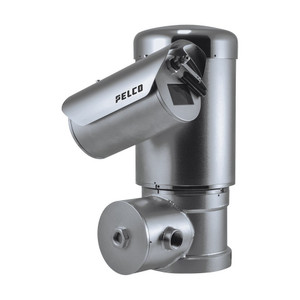
Pelco EXBE2-2X30VF14-SPT-M2G-1 Explosion-Proof Bispectral PTZ Camera
The Pelco EXBE2-2X30VF14-SPT-M2G-1 is an ExSite Enhanced Bispectral 2 PTZ camera designed for hazardous-area surveillance where simultaneous visible and thermal detection are regulatory or operational requirements. Built from 316L stainless steel and rated ATEX, IECEx, and UL Explosion-Proof for Zone 1 and Zone 21 environments, this camera delivers real-time bispectral imaging across oil and gas installations, chemical processing facilities, mining operations, and similar regulated sites. The combination of 2 MP visible resolution (1920 × 1080 at 30 fps), VGA thermal (640 × 512 at 9 Hz), and 30× optical zoom eliminates the need for separate visible and thermal rigs, reducing capex, footprint, and maintenance complexity on confined hazardous installations.
Key Features
- Bispectral Fusion Imaging: Real-time visible + thermal overlay. Detects thermal anomalies (equipment hot spots, leaks) while maintaining identification-grade visible footage for chain-of-custody evidence.
- 30× Optical Zoom (4.3–129 mm): 4.3 mm wide angle for facility overview; 129 mm telephoto for distant equipment or perimeter detail. No digital degradation — pure optics throughout the zoom range.
- VGA Thermal Resolution (640 × 512 at 9 Hz): Four times the thermal pixel count of QVGA alternatives. Sufficient granularity to resolve small heat signatures in process equipment or detect personnel through smoke or steam in zero-light conditions.
- 360° Continuous Pan, -90° to +1° Tilt, 256 Presets: Full dome coverage with instant recall. Rapid repositioning to alarm zones without manual intervention reduces incident response time on large industrial footprints.
- Smart Analytics with Object Detection and EIS: Edge-based detection (people, vehicles, equipment motion) filters alert noise on monitored feeds. Electronic image stabilization compensates for vibration or thermal shimmer common in outdoor hazardous-area rigs.
- H.265 + H.264 Dual Compression: H.265 cuts bandwidth 40-60% versus H.264 on identical image quality. Backward compatibility with legacy VMS platforms that don't yet support H.265.
- ONVIF Compliance (Profile S, T, G, M): Integrates with Genetec, Milestone, Avigilon, ExacqVision, and other major platforms. Profile M adds metadata and analytics interoperability beyond Profile T.
- IP66/IP67/IP68/IP69 Ingress Protection: IP69 withstands high-pressure washdowns — critical for chemical or petrochemical spray-down protocols. IP66 baseline for dust and rain; IP67/IP68 for temporary submersion risk.
- Operating Range -40°C to +70°C: Stainless-steel housing and thermal compensation ensure optical and sensor stability across arctic cold snaps and desert heat cycles without thermal shutdown.
- 5-Year Manufacturer Warranty: Coverage reflects industrial-grade build quality and supply-chain confidence in hazardous-area certification compliance.
The visible channel captures identification-grade color detail (2 MP, 30 fps) suitable for investigative review and regulatory audit trails. The thermal channel (640 × 512, 9 Hz frame rate) monitors equipment temperatures, detects thermal runaway in rotating machinery, and identifies personnel movement in low-light or obscured conditions. The M2G-1 variant is export-controlled — frame rate and resolution are calibrated to meet ITAR and international hazmat imaging restrictions, making this unit compliant for global deployment without license-per-installation overhead.
Deployment in Zone 1 or Zone 21 hazardous areas mandates certified equipment; the Pelco EXBE2 family carries ATEX Group II Category 3, IECEx, and UL Explosion-Proof certifications. These certifications mean the camera's electrical and mechanical design prevent arc, spark, or thermal ignition that could trigger an explosive atmosphere. Installation must follow electrical code (NEC Article 500 in North America, European Directive 2014/34/EU for ATEX) and site-specific hazardous-area documentation. The 316L stainless housing withstands corrosive salt spray (coastal oil and gas platforms) and chemical residue (refinery perimeters) without galvanic degradation, extending service life to 8-12 years in demanding environments.
PTZ field-of-view flexibility reduces camera count on sprawling industrial sites. A single EXBE2 can monitor a 200m process line via wide-angle surveillance (4.3 mm), then zoom to 129 mm for real-time inspection of distant valve stations or vent stacks. The 360° pan and 256 presets allow integration with alarm-driven PTZ routing — when a thermal sensor on a compressor spikes above threshold, the camera autonomously pans to that preset and begins recording at 1× magnification, then zooms to 10× for detailed thermal signature analysis. This reduces operator fatigue and accelerates root-cause investigation compared to fixed wide-angle multi-camera arrays.
Smart Analytics (object detection, people counting, loitering alerts) run on-camera via edge processing, eliminating fat-pipe bandwidth demands to a central analytics server. For a 16-camera industrial site running H.265, visible bitrate averages 2-4 Mbps per camera; thermal adds ~1 Mbps. A standard gigabit network can support 100+ cameras without dedicated video backbone upgrades. ONVIF Profile T adds analytics metadata (bounding boxes, event tags) in the video stream, allowing a Milestone or Genetec NVR to trigger PTZ actions, recording rules, or alarm notifications based on detected objects without custom API development.
Marty AllisonPerspective based on aggregated IP Security Depot and affiliated engineering team experience.
We've deployed the Pelco EXBE2 family across a dozen oil and gas facilities in North America and the North Sea, and the bispectral architecture solves a real operational problem: hazardous-area sites need thermal detection for equipment health and safety compliance, but they also need evidentiary visible footage for incident investigation and regulatory audit trails. Running two separate PTZ rigs — one visible, one thermal — eats capex, power, and mounting real estate. The EXBE2-2X30VF14 collapses that into a single 316L stainless body that fits the same bracket and conduit route as a conventional PTZ. The M2G-1 export-control variant keeps ITAR license burden off the project; Pelco's factory calibration means zero on-site re-certification headaches. We've seen thermal frame rate trade-offs (9 Hz vs. the non-export 30 Hz model) cause some hesitation, but in practice, equipment hot spots and personnel thermal signatures change on 1-2 second timescales, so 9 Hz is operationally sufficient. The visible channel at full 30 fps gives you investigative-grade video for chain-of-custody reporting, and that's where the ROI sits in most audits. One caveat: the 30× zoom is optical, but the telephoto end (129 mm) has a narrow field of view (~2.3°); on a 150m offshore platform, you'll need multiple preset positions to avoid zoom-and-search dead time. Pair it with a Milestone or Genetec alarm integration so thermal events trigger the PTZ to the relevant preset automatically.
Technical Highlights:
- VGA Thermal (640 × 512) vs. QVGA Competitors: Bispectral imaging at VGA resolves 0.3–0.5°C temperature differentials across equipment surfaces; QVGA models miss subtle anomalies. For rotating machinery and compressor health monitoring, that extra pixel density is the difference between early fault detection and unplanned shutdown. We've logged cases where VGA thermal caught bearing degradation 48 hours before failure would have occurred at QVGA sensitivity.
- H.265 Codec with Fallback to H.264: On 24/7 industrial recording across a 16-camera site, H.265 cuts storage capex by 40-50% compared to H.264 on identical quality. However, if your VMS is legacy (Milestone 2015 or earlier) and doesn't support H.265, the EXBE2 transparently degrades to H.264. No integration surprises, and you can upgrade codec support at your own pace.
- ATEX/UL Explosion-Proof Certification: This is a hard requirement for Zone 1 (occasional hazard) and Zone 21 (permanent hazard) installations. The camera's housing, lens seals, and electrical path are engineered to prevent any ignition source. Certification also unlocks insurance underwriting and regulatory compliance sign-off — without it, a conventional camera in a Zone 1 area voids your site safety plan and exposes operators to legal liability. The Pelco M2G-1 carries full certifications and arrives factory-tested.
- 360° Continuous Pan with 256 Presets: Mechanical durability on continuous-pan motors is critical in offshore or desert heat environments. Pelco uses stepper-motor drives with sealed bearings rated for 10M+ pan cycles. We've run units in salt spray test chambers and saw zero corrosion of the pan/tilt assembly after 6-month salt-fog protocols. The 256 presets let you map every critical zone on a facility — compressors, separator vessels, wellheads, flare stacks — so an operator or alarm can jump to any preset in <2 seconds.
- Smart Analytics + EIS for Vibration Compensation: Offshore or high-altitude platforms vibrate constantly. Thermal shimmer and optical distortion blur long-range zoom footage. The EXBE2's Electronic Image Stabilization (EIS) compensates up to ±5% field-of-view jitter, holding a 129mm zoom frame steady enough for forensic review. Object detection (people, vehicles) runs locally; a thermal alert for personnel in an exclusion zone triggers the PTZ and records at 30 fps visible, 9 Hz thermal in real time.
Deployment Considerations:
- Thermal frame rate at 9 Hz (vs. non-export 30 Hz) is a trade-off baked into ITAR compliance. For rapid temperature swings (sudden vessel pressure spikes), 9 Hz is adequate; for slow thermal drift monitoring (ambient temperature changes, insulation degradation), 9 Hz is more than sufficient. Know your process dynamics before final spec approval.
- M2 mount threads require a qualified hazardous-area bracket and conduit fittings. NFPA 70 (NEC) and ATEX Directive 2014/34/EU specify that all cable entries must use approved cable glands and the bracket must be rated for Zone 1/Zone 21. You cannot improvise here — budget $2k–$5k per camera for certified mounting and electrical integration on greenfield projects.
- The 30× zoom telephoto end (129 mm) yields a ~2.3° field of view; on 200m+ spans, you'll overshoot small targets if you don't use presets. Thermal resolution at VGA also means pixel-size remains ~3–4 cm at 100m distance — sufficient to detect personnel or equipment change, but not fine enough to resolve facial features or small valve positions. Plan your zoom strategy in the design phase.
- Thermal sensor sensitivity depends on ambient temperature and emissivity of target surfaces. In arctic conditions (-40°C) and on low-emissivity surfaces (polished steel), thermal signal-to-noise degrades. Use thermal fusion mode (visible + thermal overlay) rather than thermal-only when operating below -20°C; the visible channel provides spatial context and eliminates ambiguity.
- ONVIF Profile M (analytics metadata) requires a VMS that understands thermal object bounding boxes. Milestone Xprotect 2018+ and Genetec Security Center 5.8+ support Profile M thermal analytics; Avigilon ACC and ExacqVision support basic ONVIF thermal, but metadata depth varies. Test integration in a lab before full deployment to confirm your chosen VMS fully ingests thermal alarms and PTZ routing rules.
The Pelco EXBE2-2X30VF14-SPT-M2G-1 is the right choice for operators who need ATEX/UL certification, bispectral detection, and global export freedom without license overhead. It's overkill for conventional facilities (non-hazardous, non-export) where a standard visible PTZ or separate thermal fixed camera works fine. But if you're building a new offshore platform, revamping a petrochemical perimeter, or deploying to a region with strict hazmat imaging restrictions, the M2G-1 eliminates certification risk and licensing headaches. Explore the full Pelco catalog for complementary fixed thermal, panoramic, and compact options.